Key takeaways
- Coastal or high-rain climates: HDPE, since salt air and standing water don’t degrade it and it needs no yearly maintenance.
- Covered patios, dry summers: Sealed acacia gives the warmest look and the storage cavity stays dry as long as it’s not exposed to direct rain.
- Windy rooftops or open decks: Powder-coated steel for the base weight and structural stability, paired with a removable plastic bin inside rather than trusting the metal shell alone.
What's inside
An outdoor sofa table with storage earns its keep when it holds a full set of outdoor cushions plus a few bottles or games, drains fast after rain, and still leaves enough walk-behind space on a narrow deck or balcony. That means checking interior cavity depth (not just exterior footprint), confirming the material handles standing water without warping or rusting, and measuring your actual clearance before you buy.
What “storage” actually means on these tables
Most outdoor sofa tables with storage fall into two builds: a lift-top or hinged-lid console with a hollow interior, or a table with one to three drawers plus open shelving underneath. The console style holds more volume and is better for bulky items like folded cushions or a rolled umbrella. The drawer style is easier to organize but each drawer usually caps out at 3-5 inches of usable height, which rules out anything bulky.
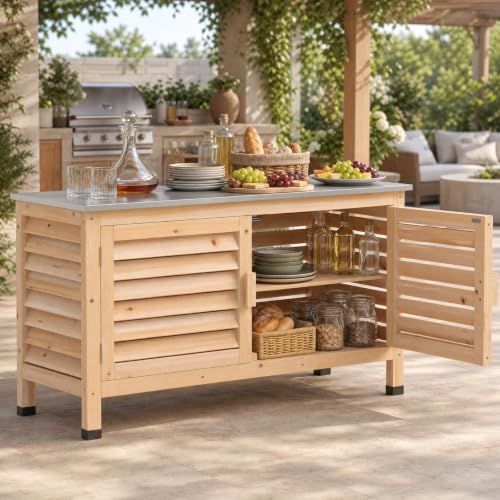
Goplus Patio Storage Cabinet, 2-Door Console Table (Natural)
Included for 'Outdoor Sofa Tables With Storage: Depth, Drainage and What Fits Inside' because the listing specifies 2-Door Console Table (Natural), details this guide uses to compare options.
View on Amazon
Rattaner Patio Coffee Table with Storage Wicker Outdoor Coffee Table and All-Weather Wicker Side Table with Waterproof Cover, Black
Included for 'Outdoor Sofa Tables With Storage: Depth, Drainage and What Fits Inside' because the listing specifies Black, details this guide uses to compare options.
View on Amazon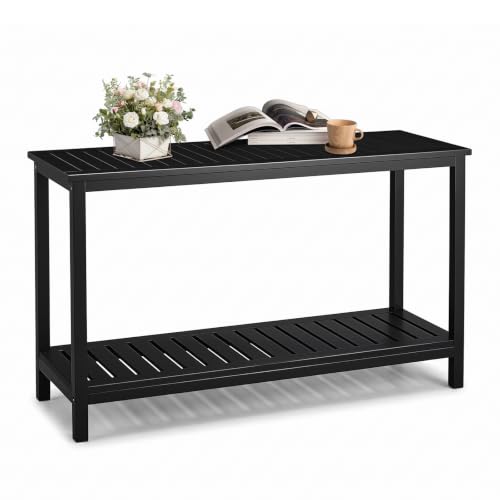
VINGLI 49in Solid Wood Outdoor Console Table, 2-Tier Patio Buffet Bar Table, Multi-Functional Storage Sideboard for Garden, Porch, Balcony (Black)
Included for 'Outdoor Sofa Tables With Storage: Depth, Drainage and What Fits Inside' because the listing specifies 2-Tier Patio Buffet Bar Table and Multi-Functional Storage Sideboard for Garden, details this guide uses to compare options.
View on Amazon
Mederlo Wooden Patio Bar Table with Storage, Cedar Outdoor Buffet Cabinet Sideboard, 42 x 18 x 37 in Serving Station with Double-Layer Tabletop for Patio, Deck, Backyard, Indoor
Included for 'Outdoor Sofa Tables With Storage: Depth, Drainage and What Fits Inside' because the listing specifies Cedar Outdoor Buffet Cabinet Sideboard and Deck, details this guide uses to compare options.
View on AmazonBefore buying, measure what you actually want to store. A standard outdoor throw pillow is roughly 18 x 18 x 6 inches uncompressed, so a storage cavity needs at least 19 inches of interior length and 7-8 inches of clearance to fit one without cramming. Wine and seltzer bottles run about 12 inches tall, so any shelf meant to hold them needs a minimum of 13 inches of vertical clearance plus room to grab the neck.
Usable interior dimensions to check against the listing
| Storage type | Typical interior depth | Typical interior height | Fits comfortably |
|---|---|---|---|
| Lift-top console cavity | 10-14 in | 8-12 in | 2-3 folded seat cushions, small games, string lights |
| Single drawer | 12-16 in | 3-5 in | Coasters, lighters, phone chargers, sunscreen |
| Open lower shelf | 10-13 in | 10-14 in | 4-6 standing bottles, a small cooler bag, citronella candles |
| Side bin/basket insert | 8-10 in | 10-12 in | Throw blankets, dog toys, tablet or magazines in a dry bag |
Manufacturer listings almost always give exterior dimensions and skip interior ones. If a product page only lists overall width, height and depth, subtract at least 1.5-2 inches per wall for material thickness plus any lid lip or drawer slide hardware to estimate what’s actually usable.
Material comparison for moisture resistance
The material decides whether the storage compartment stays dry and functional after a season of rain, not just how the table looks on day one. Here’s how the three common builds hold up.
| Material | Moisture resistance | Weight | Typical price range | Weak point over time |
|---|---|---|---|---|
| HDPE (poly lumber) | Excellent, non-porous, won’t rot or absorb water | Heavy (helps in wind) | usually $250-$550 | Can flex or crack below freezing if impact-stressed |
| Acacia wood (sealed) | Good if sealed yearly; poor if seal wears off | Moderate | usually $200-$450 | Grain checking/splitting from repeated wet-dry cycles |
| Powder-coated steel | Good on the coated frame; rust risk at drainage cutouts, welds, and scratches | Moderate to heavy | usually $180-$500 | Rust bleeding at chips or where screws penetrate coating |
HDPE is the safest choice for a table that will hold cushions or fabric items inside the cavity, since it doesn’t wick moisture into whatever is stored. Acacia looks the most like traditional furniture and works fine in covered or dry climates, but the interior storage compartment is the first place to check for mold if the lid isn’t fully weatherproof, since trapped humidity with no airflow is worse for wood than open rain exposure. Powder-coated steel is a good structural choice for tables that need to anchor down in wind, but any storage bin built into a steel frame needs a liner or drainage gap, because condensation forms on the inside of metal panels even when it hasn’t rained.
Where each material makes sense
- Coastal or high-rain climates: HDPE, since salt air and standing water don’t degrade it and it needs no yearly maintenance.
- Covered patios, dry summers: Sealed acacia gives the warmest look and the storage cavity stays dry as long as it’s not exposed to direct rain.
- Windy rooftops or open decks: Powder-coated steel for the base weight and structural stability, paired with a removable plastic bin inside rather than trusting the metal shell alone.
Drainage: the detail most listings skip
A sealed storage box that traps rainwater is worse than no storage at all, since it turns into a standing puddle that soaks whatever’s inside and breeds mold. Look for these features specifically:
- Drainage holes or channels in the base, not just in the lid seam. Water gets in around hinges even with a tight-fitting lid.
- A raised interior floor or slotted tray so items sit above any water that does collect, rather than directly on the base.
- Gasket or rubber seal around the lid on HDPE consoles, which blocks most rain but still needs a drain hole as backup.
- Removable liner or bin that can be lifted out and dumped, since a fixed compartment with no way to empty standing water will eventually smell or mildew.
If a listing doesn’t mention drainage at all, assume it has none and plan to drill 2-3 small holes (3/16 to 1/4 inch) in the lowest points of the base yourself, angled slightly so water runs to one corner.
Clearance behind a sofa on a narrow deck or balcony
Sofa tables sit behind or beside seating, so the number that actually matters is walk-behind clearance, not just the table’s footprint. As a baseline:
- 18 inches minimum between the back of the table and a railing or wall for occasional single-file passage.
- 24-30 inches if the path is a regular walkway to a door or grill, so one person can pass without turning sideways.
- 36 inches if it needs to be wheelchair or stroller accessible.
Most outdoor sofa tables with storage run 12-16 inches deep and 24-60 inches long. On a narrow balcony (say, a rail-to-door depth of 6-7 feet), a 14-inch-deep table against the rail with a sofa 30 inches deep in front of it already uses roughly 44 inches, leaving 28-38 inches of a 72-84 inch total depth for walking room. Measure your actual rail-to-door distance and subtract sofa depth plus table depth plus at least 18 inches before assuming a table will fit.
Matching table type to situation
| Situation | Best fit | Why |
|---|---|---|
| Small balcony, tight walk space | Narrow HDPE console, 12 in deep or less | Minimizes footprint while still sealing out rain |
| Family patio, cushions stored seasonally | Lift-top console, 14+ in interior depth | Fits folded cushions in one bulk load instead of stacking in drawers |
| Entertaining space, drinks and games | Table with open lower shelf plus drawer | Bottles and glassware need vertical clearance drawers don’t offer |
| Windy or coastal exposure | Steel-framed base with HDPE or lined bin insert | Weight resists wind; liner keeps stored items dry despite condensation risk |
| Low-maintenance, no yearly sealing | HDPE, any configuration | No refinishing, no rust, holds up to being left out year-round |
Sizing checklist before you buy
- Measure the largest item you plan to store (folded cushion, bottle height) and add 1-2 inches of slack.
- Confirm interior depth and height separately from exterior dimensions, since walls and lid clearance eat 1.5-2 inches per side.
- Check for at least one drainage feature; plan to add your own holes if none exist.
- Measure rail-to-door or wall-to-wall depth on your deck, then subtract sofa depth, table depth, and 18-36 inches of walk clearance depending on how the space is used.
- Match material to climate: HDPE for wet or coastal, sealed acacia for covered dry patios, powder-coated steel plus a liner for windy open spaces.