Key takeaways
- 180D polyester: Lightest common option. Adequate for seasonal, covered-patio use. Usually $200-$350 range. Prone to flapping and faster UV fade if not solution-dyed.
- 240D-280D polyester with PU coating: The sweet spot for 2026 models. Heavier drape, less wind noise, and better water beading. Look for 600mm to 1500mm PU backing or PVC backing for true water resistance.
- 600D Oxford polyester: Heaviest, most wind-resistant, but retains heat and costs more. Often found on premium porch-style swings usually $550-$900.
What's inside
The best outdoor swing with canopy in 2026 is a 3-seat steel-frame model with a 180D to 240D polyester canopy with PU or PVC backing, a powder-coated frame with at least 1.5mm wall thickness, and included ground anchors. For most yards, look for a 500-600 lb total weight capacity, a tilting canopy that locks at multiple angles, and convertible seats that fold into a daybed for lounging.
What Makes a Canopy Swing Last Outdoors
Canopy swings fail in three places first: the fabric fades or tears, the frame rusts at welds and bolt holes, and the legs lift or rack in wind. Understanding denier, coating, and anchoring prevents all three.

Best Choice Products 3-Seat Outdoor Large Converting Canopy Swing Glider, Patio Hammock Lounge Chair for Porch, Backyard w/Flatbed, Adjustable Shade, Removable Cushions - Gray
Included for 'Best Outdoor Swing With Canopy in 2026: Shaded Swings for the Yard' because the listing specifies Patio Hammock Lounge Chair for Porch and Backyard w/Flatbed, details this guide uses to compare options.
View on Amazon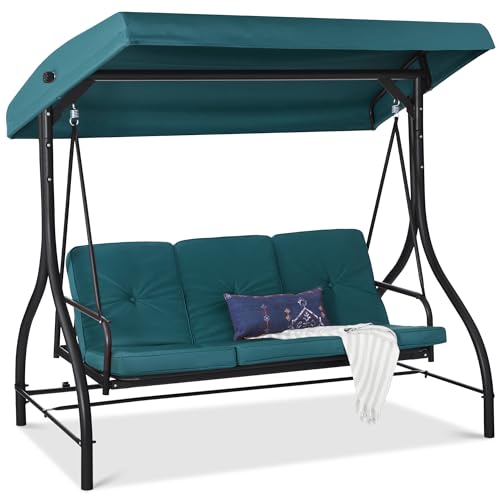
Best Choice Products 3-Seat Outdoor Large Converting Canopy Swing Glider, Patio Hammock Lounge Chair for Porch, Backyard w/Flatbed, Adjustable Shade, Removable Cushions - Peacock
Included for 'Best Outdoor Swing With Canopy in 2026: Shaded Swings for the Yard' because the listing specifies Patio Hammock Lounge Chair for Porch and Backyard w/Flatbed, details this guide uses to compare options.
View on Amazon
Yalissey 3 in 1 Outdoor Porch Swing with Adjustable Canopy, 3 Seat Outdoor Swing for Adults, Patio Swing Chair with Thickened Cushions,Pillows & Cup Holders for Backyard, Porch, Garden (Blue)
Included for 'Best Outdoor Swing With Canopy in 2026: Shaded Swings for the Yard' because the listing specifies 3 Seat Outdoor Swing for Adults and Patio Swing Chair with Thickened Cushions, details this guide uses to compare options.
View on AmazonCanopy Fabric: Denier, Weave, and Water Resistance
Denier (D) measures fiber thickness, not quality alone, but it predicts tear strength and UV stability. For outdoor swings, polyester dominates because it resists stretching and mildew better than cotton canvas.
- 180D polyester: Lightest common option. Adequate for seasonal, covered-patio use. Usually $200-$350 range. Prone to flapping and faster UV fade if not solution-dyed.
- 240D-280D polyester with PU coating: The sweet spot for 2026 models. Heavier drape, less wind noise, and better water beading. Look for 600mm to 1500mm PU backing or PVC backing for true water resistance.
- 600D Oxford polyester: Heaviest, most wind-resistant, but retains heat and costs more. Often found on premium porch-style swings usually $550-$900.
Water resistance is graded by hydrostatic head (mm). A canopy listed as “water-resistant” without a rating will bead light drizzle for 10-15 minutes before soaking through. For real rain protection, you need:
- PU-coated polyester at 600mm+ for light rain and morning dew
- PVC-backed or 1500mm+ PU for sustained rain
- Tap-sealed seams and a slight canopy peak or tilt so water sheds instead of pooling. Flat canopies pond and stretch within one season.
UV protection matters more than waterproofing for daily use. Look for UPF 50+ or explicit “solution-dyed” polyester. Piece-dyed 180D fades noticeably after one full summer of southern exposure, while solution-dyed 240D holds color for 3-4 seasons before significant fading.
Steel Frame and Powder Coating
Almost all canopy swings use steel tubing. Strength comes from tube diameter, wall thickness, and coating quality, not just total weight.
- Tube diameter: 38mm (1.5 inch) is standard for legs and top bar on 2-seat models; 42mm-48mm is preferable for 3-seat, 500 lb+ capacity models. Thinner tubes flex and loosen at joints.
- Wall thickness: 1.2mm is light-duty, 1.5mm is the durability baseline, 1.8mm+ is commercial-grade. Vendors rarely list this; if weight capacity is under 400 lbs total, wall thickness is likely 1.2mm.
- Powder coating: A properly applied polyester powder coat should be 60-90 microns thick, even around welds, with no bare metal inside bolt holes. Hammertone or textured powder coats hide minor chips better than glossy coats. The first rust spots almost always appear at weld seams and where the canopy bolts penetrate the top bar. Touch up any chip immediately with rust-inhibiting enamel.
Avoid frames that rely solely on push-button spring clips without through-bolts at the top bar. Through-bolts with lock nuts resist racking when people swing unevenly.
| Feature | Light-Duty (Budget 2-Seat) | Mid-Range 3-Seat (Recommended) | Heavy-Duty Convertible Daybed |
|---|---|---|---|
| Canopy Fabric | 180D polyester, 400mm PU, piece-dyed | 240D polyester, 600-1000mm PU, solution-dyed, UPF 50+ | 280D-600D Oxford, 1500mm PVC-backed |
| Frame Tube | 38mm x 1.2mm steel | 42mm x 1.5mm steel, powder-coated 70-90 microns | 48mm x 1.8mm steel, reinforced A-frame |
| Weight Capacity | 350-400 lbs total (175-200 lbs per seat) | 500-600 lbs total (approx. 200 lbs per seat) | 600-750 lbs total, evenly distributed |
| Seat Height / Depth | 19-20 in high, 18 in deep | 20-21 in high, 20-22 in deep | 19-20 in high, 22-24 in deep, folds flat to 42-48 in deep daybed |
| Footprint (approx.) | 68W x 48D x 67H in | 78-82W x 52-56D x 70-74H in | 82-86W x 56-62D x 74-78H in |
| Typical Market Range | usually $180-$320 | usually $350-$600 | usually $550-$900 |
Best Outdoor Swing With Canopy Picks by Situation
There is no single best swing for every yard. Match the swing type to wind exposure, ground surface, and how you will use it.
Best for Small Yards and Patios: Compact 2-Seat Swing
If your patio is 10×12 ft or smaller, a full 3-seat swing will dominate the space. A compact 2-seat frame at about 68 inches wide needs 24-30 inches of clearance behind the swing for arc and 18 inches on each side to avoid hitting walls or railings. That leaves a usable 6×8 ft zone in front for a small coffee table. Choose a fixed, non-convertible bench with mesh side panels for airflow. You lose the daybed function but save 12-14 inches of depth, which matters for doorway access and tight corners.
Best for Windy, Open Yards: A-Frame with Anchoring Kit
Open lawns and corner lots see lifting and scooting in 20-25 mph gusts. An A-frame base is far more stable than a straight-leg or X-leg design. For wind, prioritize:
- Four-point anchoring: Spiral ground stakes (12-15 inch steel augers) for soil/grass, or wedge anchors / concrete bolt kits for concrete pavers. The common included U-stakes are not enough for sustained wind.
- Removable canopy: Canopies act as sails. In forecasted winds over 25 mph, remove or strap the canopy down. Models with quick-release bungees instead of threaded bolts make this a 2-minute job.
- Vented canopy peak: A 2-3 inch vent along the top bar reduces uplift without sacrificing shade.
Best for Uneven Ground: Adjustable Feet and Freestanding Base
Grass, flagstone, and slightly sloped patios (1-2% grade is common for drainage) will rack a rigid frame. Look for adjustable leveling feet with 0.75-1.0 inch of threaded adjustment and rubber pads, not just plastic caps. If your slope is more than 1.5 inches over the 50-inch depth of the base, shim the low side with composite patio shims rather than extending feet to their limit, which weakens stability. Freestanding bases without need for permanent bolting are essential for renters.
Best for Lounging and Napping: Convertible Canopy Daybed Swing
Convertible models let the seat back fold flat to create a 42-48 inch deep daybed for two. They are ideal if you want to recline but they require more space and have more moving parts. Check that the conversion mechanism uses locking pins, not just gravity. Seat cushion thickness should be at least 3.5-4 inches of foam (density 28-33 kg/m3) to avoid feeling the metal bars when in daybed mode. Cushion covers should be removable and made from solution-dyed polyester or olefin for washability.
Fit, Clearance, and Weight Limits: Real Numbers Before You Buy
Measure before ordering. Boxes for 3-seat swings are typically 65-75 inches long and weigh 85-125 lbs split across one or two cartons. Doorway width must be at least 30 inches clear to carry panels flat, and most frames require a 9×9 ft assembly area.
- Swing arc clearance: Allow 30-36 inches behind the back legs and 24 inches in front of the seat edge when gliding. Hanging the swing too close to a fence will scuff the frame and block motion.
- Seat height: 20-21 inches from ground to seat is comfortable for most adults to stand up from. Lower than 19 inches feels like a beach chair and stresses knees.
- Weight limits: A 500 lb rating means 500 lbs total static load evenly distributed, not 500 lbs per seat. For three adults, a 600 lb total rating gives a safe margin. Dynamic swinging adds 15-20% more force than static sitting.
- Canopy height: Underside of canopy should be 68-72 inches above the seat so taller users do not hit their head when standing, while still providing shade at 10am-3pm when the canopy is tilted 15-30 degrees back.
Assembly, Moving, and What Wears First
Expect 60-120 minutes assembly for two adults with a 13mm and 17mm wrench and a Phillips driver. Pre-thread all bolts by hand before tightening to avoid cross-threading powder-coated holes. Fully tighten frame bolts in sequence after the whole frame is standing, otherwise the top bar will bind.
What wears first and how to delay it:
- Canopy fabric: UV and pooling water degrade stitching. Hose off pollen monthly and store the canopy indoors over winter. Replacement canopies usually $40-$90 and extend frame life by 2-3 years.
- Suspension springs / hooks: They squeak and elongate. Spray silicone lubricant every 2 months during use season, not WD-40 which attracts grit. Replace stretched springs as a pair.
- Cushions: Foam compresses and covers mildew if left out in rain. Choose cushions with mesh undersides and store upright after rain. Low-density foam under 25 kg/m3 will pack down in one season.
- Powder coating at joints: Tighten bolts at the start of each season. Loose joints chip coating through micro-movement, exposing bare steel.
If you move within 1-2 years, keep the original box hardware bag. Swing frames do not fold flat for transport without full disassembly, and lost barrel nuts or canopy brackets are hard to match.
Anchoring Options Compared
Choose anchoring based on your base surface, not just wind:
- Spiral auger stakes (soil/grass): Best holding power for lawns, 12-inch minimum length. Install at 45 degrees away from the leg for pull-out resistance. Remove and fill holes before mowing season ends to avoid trip hazards.
- Concrete wedge anchors (poured patio/footings): Permanent, highest wind resistance. Requires 3/8 inch masonry drill bit and 2.5 inch embedment. Not suitable for renters or thin pavers under 2 inches thick.
- Weighted base plates or sandbags (pavers/decks/renters): Add 80-120 lbs total (20-30 lbs per leg) with decorative sandbag covers or plate weights. Less secure than ground anchors but leaves no holes and works on composite decks where drilling is not allowed.
- Strap kits over top bar: Supplemental only. Straps over the canopy reduce lift but do not prevent legs from walking. Always pair with foot-level anchoring.
For uneven flagstone or stamped concrete, combine adjustable feet for leveling with weighted bags rather than drilling. On bare soil with a noticeable slope, place the swing across the slope, not facing downhill, to keep the swing arc level and prevent tipping.
FAQ
Can I leave a canopy swing out in rain and winter?
The steel frame can stay out year-round if powder coating is intact and anchor points are solid, but remove cushions and the fabric canopy for winter. Repeated freeze-thaw with a wet canopy stretches seams and accelerates rust at the top bar. If you must leave the canopy on, tilt it fully to shed snow and brush snow off rather than letting it melt and refreeze.
What denier should I choose if I live in a hot, sunny climate?
Choose 240D or higher solution-dyed polyester with UPF 50+. In high-UV regions, 180D piece-dyed fabric can chalk and weaken in 12-18 months. A lighter color (beige, light grey) reflects heat and fades less noticeably than dark green or burgundy, and a vented canopy reduces heat buildup by several degrees.
How do I stop my swing from sinking into the grass?
Place 12×12 inch patio pavers or composite deck tiles under each foot to spread the load from about 6 square inches per foot to 144 square inches. This prevents sinking after rain and makes leveling easier. Check pavers after heavy rain as soil settles.