Key takeaways
- Front and back swing arc: Leave at least 36 inches of clear space in front of and behind the swing’s resting position. A standard 48-52 inch swing seat will travel 18-24 inches each way while swinging.
- Side clearance: Leave 24 inches between the frame’s outer leg and any wall, railing, or step. This prevents pinch points and gives room to get in and out.
- Overhead clearance: You need 7-10 inches between the top of the swing’s backrest and the frame’s top beam to prevent the chains from rubbing.
- Porch depth check: Most covered porches are 6, 8, or 10 feet deep. An A-frame at 48″ deep fits an 8-foot deep porch with room to walk in front. A pergola-style at 66-72″ deep will dominate a 6-foot porch and leave no walkway — it needs a 10-foot depth or an open patio.
- Doorway and path width: Boxes for these frames are 62-74 inches long and weigh 65-110 lbs. Measure your narrowest doorway (usually 30-32 inches) and any tight turn from the street to the porch. A-frame boxes fit through a standard door; pergola boxes often need to be opened on the porch.
What's inside
The best porch swing with frame for most porches without ceiling joists is an A-frame stand made from 2-inch powder-coated steel with a 14-gauge or thicker wall, a 500-550 lb weight limit, and a footprint under 6 x 4 feet, while pergola-style frames are better if you want shade coverage and a more built-in look and have at least 9 x 6 feet of open floor space.
A-Frame vs. Pergola-Style: Head-to-Head Comparison
Both types solve the same problem — no overhead joists or rental restrictions that prevent ceiling mounting — but they distribute weight and space very differently.

Best Choice Products 3-Seat Outdoor Large Converting Canopy Swing Glider, Patio Hammock Lounge Chair for Porch, Backyard w/Flatbed, Adjustable Shade, Removable Cushions - Gray
Included for 'Best Porch Swing With Frame in 2026: Freestanding Swings Without Installation' because the listing specifies Patio Hammock Lounge Chair for Porch and Backyard w/Flatbed, details this guide uses to compare options.
View on Amazon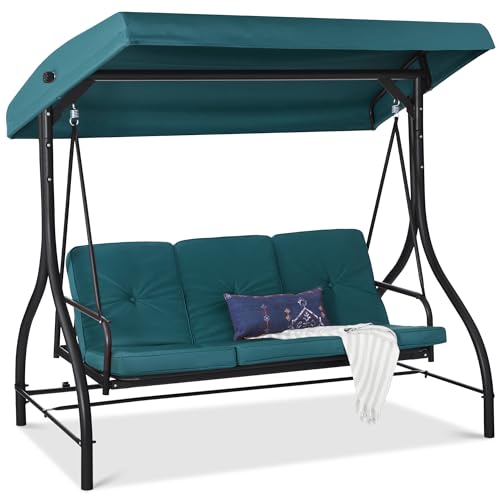
Best Choice Products 3-Seat Outdoor Large Converting Canopy Swing Glider, Patio Hammock Lounge Chair for Porch, Backyard w/Flatbed, Adjustable Shade, Removable Cushions - Peacock
Included for 'Best Porch Swing With Frame in 2026: Freestanding Swings Without Installation' because the listing specifies Patio Hammock Lounge Chair for Porch and Backyard w/Flatbed, details this guide uses to compare options.
View on AmazonA-frame stands use two triangular ends connected by a top beam. The swing hangs from hooks on that beam. The footprint is narrow at the top and wider at the base for stability, and most folds or breaks down into 3-4 main tubes.
Pergola-style stands use four vertical posts with a rectangular top frame, often with an integrated canopy or fabric shade. The swing hangs from the top crossbeam inside the rectangle. They look like a small pergola and often include side trellises, but they need significantly more square footage and are rarely portable once assembled.
| Feature | A-Frame Stand | Pergola-Style Stand |
|---|---|---|
| Typical Footprint (L x W) | 65″ – 75″ L x 42″ – 52″ W (5.5 x 4 ft avg.) | 84″ – 108″ L x 60″ – 72″ W (8 x 6 ft avg.) |
| Height to Top Beam | 72″ – 84″ | 78″ – 88″ |
| Steel Tube Diameter | 1.75″ – 2.5″ | 1.5″ – 2.25″ (more tubes, smaller diameter) |
| Common Steel Gauge | 14-gauge (1.9mm) to 15-gauge (1.7mm) | 15-gauge to 16-gauge (1.6mm) plus canopy frame |
| Advertised Weight Limit | 450 – 600 lbs (twin-seat models usually 550 lbs) | 400 – 500 lbs |
| Assembly Time (2 people) | 45 – 75 minutes, 12-18 bolts | 90 – 150 minutes, 30-50+ bolts plus canopy |
| Canopy / Shade Included | Rarely, usually sold separately | Often included (polyester or Textilene shade) |
| Best For | Small porches, decks, renters, easy storage | Large patios, sun-exposed yards, permanent placement |
For a porch swing with frame, gauge matters more than tube diameter alone. A 14-gauge 2-inch tube will flex less and handle dynamic load (swinging motion) better than a thinner 16-gauge 2.5-inch tube. If a listing only says “heavy-duty steel” without a gauge number, assume 16-gauge or thinner.
How to Measure Your Porch Before You Buy
Freestanding frames need clearance in every direction, not just floor space. Use painter’s tape to mark the footprint before ordering.
Clearance Rules That Prevent Bumping and Tipping
- Front and back swing arc: Leave at least 36 inches of clear space in front of and behind the swing’s resting position. A standard 48-52 inch swing seat will travel 18-24 inches each way while swinging.
- Side clearance: Leave 24 inches between the frame’s outer leg and any wall, railing, or step. This prevents pinch points and gives room to get in and out.
- Overhead clearance: You need 7-10 inches between the top of the swing’s backrest and the frame’s top beam to prevent the chains from rubbing.
- Porch depth check: Most covered porches are 6, 8, or 10 feet deep. An A-frame at 48″ deep fits an 8-foot deep porch with room to walk in front. A pergola-style at 66-72″ deep will dominate a 6-foot porch and leave no walkway — it needs a 10-foot depth or an open patio.
- Doorway and path width: Boxes for these frames are 62-74 inches long and weigh 65-110 lbs. Measure your narrowest doorway (usually 30-32 inches) and any tight turn from the street to the porch. A-frame boxes fit through a standard door; pergola boxes often need to be opened on the porch.
Room-size fit examples: On a 10×12 ft porch, an A-frame (approx. 6 x 4 ft) uses about 20% of the floor and leaves room for a small side table and two people to walk by. The same porch with a 9 x 6 ft pergola frame uses 45% of the floor, leaving only a narrow 2-foot perimeter. On a small 8×8 ft apartment balcony, only a compact A-frame under 68″ long is realistic.
Seat Height and Comfort Specs to Check
- Seat height off the ground: 17-19 inches is standard and comfortable for most adults to stand up from. Below 16 inches feels too low and makes the knees sit high.
- Seat depth: 18-20 inches for upright seating, 20-23 inches if you want to tuck a leg up or add a thick cushion.
- Chain/hanging length: Adjustable chains from 54-66 inches let you level the seat even if the porch floor slopes slightly for drainage (most porches slope 1/8″ to 1/4″ per foot).
Steel Gauge, Joints, and Weight Limits: What Actually Holds Up
Weight limits on porch swings with frames are static ratings. Dynamic load from swinging can momentarily exceed your body weight by 1.5x. A frame rated for 500 lbs is appropriate for two adults totaling 350-400 lbs who swing gently. If two larger adults will use it daily, look for 550 lbs or higher.
| Construction Detail | What to Look For | What to Avoid |
|---|---|---|
| Steel Gauge | 14-gauge (1.9mm) wall thickness, 15-gauge acceptable for lighter use | 16-gauge or 18-gauge, or no gauge listed — flexes and dents easily |
| Finish | Powder-coated steel with UV inhibitor, stainless or zinc-plated hardware | Painted only, no powder coat — chips and rusts within one season |
| Joints / Welds | Continuous welds at the top beam, reinforced gussets at A-joint | Spot welds only, plastic joint covers hiding thin connectors |
| Feet | Wide, flat feet (4″ x 4″ or larger) with adjustable levelers | Narrow pin feet — wobbles and sinks into wood decking |
| Swing Suspension | Zinc-plated steel springs or swivel hangers rated per side | Open S-hooks without safety clasps — can unhook while swinging |
Metal vs. wood vs. engineered wood frames: Solid wood frames (typically acacia, teak, or cedar) look warmer and absorb vibration, but need annual oiling and weigh 90-140 lbs. Powder-coated steel is the most common for freestanding swings because it offers the highest strength-to-weight ratio and resists rot. Avoid engineered wood or MDF-based frames for outdoor use — they swell and delaminate even with covers.
For fabric, solution-dyed polyester and Textilene (PVC-coated mesh) resist fading and dry quickly. Cotton canvas and untreated polyester absorb water and mildew. For cushions, look for foam density of 1.8 lbs per cubic foot or higher — lower density foam compresses flat within one summer. Reticulated or open-cell foam drains water instead of holding it.
Assembly, Moving, and What Wears First
Expect two-person assembly. A-frame kits usually include one long top beam, four legs, two bottom spreaders, and chains. The main frustration point is aligning the top beam holes while holding heavy tubes — a second person is essential for the first 15 minutes.
- Box weight and handling: A-frame sets ship in one box at 65-85 lbs. Pergola styles often ship in two boxes totaling 95-130 lbs. If you live upstairs or have no help, an A-frame is significantly easier to carry.
- Tools needed: Most include a small wrench but not a ratchet. A 14mm and 17mm socket wrench cuts assembly time by 20 minutes. All frame bolts should get hand-tightened first, then fully tightened once the frame is standing.
- Leveling: Porches and patios are rarely perfectly level. Use the adjustable feet or add rubber shims under one side. A wobbling frame will loosen bolts faster.
- What fails first: 1) Canopy fabric fading and tearing at the grommets after 12-18 months of sun, 2) Chain springs losing tension and squeaking, 3) Foot caps cracking from UV, and 4) Bottom bolts rusting if caps are missing. Check and re-torque all bolts after the first 2 weeks of use and at the start of each season.
- Winter storage: Steel frames can stay out year-round with a breathable cover that does not trap moisture. Cushions and canopies should be stored indoors. Even powder-coated steel will rust if leaves pile around the feet all winter.
General market ranges in 2026: steel A-frame swing sets with cushions usually $300–$600, larger pergola-style sets with canopy usually $500–$900, and solid wood freestanding swings usually $700–$1,200. Three-seat (approx. 60-inch) models add $100–$200 over two-seat versions.
Which Frame Should You Choose? A Decision Matrix
Match your situation to the right structure before you focus on color or cushions.
| Your Situation | Recommended Pick | Why |
|---|---|---|
| Small porch (under 8 ft deep), apartment or rental | Compact A-frame, 60″-68″ long | Smallest footprint, no ceiling anchors, easiest to move when you relocate |
| Large open deck or patio with strong sun, no existing shade | Pergola-style with canopy | Provides overhead shade and defines a seating area |
| Kids and pets will use it daily | A-frame, 14-gauge steel, 550 lb limit, Textilene or HDPE seat | Stronger dynamic load handling, wipe-clean seat, fewer fabric seams to tear |
| Want to move it between porch and yard seasonally | A-frame with quick-pin assembly | Disassembles to 4 tubes in 20 minutes; pergola style is semi-permanent |
| Back pain, need upright support | A-frame with high-back slatted seat (backrest 22″+) plus 3″ foam cushion | Upright angle reduces slouching; deep porch swings sag and strain lower back |
| Historic home or HOA with style rules | Wood-look steel A-frame or solid wood frame | Blends with traditional porch trim better than a bulky canopy |
Features Worth Paying For (and What to Skip)
Beyond the frame itself, these details affect daily comfort.
- Worth it: Swivel hanging springs (reduce chain twist and noise), removable cushion covers with zippers for washing, and a conversion option that lets you use the swing seat alone on a porch ceiling later if you move.
- Skip if on a budget: Built-in side tables that attach to the frame — they rattle and are too small for a drink, a separate small side table at 18-20 inches high is more useful.
- Safety check: Look for locking hangers or closed eye bolts, not open hooks. Chains should have vinyl coating or be at least 4mm thick welded link, not twisted wire.
FAQ
Can I put a freestanding swing on a composite deck?
Yes, but use wide, rubber-padded feet and check your deck’s live-load rating. Most residential decks are rated for 50 lbs per square foot. A 550 lb loaded swing spread over four feet at 16 square inches each is well within limits, but avoid concentrating the feet on a single deck board.
Do I need to bolt the frame to the ground?
Most A-frame and pergola stands are designed to be freestanding and do not require anchors on a level, hard surface. On windy, exposed porches or on soft ground, use the included ground stakes or add sandbags to the base. Do not use a swing frame on an uneven lawn without leveling it first.
How long do these frames last?
A 14-gauge powder-coated steel frame lasts 5-8 years with seasonal covers and bolt checks. Thinner 16-gauge frames or frames with only painted finishes often show rust at welds within 2-3 years, especially near coasts or where de-icing salts are used.