Key takeaways
- First smoker, occasional family meals: Pick a bullet water smoker. Its compact footprint and water pan make it forgiving, and two grates let you cook different foods at once. It suits cooks who are comfortable managing vents but do not want an offset’s constant fire tending.
- Frequent cooks who want easy food access: Consider a drum smoker. The broad cooking chamber is convenient for larger cuts, and many designs let you open the lid without moving stacked sections. Heat can climb quickly if the intake is opened too far, so make small adjustments.
- Cold, breezy location or long overnight cooks: An insulated cabinet is the stronger choice. Its walls reduce heat loss and can make fuel use more predictable. The trade-offs are greater weight, a higher purchase cost, and less convenience if you need to move it often.
- You enjoy tending a fire and want smoke from a separate firebox: Choose an offset only if you are ready for a steeper learning curve. Its layout gives direct access to the fire, but temperature varies along the cooking chamber and usually takes practice to manage.
Best charcoal smokers: the quick picks
The best charcoal smoker for most backyard cooks is a mid-size bullet smoker: it offers enough cooking area for a family meal, runs efficiently, and is easier to regulate than a large offset. Choose a drum smoker if you want more grate space and simpler access to food; choose an insulated cabinet smoker if steady temperatures in cold or windy weather matter more than price and portability.
There is no single winner for every yard. The right choice depends on how much food you cook at once, how often you want to tend the fire, and whether you need to reach the charcoal or water pan during a long cook.

Masterbuilt 30-Inch Dual Fuel Propane & Charcoal Vertical Smoker with 730 Sq. In. Cooking Space, Push-Button Ignition, Temperature Gauge, 4 Smoking Racks, Black
Included for 'Best Charcoal Smokers for Backyard Barbecue' because the listing specifies Push-Button Ignition and Temperature Gauge, details this guide uses to compare options.
View on Amazon
Dyna-Glo DGO1176BDC-D Vertical Offset Charcoal Smoker
Included for 'Best Charcoal Smokers for Backyard Barbecue' as a relevant option in this category; details come from the product listing.
View on Amazon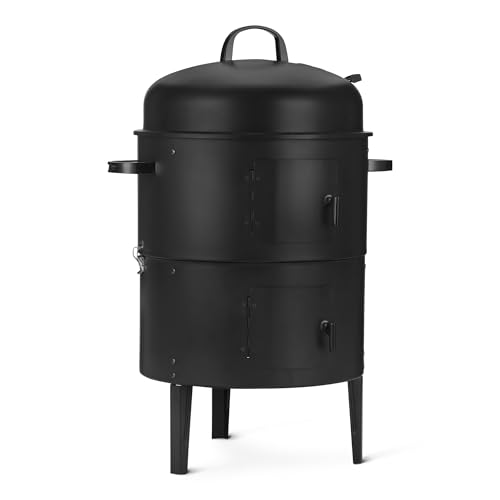
Amazon Basics 16 inch Vertical Charcoal Outdoor Smoker, BBQ Grill, with Built-in Thermometer, 2-Layer Design, Adjustable Air Supply Control, Black
Included for 'Best Charcoal Smokers for Backyard Barbecue' because the listing specifies BBQ Grill and with Built-in Thermometer, details this guide uses to compare options.
View on Amazon
Realcook Charcoal BBQ Smoker Grill - 20 Inch Vertical Smoker
Included for 'Best Charcoal Smokers for Backyard Barbecue' because the listing specifies 20 Inch Vertical Smoker, details this guide uses to compare options.
View on AmazonCompare the main smoker types
| Smoker type | Typical cooking area | Temperature control | Fuel and access | Learning curve |
|---|---|---|---|---|
| Bullet water smoker | About 400–700 sq in across stacked grates | Good once vents are adjusted; water helps buffer heat | Efficient; charcoal access varies by design, and the water pan may need careful handling | Low to moderate |
| Drum smoker | About 500–700 sq in on one or more grates | Good after the intake is dialed in; responds to vent changes | Often efficient; typically easier to add fuel than in a compact bullet | Moderate |
| Insulated cabinet | About 700–1,000 sq in across several racks | Very steady; insulation reduces swings from weather | Can use charcoal slowly; access doors make fuel and ash service easier | Low to moderate |
| Offset smoker | About 500–1,000 sq in, depending on chamber size | Requires active fire management and attention to airflow | Uses more fuel; firebox is accessible, but tending is frequent | High |
These are broad category ranges, not guarantees: grate layout and usable space vary by model. Check the manufacturer’s dimensions and cooking capacity before buying, especially if you plan to smoke a whole brisket or several racks of ribs.
Which charcoal smoker fits your situation?
- First smoker, occasional family meals: Pick a bullet water smoker. Its compact footprint and water pan make it forgiving, and two grates let you cook different foods at once. It suits cooks who are comfortable managing vents but do not want an offset’s constant fire tending.
- Frequent cooks who want easy food access: Consider a drum smoker. The broad cooking chamber is convenient for larger cuts, and many designs let you open the lid without moving stacked sections. Heat can climb quickly if the intake is opened too far, so make small adjustments.
- Cold, breezy location or long overnight cooks: An insulated cabinet is the stronger choice. Its walls reduce heat loss and can make fuel use more predictable. The trade-offs are greater weight, a higher purchase cost, and less convenience if you need to move it often.
- You enjoy tending a fire and want smoke from a separate firebox: Choose an offset only if you are ready for a steeper learning curve. Its layout gives direct access to the fire, but temperature varies along the cooking chamber and usually takes practice to manage.
What matters beyond grate area
Temperature control and insulation
Vents control how much oxygen reaches the charcoal: more intake generally means a hotter fire, while restricting airflow slows it. A smoker with tight-fitting doors and predictable vents is easier to manage than one with air leaks. Insulation is particularly useful when outdoor temperatures drop or wind hits the cooker, but it does not remove the need to monitor fuel and airflow.
A water pan adds thermal mass and helps stabilize cooking temperatures. It also takes up space and may need refilling during a long session. Check whether it can be removed or refilled without lifting hot grates. A pan positioned directly above the charcoal may be harder to service safely than one reachable through a separate door.
Fuel efficiency and charcoal access
Efficiency depends on construction, weather, target temperature, and how often the lid is opened—not just the smoker type. A well-sealed bullet or insulated cabinet can stretch a load of charcoal by limiting unnecessary airflow. An offset usually burns more because its firebox must keep producing heat while transferring it through the cooking chamber.
Before buying, look for a charcoal door or access hatch, an ash-removal system, and enough clearance to add fuel without dismantling the cooker. For a long cook, a convenient access point can matter more than a modest increase in grate area. If the design requires removing hot food and grates to reach the charcoal, expect interruptions.
Backyard fit, moving, and upkeep
Allow about 24 inches of open working space around the sides you use for vent controls, doors, and ash removal. Keep the smoker on a stable, noncombustible surface and follow the manufacturer’s fire-clearance instructions; the 24-inch figure is workspace, not a safe-distance rule. Avoid positioning it under low branches, roof overhangs, or near siding, and check local rules before use.
As a practical planning estimate, reserve a level area of roughly 4 by 4 feet for a compact bullet smoker, including room to work. A larger offset needs more room for its firebox door and long chamber; measure the cooker with its doors open rather than relying only on its closed dimensions. A narrow gate, steps, or soft lawn can make a heavy cabinet smoker difficult to bring into position, so check its shipping and assembled weight and wheel dimensions in advance.
Charcoal ash, grease, and repeated heating are the main upkeep realities. Empty ash only when it is fully cold, clean grease-prone surfaces, and protect the cooker from standing water. Thin paint or coatings around doors and fireboxes tend to show wear first; inspect hinges, seals, and wheels periodically. Replacement grates and seals are useful only if the manufacturer makes compatible parts available.
A simple first-cook plan
- Season the smoker if required. Follow its manual to burn off manufacturing residues and prepare uncoated cooking surfaces.
- Start with a moderate target. Use a small, controlled charcoal load and bring the smoker to a steady temperature before adding food.
- Adjust vents gradually. Make one small change at a time, then wait for the cooker to respond. Large corrections can overshoot the target.
- Track grate-level temperature. A separate thermometer near the food helps reveal differences between the lid reading and actual cooking conditions.
- Keep a brief log. Record charcoal amount, vent positions, weather, and temperature changes. That turns the next cook into a repeatable process.
For beginners, a bullet smoker is usually the best balance of price, fuel use, and manageable temperature control. Move up to a drum for easier access and larger cooks, or an insulated cabinet when weather stability and longer unattended stretches justify the extra cost. Choose an offset for the cooking style and active fire management—not simply because its cooking area looks impressive.