Key takeaways
- For four dining-chair cushions, allow roughly 60–80 gallons.
- For a loveseat cushion set with pillows, 90–120 gallons is safer.
- For sectional cushions, measure each cushion and consider two medium boxes instead of one very large box.
- For long-handled tools, check interior length rather than gallon capacity; many deck boxes are too short for rakes and hoes.
- For pool toys or children’s equipment, vertical interior height is often more useful than total volume.
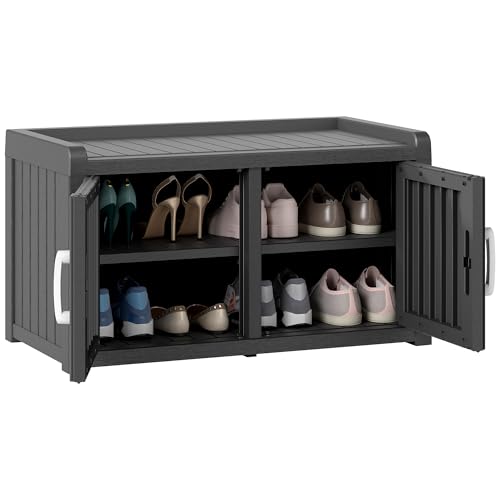
The best deck boxes for outdoor storage are resin or powder-coated metal boxes with a 100–150 gallon capacity, a gasketed or overlapping lid, ventilation, and a load rating of at least 250 pounds if you want the box to double as seating.
Choosing by appearance alone is risky: two boxes that look similar can differ substantially in rain protection, usable capacity, lid strength, and ease of moving. The right choice depends on whether you are storing thick cushions, gardening tools, children’s equipment, or smaller patio accessories.

Keter Westwood 150 Gal Outdoor Storage Box for Patio and Pool Accessories
Included for 'Best Deck Boxes for Outdoor Storage' as a relevant option in this category; details come from the product listing.
View on Amazon
EFU Outdoor Storage Box, 150 Gal Gen 2 Resin Deck Box w/Gas Struts & Wheels
Included for 'Best Deck Boxes for Outdoor Storage' because the listing specifies 150 Gal Gen 2 Resin Deck Box w/Gas Struts & Wheels, details this guide uses to compare options.
View on Amazon
LIFETIME 60186 Heavy-Duty Outdoor Storage Deck Box, 116 Gallon, Desert Sand/Brown
Included for 'Best Deck Boxes for Outdoor Storage' because the listing specifies 116 Gallon and Desert Sand/Brown, details this guide uses to compare options.
View on Amazon
Keter Westwood 150 Gallon Resin Large Outdoor Storage Box for Patio Furniture, Outdoor Cushions, Garden Tools and Pool Floats, Taupe
Included for 'Best Deck Boxes for Outdoor Storage' because the listing specifies Outdoor Cushions and Garden Tools and Pool Floats, details this guide uses to compare options.
View on AmazonBest deck boxes by outdoor-storage situation
| Situation | Best box type | Useful capacity | Specifications to prioritize |
|---|---|---|---|
| Small balcony or apartment patio | Compact resin box | 30–60 gallons | Under 30 inches wide, handles, lightweight construction |
| Standard patio cushions | Medium resin or metal box | 70–120 gallons | Interior height of at least 24 inches, raised base, rain-shedding lid |
| Sectional cushions and pillows | Large resin, metal, or lined wood box | 120–180 gallons | Interior length of 45–55 inches, hydraulic or assisted lid, strong floor |
| Tools, hoses, and pool accessories | Ventilated resin or metal box | 80–150 gallons | Lockable hasp, corrosion-resistant hardware, airflow openings |
| Extra outdoor seating | Reinforced seat-height box | 100–150 gallons | Load rating of 250–500 pounds, rigid lid, rounded edges |
What makes a deck box weather-resistant?
Resin and plastic: the practical default
UV-stabilized resin is usually the best balance of price, weight, and maintenance. Quality resin boxes do not rust, need no paint, and are easier to move than wood or steel. Look for thick molded panels, a reinforced rim, and a lid that overhangs the walls on all four sides.
Resin is not automatically waterproof. Rain can enter through the lid seam, hinge area, or ventilation openings. A box described as water-resistant may protect against ordinary showers while still allowing moisture inside during wind-driven rain or prolonged exposure. For cushions, use a box with a continuous gasket or a lid with a deep overlapping channel, then keep fabric items in breathable storage bags rather than sealed plastic bags.
Powder-coated metal: strong and secure
Powder-coated steel or aluminum is a good choice for tools, firewood accessories, and locations where security matters. Metal generally provides a more rigid lid and better resistance to chewing pets or impact. Aluminum is lighter and will not rust in the same way as steel, although fasteners and hinges can still corrode.
The weaknesses are heat, condensation, and dents. A dark metal box can become hot enough to damage delicate fabrics, while temperature changes may create moisture inside. Choose corrosion-resistant hardware and ventilation, and avoid placing wet towels or cushions directly against the metal walls.
Wood: attractive but maintenance-heavy
Cedar, acacia, and other outdoor woods can make a deck box look like part of the furniture, but they require more attention. Wood expands and contracts, so gaps around the lid are normal. A liner or waterproof tray improves protection, but trapped moisture can still promote mildew. Expect periodic sealing or oiling, and inspect the floor because moisture often causes deterioration there first.
| Material | Main advantages | Common trade-offs | Best use |
|---|---|---|---|
| UV-stabilized resin | Light, rust-free, low maintenance | Can flex, fade, or become brittle if poorly made | Cushions and general patio storage |
| Powder-coated aluminum | Light, rigid, corrosion-resistant | Can dent and heat up; often costs more | Premium storage and coastal locations |
| Powder-coated steel | Strong, secure, sturdy lid | Heavy; scratches can expose metal to rust | Tools and high-use storage |
| Outdoor wood | Furniture-like appearance and rigidity | Needs sealing; joints and floor can absorb water | Covered patios and coordinated furniture |
Capacity: measure the items, not the advertised gallons
Published capacity describes the approximate volume, but the interior shape matters more. Hinges, sloped lids, thick walls, and molded ribs reduce usable space. Before buying, measure the largest cushion stack and add clearance for easy removal.
- For four dining-chair cushions, allow roughly 60–80 gallons.
- For a loveseat cushion set with pillows, 90–120 gallons is safer.
- For sectional cushions, measure each cushion and consider two medium boxes instead of one very large box.
- For long-handled tools, check interior length rather than gallon capacity; many deck boxes are too short for rakes and hoes.
- For pool toys or children’s equipment, vertical interior height is often more useful than total volume.
Leave about 2 inches of unused space above a cushion stack. Compressing cushions against the lid makes removal awkward and can prevent the gasket from closing evenly. If the box will sit against a wall, allow at least 3 inches behind it so the lid can open without scraping. For a box used as a bench, leave approximately 24 inches of clear space in front for comfortable legroom.
Waterproofing, ventilation, and condensation
A truly sealed box is useful for dry objects but not always ideal for fabric. Warm air trapped inside can condense overnight, particularly when cushions enter the box damp. Ventilation reduces this risk, but large openings can admit rain and insects.
For cushions, choose controlled ventilation: small screened vents high on the sides, a raised floor, and a lid that sheds water away from the seam. For tools and hard goods, more airflow is acceptable. Do not rely on a deck box to dry wet cushions; allow them to dry completely before storage.
Place the box on a level surface, preferably on pavers or a low platform rather than directly on soil. Raising it 1–2 inches improves drainage and reduces splashback. Check that the floor remains level when loaded; a twisted base can distort the lid and compromise the seal.
Can a deck box safely be used as seating?
Only use a deck box as a seat if the manufacturer provides a seating load rating. A lid that supports one seated adult may not safely support two people, a child jumping on it, or someone standing on it. A useful target is at least 250 pounds for one-person seating and 400–500 pounds for a wider bench intended for two adults.
Seat height is another practical detail. A box around 17–19 inches high is close to a dining-chair seat. Boxes around 20–24 inches can work as casual bench seating but may feel tall beside a low sofa. Add a cushion only if it does not block the lid seam or create an unstable edge.
Assembly and moving realities
Most resin deck boxes arrive as interlocking panels requiring a screwdriver and basic alignment. Assembly commonly takes 20–60 minutes for one person, while large boxes with many panels or assisted hinges may take longer. Do not force a lid onto misaligned sidewalls: a small twist in the base can prevent the lid from sealing.
Large assembled boxes can be surprisingly difficult to move through a doorway. Measure the narrowest doorway, gate, stair landing, and turns before assembly. A 50-inch-wide box may fit through a 36-inch door only when carried diagonally, and its actual depth and rigidity may make that maneuver impossible. If the box weighs more than about 60 pounds empty, assemble it near its final position or choose a model with sturdy handles and a two-person moving plan.
Wheels are convenient on smooth decks but less useful on pavers or uneven ground. Small casters can concentrate weight and crack decking or sink into soft soil. If mobility matters, choose large wheels or place the box on a purpose-built outdoor furniture dolly.
Features worth paying for
- Assisted opening: Gas struts or a controlled hinge reduce the chance of a heavy lid falling on fingers.
- Lockable closure: A hasp can deter casual access, although it does not make the box a security safe.
- Raised floor: Keeps contents above small amounts of water that collect beneath the box.
- Reinforced lid: Important if the box will be used as a bench or if snow may accumulate.
- Screened vents: Improve airflow without leaving large openings for insects.
- Drainage design: Channels around the lid and sloped surfaces are more useful than a vague “waterproof” label.
Final buying recommendation
For most uncovered patios, choose a 70–120 gallon UV-stabilized resin box with a raised base, overlapping gasketed lid, screened vents, and a seating rating only if you need an occasional bench. Move up to 120–180 gallons for sectional cushions, but verify the internal dimensions and doorway route first. Choose powder-coated metal for greater rigidity and security, and choose wood when appearance matters enough to justify regular maintenance.
Prices generally range from $60–$150 for compact resin boxes, $150–$350 for medium and large resin models, and $250–$700 or more for reinforced metal or well-finished wood construction. The best value is not the largest capacity; it is the box whose interior fits your items, whose lid seals consistently, and whose weight and assembly requirements match the way you use your patio.