Key takeaways
- Locking straps: Use multiple adjustable straps that can be secured against children and animals. Replace cracked buckles or weathered straps.
- Reinforced load-bearing panels: A safety cover needs more than thick foam; it needs construction intended to resist collapse under an accidental load.
- Drainage and a sloped top: Standing water adds considerable weight and accelerates jacket wear.
- Safety certification or compliance documentation: Where offered, look for compliance with ASTM F1346 or the applicable local safety requirement. Verify what the documentation covers.
- Wind-resistant fastening: Straps should be attached to suitable cabinet or deck points, not improvised hooks that can pull loose.
The best hot tub covers for most owners are custom-fit, tapered foam covers with a heat-sealed vapor barrier, at least 4 inches of center thickness, reinforced hinge and handles, and safety-cover compliance where available.
Quick picks by situation
| Situation | Best cover specification | Why it fits |
|---|---|---|
| Cold climate or year-round use | 5–6 inch tapered foam, high-density foam, sealed vapor barrier | Reduces heat loss through the largest exposed surface and resists waterlogging |
| Small patio or narrow access route | 4 inch tapered cover, center-fold hinge, lightweight foam, cover lifter | Balances insulation with easier folding and clearance |
| Children or pets | Safety-rated cover with locking straps, reinforced cores, and secure fasteners | Helps prevent unauthorized access; it is not a substitute for supervision |
| Frequent back or shoulder pain | Lightweight high-density cover plus a supported lifter | Reduces bending, dragging, and lifting from one edge |
| Rental home or temporary installation | Standard-size replacement cover with adjustable straps and a freestanding or bracketed lifter | Can be removed with less permanent alteration to the property |
What separates the best hot tub covers
Thickness is insulation, but not the whole story
Hot tub cover thickness is usually described as a taper, such as 4 inches at the center folding hinge and 2 inches at the outside edge. The thicker center sheds rain while reducing heat loss. For moderate climates, a 4-to-2-inch taper is often adequate. In freezing regions, a 5-to-3-inch or 6-to-4-inch taper provides more insulation, especially when the tub is used throughout winter.
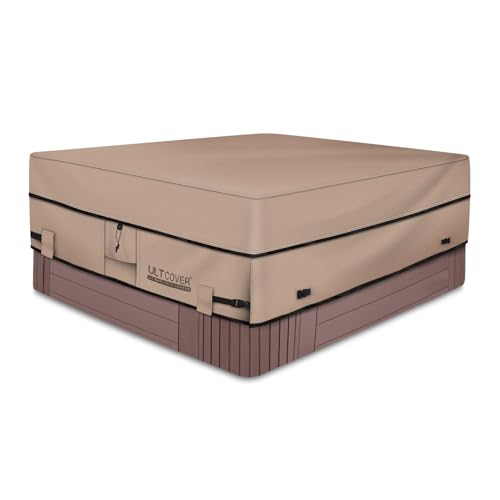
ULTCOVER Waterproof Square Hot Tub SPA Cover 85 inch
Included for 'Best Hot Tub Covers for Heat Retention and Easy Handling' as a relevant option in this category; details come from the product listing.
View on Amazon
Enzeno Outdoor SPA Hot Tub Cover Waterproof Square 86 x 86 inch fit 84 x 84 or 83 x 83 or 82 x 82 or 7 ft x 7 ft 420D Heavy Duty Cub Hot Tub Lid Protectors Protective Cover Cap
Included for 'Best Hot Tub Covers for Heat Retention and Easy Handling' as a relevant option in this category; details come from the product listing.
View on Amazon
iBirdie Outdoor Waterproof Hot Tub SPA Cover 85 x 85 inch 7 x 7 ft
Included for 'Best Hot Tub Covers for Heat Retention and Easy Handling' as a relevant option in this category; details come from the product listing.
View on Amazon
QH.HOME 85x85 Square Hot Tub Cover, 1000D IP65 Waterproof
Included for 'Best Hot Tub Covers for Heat Retention and Easy Handling' because the listing specifies 1000D IP65 Waterproof, details this guide uses to compare options.
View on AmazonThickness alone can mislead. A poorly sealed, low-density foam core may absorb moisture and become heavier while losing insulating performance. A well-made 4-inch cover with dense, dry foam can outperform a thicker cover that has absorbed water.
Foam density affects life span and handling
Foam density is commonly listed in pounds per cubic foot. Around 1.5 to 2.0 pounds per cubic foot is a practical range for a residential cover; higher-density foam generally resists compression and water absorption better, although it also adds weight and cost. Avoid choosing by density alone: the foam must be protected by a continuous vapor barrier and a durable outer jacket.
| Construction choice | Typical specification | Advantage | Trade-off |
|---|---|---|---|
| Standard tapered foam | 4–2 inch taper; approximately 1.5–2.0 lb/ft³ foam | Good balance of price, insulation, and weight | May sag or absorb water sooner if the barrier fails |
| Cold-climate foam | 5–3 or 6–4 inch taper; high-density foam | Better thermal performance and snow-shedding shape | Heavier, bulkier, and harder to lift without a mechanism |
| Foam with multiple internal supports | Reinforced hinge and load-spreading panels | Resists bending and premature center collapse | Can increase weight and reduce compact folding |
| Thin soft or fabric-only cover | Minimal insulation, no rigid foam core | Light and inexpensive for short-term dust protection | Not an effective thermal or safety cover |
Vapor barriers: the feature that protects the foam
Foam naturally absorbs water vapor. The inner vapor barrier should be heat-sealed or otherwise continuously sealed around the foam, rather than merely covered by a loose plastic sheet. A reliable barrier keeps humid air away from the core, where condensation can increase weight and reduce insulation.
Inspect the cover’s zipper and seams as well. A zipper can make the jacket replaceable, but it is a potential entry point for moisture if it is poorly protected. The outer jacket should be UV-resistant, mildew-resistant, and designed to drain rain away from the hinge rather than toward it.
Hinges, folds, and the real handling weight
Choose the hinge around your available clearance
A center-fold hinge divides the cover into two panels, usually making it possible to fold the cover while standing at one side of the tub. This is the most useful arrangement for many patios. A three-panel or multi-fold design can make a large cover easier to move, but it introduces more seams and hinge areas that may wear over time.
Measure the clearance behind the hot tub before selecting a lifter or hinge arrangement. A manual folding lifter may need roughly 18 to 30 inches of space behind the tub, while some under-mount systems require less visible floor space but need suitable cabinet access. A towel, railing, wall, or outdoor furniture can prevent the cover from opening fully even when the tub itself fits.
Weight matters more than the advertised thickness
A typical 7-by-7-foot cover may weigh approximately 50 to 80 pounds when dry, depending on foam density, reinforcement, and skirt length. Large 8-by-8-foot or 8-by-10-foot covers can approach or exceed 90 pounds. If a cover feels substantially heavier after rain, that is a warning sign of water intrusion or a failing vapor barrier.
Do not plan to move a large cover by pulling one corner across the ground. Dragging stresses the skirt, hinge, and foam edge. Two adults should carry a large cover, keeping it folded rather than sharply bent. A cover lifter is worthwhile when the tub is used several times a week or when anyone in the household has limited lifting strength.
Safety features to prioritize
- Locking straps: Use multiple adjustable straps that can be secured against children and animals. Replace cracked buckles or weathered straps.
- Reinforced load-bearing panels: A safety cover needs more than thick foam; it needs construction intended to resist collapse under an accidental load.
- Drainage and a sloped top: Standing water adds considerable weight and accelerates jacket wear.
- Safety certification or compliance documentation: Where offered, look for compliance with ASTM F1346 or the applicable local safety requirement. Verify what the documentation covers.
- Wind-resistant fastening: Straps should be attached to suitable cabinet or deck points, not improvised hooks that can pull loose.
A spa cover is not a walkable surface, even when marketed as heavy-duty or safety-rated. Keep the cover locked when the tub is not supervised, and never allow anyone to sit, stand, or place heavy objects on it.
How to match cover dimensions to the hot tub
Measure the tub itself instead of relying on the model name. Record the maximum outside length and width, including rounded corners, then measure the corner radius if the replacement supplier requests it. Measure the cabinet height and note whether the shell has unusual steps, raised controls, speakers, or a waterfall feature.
- Measure length and width in several places. Use the largest measurement, not the shortest straight section between rounded corners.
- Check squareness. Measure both diagonals. If they differ, provide both measurements rather than forcing a rectangular assumption.
- Measure the desired skirt drop. A skirt of about 4 to 6 inches commonly covers the cabinet rim, but it should not bunch on the deck.
- Confirm hinge placement. The fold should run in a direction that leaves the control panel accessible and works with the lifter.
- Account for clearance. Leave approximately 12 inches around the tub for basic access; 18 to 24 inches is more practical for servicing, cover removal, and cleaning.
Do not order a cover substantially larger to “be safe.” An oversized cover can sag, collect water, catch wind, and place stress on the hinge. An undersized cover exposes the shell and lets heat escape around the perimeter. For a replacement, compare the measurements of the old cover only as a reference; a stretched or shrunken cover may no longer reflect the tub’s actual dimensions.
Durability and maintenance realities
The outer vinyl or marine-grade fabric usually wears first at the folded hinge, corners, handle attachments, and places where the cover rubs against a lifter. Inspect these areas every few months. Clean the jacket with mild soap and water, avoid abrasive brushes, and do not use products that leave an oily film where people may walk or where straps must grip.
Keep snow brushed off rather than allowing a heavy layer to accumulate. Never use a sharp shovel. If the cover becomes waterlogged, replace or repair the vapor barrier instead of treating the added weight as normal. Store a removed cover on a support that keeps it off wet ground, out of direct sunlight, and free from pets that may claw the jacket.
Bottom line
For most buyers, the best hot tub covers are custom-sized, 4-to-2-inch tapered covers with dense foam, a sealed vapor barrier, UV-resistant jackets, reinforced center hinges, locking straps, and a compatible lifter. Upgrade to a 5-to-3-inch or 6-to-4-inch high-density design for cold climates or frequent winter use. Prioritize manageable weight and safe handling over maximum thickness when the cover must be removed often, and confirm the tub’s exact dimensions and surrounding clearance before ordering.