Our Top Picks
 AI-Assisted Medical Diagnostics: A Clinical Guide to Next-Generation6.2 x 0.81 x 9.2 InchesCheck on Amazon
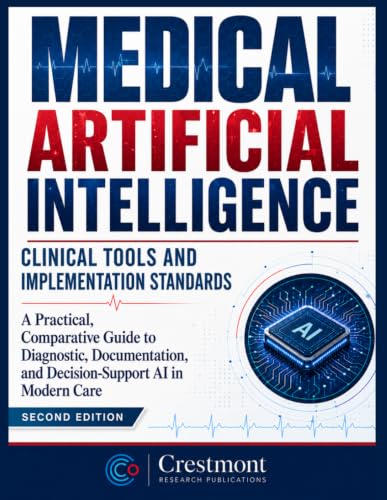 Medical Artificial Intelligence: Clinical Tools and Implementation Standards:8.5 x 0.73 x 11 InchesCheck on Amazon
 Medical AI for Beginners: Understanding Artificial Intelligence in6 x 0.51 x 9 inches0.7 PoundsCheck on Amazon
The best AI medical diagnostics tools are clinician-supervised systems with a clearly defined use, published validation, appropriate regulatory clearance, and strict limits—not general-purpose symptom checkers that promise a diagnosis from a few answers.
Best AI medical diagnostics tools by situation
| Situation | Tool or tool type | What it does | Best use | Main limitation |
|---|---|---|---|---|
| Diabetes screening in primary care | LumineticsCore | Autonomously analyzes retinal photographs for more-than-mild diabetic retinopathy | Screening adults with diabetes when an eye specialist is not immediately available | Does not replace a comprehensive eye examination or treat disease |
| Suspected stroke in a hospital | Viz.ai or Aidoc | Flags selected imaging findings and accelerates clinical notification | Hospital workflows for time-critical imaging | Availability, accuracy, and supported findings vary by module and hospital |
| Heart-sound assessment | Eko digital stethoscope with supported AI software | Assists with detection of certain murmurs and cardiac findings | Clinicians evaluating patients during an examination | Not a stand-alone diagnosis; abnormal results require conventional assessment |
| Skin concern at home | Regulated teledermatology or image-triage service | May prioritize a case or connect a user with a clinician | Deciding how soon to seek professional review | Phone images cannot reliably rule out skin cancer or other serious disease |
| General symptoms | Symptom-checking applications such as Ada | Organizes symptoms and suggests possible care pathways | Preparing questions and choosing between routine, urgent, and emergency care | It is triage support, not a validated diagnosis |
1. LumineticsCore: a strong choice for diabetic-eye screening
LumineticsCore, developed by Digital Diagnostics, is one of the clearest examples of an autonomous AI diagnostic system. It analyzes photographs of the retina and determines whether a patient has more-than-mild diabetic retinopathy, allowing an eligible patient to receive a screening result during a primary-care visit.
AI-Assisted Medical Diagnostics: A Clinical Guide to Next-Generation Diagnostics
Picked as a relevant option in this category.
View on AmazonMedical Artificial Intelligence: Clinical Tools and Implementation Standards: A Practical, Comparative Guide to Diagnostic, Documentation, and Decision-Support AI in Modern Care
Chosen because it specifies Comparative Guide to Diagnostic and Documentation.
View on AmazonMedical AI for Beginners: Understanding Artificial Intelligence in Healthcare, Medical Imaging, Diagnostics, Clinical Decision Support, and the Future of Patient Care
Chosen because it specifies Medical Imaging and Diagnostics.
View on Amazon
INTEGRATING GENERATIVE AI IN MEDICAL PRACTICE : Enhancing Patient Care & Diagnostics With Agentic AI Systems (The Architecture of Intelligence Book 4)
Picked as a relevant option in this category.
View on AmazonThe system was authorized by the U.S. Food and Drug Administration in 2018 under the name IDx-DR. Its intended use is narrow: adults with diabetes who have not previously been diagnosed with diabetic retinopathy and whose retinal images meet the system’s quality requirements. That narrow indication is a strength, because the system is not marketed as a universal eye-disease detector.
Validation and oversight
The pivotal study included more than 800 participants across primary-care settings. Reported performance was approximately 87% sensitivity and 90% specificity for the study’s defined endpoint. Those figures should not be treated as a guarantee for every clinic: image quality, patient population, camera, and workflow affect results.
Although the result can be generated without an eye specialist interpreting each image, clinicians remain responsible for selecting appropriate patients, handling ungradable images, communicating results, and arranging referral. A “negative” result also does not rule out glaucoma, macular disease, vision-threatening symptoms, or other eye problems.
Privacy and consumer limits
Retinal photographs are health information. Before using a service, ask who stores the images, whether the provider is covered by HIPAA or another applicable health-privacy law, how long data are retained, and whether images are used for algorithm training. This is a clinical screening product, not something most consumers can safely use to self-diagnose from a photograph.
2. Viz.ai and Aidoc: useful hospital imaging systems, not home diagnosis apps
Viz.ai and Aidoc are leading examples of clinical AI platforms that analyze medical images and help hospitals prioritize cases. Depending on the installed module, they may flag suspected large-vessel occlusion, pulmonary embolism, intracranial hemorrhage, fractures, or other findings. Their practical value is often workflow speed: a suspected urgent finding can be routed to the appropriate team while the radiologist completes the formal interpretation.
These products are not single, universal diagnostic tools. Each algorithm has a specific intended use, regulatory status, supported imaging protocol, and performance profile. A hospital may use one module but not another, and a product’s approval in one country does not automatically establish approval elsewhere.
Clinical validation and limits
Validation commonly includes retrospective image studies and prospective or real-world workflow evaluations. Reported measurements can include sensitivity, specificity, area under the receiver-operating-characteristic curve, and notification time. A reduction in notification time is operationally valuable, but it does not by itself prove better patient outcomes.
False positives can increase workload and anxiety. False negatives can delay care. The radiologist, emergency physician, neurologist, or other qualified clinician must review the images and the full clinical context. These platforms should therefore be purchased by healthcare organizations with an integration plan, not selected by consumers looking for an app that reads a scan uploaded from home.
Privacy questions to ask
- Is the system deployed inside the hospital’s approved environment or does imaging leave the organization?
- Is data encrypted in transit and at rest?
- Can the vendor use identifiable images for product development?
- How are audit logs, retention, deletion, and breach notification handled?
- What happens when the algorithm is unavailable or produces an uncertain result?
3. Eko AI-enabled digital stethoscopes: helpful during an examination
Eko makes digital stethoscopes and software that record and analyze heart and lung sounds. Its AI features have been developed to assist clinicians with findings such as heart murmurs, including patterns associated with possible valvular disease. The equipment can also support telemedicine by allowing a clinician to share recorded auscultation data.
This category is valuable because it adds an objective recording and algorithmic aid to a physical examination. It is not equivalent to an echocardiogram, electrocardiogram, or cardiologist’s assessment. The same murmur can have different causes, and serious heart disease can exist without an obvious murmur.
Who should use it?
An Eko device is most appropriate for a licensed healthcare professional working within the device’s cleared indication and training requirements. A consumer buying a digital stethoscope cannot safely interpret the output without examination skills and clinical context. If a clinician hears an abnormality—or if a patient has chest pain, fainting, severe breathlessness, or blue lips—urgent medical evaluation takes priority over any AI result.
Ask the provider how recordings are stored, whether identifiable audio is uploaded, whether the software is covered by the organization’s privacy agreement, and how patients can request access or deletion where applicable.
4. Symptom checkers: useful for triage, weak for diagnosis
Applications such as Ada can help users structure symptoms, identify questions to ask, and decide whether to seek routine, urgent, or emergency care. They are the most accessible tools in this list, but they should not be confused with clinical diagnostic systems.
Symptom checkers generally rely on a conversational history rather than physical examination, vital signs, laboratory tests, imaging, or a complete medical record. Their suggestions can be affected by vague symptom descriptions, missing information, rare conditions, language differences, and the user’s ability to recognize severity.
Use one as a preparation and triage aid: record when symptoms began, what makes them better or worse, medications taken, and relevant medical conditions. Do not use a reassuring app result to postpone care for emergency symptoms. Privacy also deserves scrutiny because symptom histories, age, location, and device identifiers may be collected under terms that differ from hospital privacy rules.
How to choose an AI diagnostic tool safely
- Define the task. Screening, image prioritization, monitoring, triage, and diagnosis are different functions. Choose a tool whose intended use matches the actual decision.
- Check regulatory status in your country. Look for the exact product and software module, not merely a company’s general claim that it uses AI.
- Read the validation population. Check age, disease prevalence, imaging equipment, race and ethnicity representation, and whether validation was independent of the developer.
- Confirm human oversight. Identify who reviews an abnormal, negative, low-quality, or uncertain result and how quickly follow-up occurs.
- Review privacy terms. Look for encryption, retention, secondary use, model training, deletion rights, and whether the provider is a covered healthcare entity.
- Plan for failure. A safe service explains what happens if the algorithm is wrong, unavailable, out of scope, or unable to analyze the data.
What AI diagnostics cannot safely do for consumers
Even the best AI diagnostic tools cannot replace a clinician’s examination, medical history, laboratory testing, imaging review, or shared decision-making. Performance statistics describe groups, not certainty for one person. A tool may be accurate for the condition it was designed to detect yet miss a different condition causing the same symptom.
For consumers, the best choice is usually a regulated healthcare service that uses AI as one step in a documented clinical pathway. Treat general-purpose image apps, chatbots, and symptom checkers as informational aids only. Seek urgent care for severe breathing difficulty, chest pressure, sudden weakness, confusion, uncontrolled bleeding, or rapidly worsening symptoms regardless of what an AI tool reports.