Key takeaways
- Measure the narrowest doorway, not just the room. A 48-inch-wide rack may arrive in a box shorter than the finished width, but the assembled frame still needs to pass through the opening on its side or be assembled inside the room.
- Allow two-person handling for tall racks and boxes weighing roughly 40–90 pounds, depending on the steel gauge and number of shelves.
- Use a level floor and adjust the feet before adding storage. Uneven garage slabs can make a rack wobble even when every connector is properly fitted.
- Install the highest shelf only after confirming that you can safely lift containers into it. A top shelf near 72 inches is poor storage for heavy boxes.
- Secure a tall, narrow rack to a wall when children, pets, or earthquake risk make tipping a concern. Wall anchoring is a stability measure, not a substitute for respecting shelf limits.
The best heavy duty wire shelving racks are usually 48-inch-wide, chrome- or powder-coated steel units rated for at least 600 pounds per shelf, with adjustable tiers, locking casters, and enough clearance to fit through your doors and around stored equipment.
Quick picks by garage or utility-room situation
| Situation | Best rack configuration | Why it fits | Typical market range |
|---|---|---|---|
| Small utility room or apartment | 36 in. W × 14–18 in. D, 4 tiers, 350–600 lb per shelf | Uses less floor space while holding cleaning supplies, pantry overflow, or tools | $80–$180 |
| Standard home garage | 48 in. W × 18–24 in. D, 5 tiers, 600–1,000 lb per shelf | Balances usable capacity with manageable reach and aisle clearance | $130–$300 |
| Heavy bins, paint, or workshop equipment | 60–72 in. W × 24 in. D, 5 tiers, 800–1,500 lb per shelf | Provides broad, deep storage for dense loads without stacking several small racks | $250–$600 |
| Frequently rearranged storage | 48 in. W × 18 in. D, 4–5 tiers, locking casters, 600–800 lb per shelf | Can be moved for cleaning or vehicle access, provided the floor is smooth and the rack is not overloaded | $150–$350 |
What “heavy duty” should mean
Manufacturers often publish a maximum load per shelf, but the number may assume an evenly distributed load, a level floor, and no movement. A rack rated at 1,000 pounds per shelf is not designed for a 1,000-pound point load in the center or for rolling over a garage threshold while fully loaded.

Amazon Basics 5-Shelf Adjustable Heavy Duty Steel Wire Rack, Space Saving Storage Shelving Organizer for Kitchen, Garage, No-Tool Assembly, 350 lbs Weight Capacity, 36" x 14" x 72", Chrome
Included for 'Best Heavy-Duty Wire Shelving Racks' because the listing specifies Space Saving Storage Shelving Organizer for Kitchen and Garage, details this guide uses to compare options.
View on Amazon
Seville Classics UltraDurable Heavy Duty NSF Solid Steel Wire Rack Storage Unit Organizer for Garage, Warehouse, Office, Restaurant, Classroom, Kitchen, 5-Tier Shelving, 48" W x 18" D
Included for 'Best Heavy-Duty Wire Shelving Racks' because the listing specifies Warehouse and Office, details this guide uses to compare options.
View on Amazon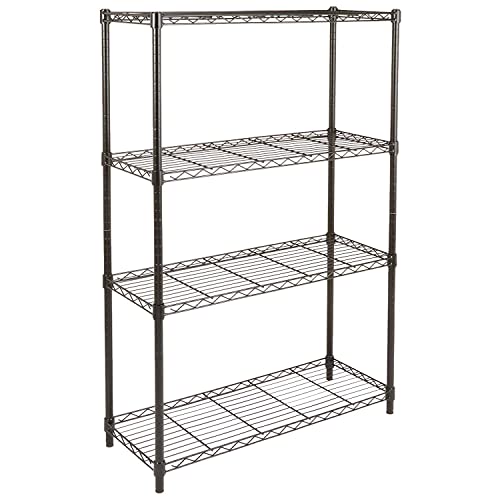
Amazon Basics 4-Shelf Adjustable Heavy Duty Steel Wire Rack Storage Shelving, Sturdy Garage Shelving, 350 lbs Capacity Per Shelf, Easy No-Tool Assembly, 36" x 14" x 54", Black
Included for 'Best Heavy-Duty Wire Shelving Racks' because the listing specifies Sturdy Garage Shelving and 350 lbs Capacity Per Shelf, details this guide uses to compare options.
View on Amazon
RackBro 48" W Garage Shelving 1875LBS Heavy Duty Wire Shelving Unit, Metal 5-Tier Adjustable Steel Storage Rack with Liners, Storage Tote Rack, 48" W x 18" D x 72" H for Garage Commercial, Black
Included for 'Best Heavy-Duty Wire Shelving Racks' because the listing specifies Metal 5-Tier Adjustable Steel Storage Rack with Liners and Storage Tote Rack, details this guide uses to compare options.
View on AmazonFor household use, a practical target is 600 pounds per shelf for evenly distributed boxes and containers. Choose 800–1,500 pounds per shelf when storing dense items such as tool cases, automotive parts, tile, bottled liquids, or multiple paint cans. Check whether the rating is for the entire shelf or for the rack’s total capacity, and look for a reduced rating when casters are installed.
Usable capacity is also limited by shelf depth. A 24-inch-deep shelf may hold more, but items at the back can become difficult to identify. For most garages, 18 inches deep is easier to access; 24 inches is worthwhile for large storage totes and workshop equipment.
Head-to-head: the features that separate good racks from frustrating ones
Steel construction and shelf decking
Heavy-gauge steel posts and welded wire frames resist bending better than thin, lightly formed metal. Powder-coated steel is a strong choice for garages because the coating helps protect against ordinary scuffs and humidity. Chrome-plated steel is attractive in a utility room and can resist surface corrosion, but scratches that reach the underlying steel should be kept dry.
Wire shelves improve visibility and ventilation, which is useful for damp tools, laundry supplies, and stored textiles. The trade-off is that small jars, narrow bottles, and loose hardware can tip through the grid. Add shelf liners or shallow plastic trays, but avoid thick cardboard that can absorb moisture. If you need a completely flat surface for small parts, select a rack with removable solid liners or use correctly sized rigid shelf panels.
| Construction choice | Strength and durability | Best use | Limitation |
|---|---|---|---|
| Powder-coated steel | Strong, abrasion-resistant, suitable for garages | Tools, bins, seasonal equipment | Chips can expose steel to rust |
| Chrome-plated steel | Good indoor corrosion resistance and easy wiping | Laundry rooms and clean utility areas | Scratches may show; less ideal for persistently damp spaces |
| Wire shelf with plastic liners | Ventilated frame with a more stable storage surface | Cleaning bottles, small containers, pantry overflow | Liners may bow or stain under heavy use |
| Thin stamped metal | Acceptable for light household storage | Paper goods and empty containers | Can flex, dent, or wobble under concentrated loads |
Adjustable tiers and practical clearance
Look for shelves that adjust in roughly 1-inch increments rather than only two or three fixed positions. This lets you place a 12-inch storage tote beneath a shelf with less wasted space. Measure the real height of your containers, including handles and lids, then allow about 1–2 inches of lifting clearance above each item.
A common five-tier rack may stand 72–77 inches tall. In a room with an 84-inch ceiling, that leaves only 7–12 inches above the rack. That is enough for ventilation and access, but not enough to tilt the assembled unit upright if it is built flat on the floor. In a room with an 8-foot ceiling, confirm the rack’s assembled height before buying.
For a 10-by-12-foot garage or utility room, a 48-inch-wide rack leaves approximately 8 feet of width beside it. A 24-inch-deep rack placed against a wall still leaves a 10-foot-long open dimension, but a comfortable walking path generally needs at least 30–36 inches. If a car, washer, workbench, or door swing shares the room, a 36-inch-wide rack may be more functional than a larger model.
Casters: useful, but not automatically heavy duty
Casters are valuable when you need to sweep behind a rack or move it away from a garage door. Choose wheels at least 3 inches in diameter for smooth concrete and 4 inches or larger if the rack must cross a small threshold. Swivel casters make positioning easier; locking casters should lock both the wheel and the swivel action when possible.
Wheel quality matters more than the advertised rack capacity. Small hard casters can crack, bind, or leave marks under a fully loaded unit. Rubber or polyurethane wheels roll more quietly and handle minor floor imperfections better. Never move a tall rack quickly, and keep heavy items on the bottom two shelves to reduce the risk of tipping. If the rack will remain stationary, leveling feet usually provide better stability and more capacity than casters.
Assembly and moving realities
Most boltless wire racks assemble with split sleeves or similar collar systems: the posts are connected first, then each shelf is tapped into place with a rubber mallet. This is faster than a fully bolted frame, but the connections must be seated evenly. If one corner sits higher than the others, the shelf can rock and the published load rating no longer represents a stable setup.
- Measure the narrowest doorway, not just the room. A 48-inch-wide rack may arrive in a box shorter than the finished width, but the assembled frame still needs to pass through the opening on its side or be assembled inside the room.
- Allow two-person handling for tall racks and boxes weighing roughly 40–90 pounds, depending on the steel gauge and number of shelves.
- Use a level floor and adjust the feet before adding storage. Uneven garage slabs can make a rack wobble even when every connector is properly fitted.
- Install the highest shelf only after confirming that you can safely lift containers into it. A top shelf near 72 inches is poor storage for heavy boxes.
- Secure a tall, narrow rack to a wall when children, pets, or earthquake risk make tipping a concern. Wall anchoring is a stability measure, not a substitute for respecting shelf limits.
How to choose the right dimensions
Start with the largest object you expect to store. Standard 18-gallon totes typically need more than 16 inches of vertical clearance once handles are included, while large 27-gallon totes may need about 18–20 inches. Measure the tote’s actual width and depth; advertised nominal sizes do not always match the outside dimensions.
For a utility room, a rack 14–18 inches deep often preserves a 30-inch-or-wider passage. In a garage, 18–24 inches is usually more useful, but keep the front edge out of the door swing and away from vehicle paths. A rack should not reduce the main walking route to less than about 30 inches, and 36 inches is more comfortable when carrying bins.
Width affects both storage efficiency and stiffness. A 36-inch rack is easier to place in a narrow room. A 48-inch rack is the most versatile household size. A 60- or 72-inch rack can reduce the number of uprights and shelves needed, but it requires a flatter floor and more care when loading because a wide shelf can flex if its center support is weak.
Bottom line
For most garages, the best heavy duty wire shelving racks are 48 inches wide, 18–24 inches deep, 72–77 inches tall, and rated for at least 600 pounds per shelf under evenly distributed loading. Select adjustable tiers, powder-coated steel, leveling feet, and a center support for dense storage. Add large locking casters only when mobility is important, and choose a narrower 36-inch model when preserving a clear utility-room walkway matters more than maximum capacity.