Our Top Picks
 HIGDBFE Tall Dresser 44''H with Hanging Rack12"D x 30"W x 44"H (4 Drawers)12 x 30 x 44 inches17 PoundsCheck on Amazon
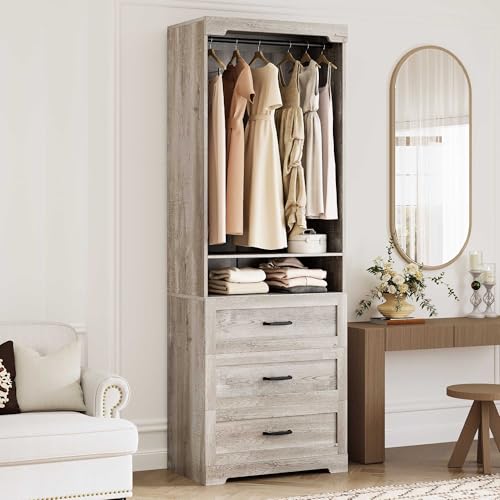 IRONCK Freestanding Closet System with Adjustable Shelves &23.6" W16.2 x 23.6 x 78.9 inches81.13 poundsCheck on Amazon
For most small bedrooms, a tall, narrow wardrobe with hanging space and shallow depth, or a modular system you can size to the wall, gives the most storage for the least floor area, while sliding doors suit rooms where swinging doors would hit the bed. The right choice depends mainly on door clearance, ceiling height and how much hanging versus folded storage you need, so measure before comparing styles.
Wardrobe Options at a Glance
| Type | Best for | Space notes | Limits |
|---|---|---|---|
| Modular system (for example IKEA PAX) | Custom fit, mixed hanging and shelves | Offered in several widths and heights; add interior fittings | Assembly takes time; frames need anchoring to the wall |
| Narrow single-door wardrobe | Alcoves, tiny rooms | Slim footprint; one door swing | Limited rail length |
| Sliding-door wardrobe | Tight bedrooms with little door clearance | No door swing | Only part of the interior is open at one time |
| Freestanding double wardrobe | Rooms with one clear wall | Classic hanging plus drawers | Needs door clearance of roughly the door width |
| Open clothing rail with shelves | Renters, fast access | Light and airy visually | Clothes stay visible and dusty |
| Wardrobe with mirrored doors | No wall space for a mirror | Doubles as a full-length mirror and brightens the room | Heavier doors; fingerprints |
Measure First: The Three Numbers That Decide Everything
- Depth. A standard hanging rail needs roughly 22 to 24 inches front to back for clothes on hangers to hang straight, and many makers list their depth explicitly. Shallow wardrobes of about 16 to 18 inches usually require clothes to hang sideways or use a turning rail. Check the maker’s stated interior depth, not only the exterior.
- Door clearance. Hinged doors need space equal to the door width to open fully. In a small room, sliding doors or folding doors may be the only way to avoid blocking the bed or walkway.
- Height. Tall wardrobes use vertical space well, but check ceiling height, baseboards and any sloping ceilings. Many flat-pack frames are assembled lying down and then stood upright, which needs extra clearance on installation day.
Also note the width of your stairwell, hallway and bedroom doorway. A large assembled wardrobe will not pass through a narrow stairway, and flat-pack boxes may be long and heavy.
HIGDBFE Tall Dresser 44''H with Hanging Rack, 4 Drawers Small Closet Dresser for Bedroom, Reversible Fabric Chest of Drawers with Clothes Rack, Tall Storage Tower, Sturdy Frame, White
Chosen because it specifies 4 Drawers Small Closet Dresser for Bedroom and Reversible Fabric Chest of Drawers with Clothes Rack.
View on Amazon
HIGDBFE Tall Dresser 44''H with Hanging Rack, 4 Drawers Small Closet Dresser for Bedroom, Reversible Fabric Chest of Drawers with Clothes Rack, Tall Storage Tower, Sturdy Frame, Rustic Brown
Chosen because it specifies 4 Drawers Small Closet Dresser for Bedroom and Reversible Fabric Chest of Drawers with Clothes Rack.
View on AmazonIRONCK Freestanding Closet System with Adjustable Shelves & 3 Drawers | Closet Organizer with Hanging Rod, Ideal for Bedrooms, Apartments and Small Closet Storage, 23.6" Rustic Maple
Chosen because it specifies Closet Organizer with Hanging Rod and Ideal for Bedrooms.
View on AmazonModular Systems: The Most Flexible Choice
Modular systems such as the IKEA PAX range let you choose frame widths, heights and doors, and then pick interior fittings: rails, shelves, drawers and pull-out trays. The maker publishes planner tools and lists frame sizes and door options on its site, so buyers can design a fit for an alcove or around a chimney breast. They are well suited to small bedrooms because every inch can be used, and you can start small and add units later. On the other hand, they take time to assemble, the maker’s instructions call for securing tall units to the wall, and quality varies by the board thickness of each tier. Reviewers frequently point out that the layout planning is the real work, so allow time for it.
Sliding Doors: The Small-Room Solution
Sliding wardrobes save the swing space that hinged doors need. They suit bedrooms where the wardrobe faces the bed within a few feet. The compromise is that you can only reach about half the interior at a time, and track mechanisms need occasional cleaning and light lubrication according to most manuals. Mirrored sliding doors are popular because they double as a full-length mirror and bounce light around a small room, but the glass makes them heavy, so wall fixing and installation instructions matter.
Narrow and Compact Wardrobes
If your alcove is only a couple of feet wide, a single-door wardrobe or a tall cabinet with a short hanging rail can still hold a surprising amount. Look for wardrobes that combine a short rail with shelves for folded items and a drawer or two at the base. Fabric wardrobes with a metal frame are the budget route and are light and easy to move, though they carry less weight and look less polished than rigid ones. They suit student rooms, temporary rentals and guest rooms.
Corner and Awkward Spaces
Where a wall is sloped or cut by a bulkhead, a low-height wardrobe or open rail often works better than a tall unit. Make sure doors and handles do not catch on skirting boards. If a standard wardrobe cannot fit your layout, built-in carpentry is the premium route; a mid-range alternative is a modular system with filler panels that close the gap neatly.
Materials and Safety Notes
- Particleboard or MDF with laminate: The most common budget and mid-range construction. Makers usually describe it as lightweight and wipe-clean, but it does not like standing water or damp walls.
- Solid wood or veneer: Better for heavy loads and long-term durability, with a higher weight and tier.
- Metal frames with fabric covers: Light and affordable; check the stated weight limit for the hanging rail.
- Wall anchoring: Tall furniture can tip, and child-safety groups advise anchoring wardrobes to the wall using the hardware the maker provides. Follow the manual, and use fixings suited to your wall type.
- Odours and care: New flat-pack furniture can have a faint smell at first; airing the room helps. Wipe surfaces with a slightly damp cloth, and avoid harsh solvents.
Budget Tiers
| Tier | Typical offering | Trade-off |
|---|---|---|
| Budget | Fabric-and-frame wardrobes, simple laminate flat-pack | Lower weight capacity, simpler finishes |
| Mid-range | Modular systems, sliding doors, mirrored fronts | More planning and assembly |
| Premium | Solid wood, fitted or made-to-measure units | Higher cost; longer lead times |
Pick X If… Decision Table
| Pick this | If your situation is… |
|---|---|
| Modular system | an alcove or unusual wall, and you want to tailor the interior |
| Sliding-door wardrobe | the bed sits close to the wardrobe wall |
| Single narrow wardrobe | there is only a small slice of free wall |
| Mirrored wardrobe | you lack wall space for a mirror and want the room to feel brighter |
| Open rail with shelves | you rent and want something that moves easily |
| Fabric wardrobe | you need a temporary or guest-room solution |
Alternatives to Consider
- Under-bed storage: Lidded boxes or a bed with drawers can take off-season knitwear and bedding, easing the load on the wardrobe.
- Over-door and wall hooks: Cheap ways to clear coats and bags from the interior.
- A tall chest of drawers: If most of your clothes are folded, a chest of drawers uses less depth than a hanging wardrobe.
Layout Tips for Small Rooms
Put the wardrobe on the wall that avoids blocking the window or door swing. Pale colours and mirrored surfaces visually enlarge the space. Use double-hanging rails for shirts and trousers, because many people have more short items than long coats. Store out-of-season items on the highest shelves or in under-bed boxes, and keep everyday items at eye level. Slim, matching hangers use less rail space, and a drawer insert or shelf divider keeps folded stacks from toppling.
Assembly, Delivery and Daily Use
Flat-pack wardrobes arrive in several heavy boxes. Confirm that you can carry them to the room, and plan assembly on a cleared floor with a second person for lifting the frame upright. Allow a few hours for a mid-size unit and read the instructions through before starting. Tighten fittings again after a few weeks, because new furniture can settle. If the wardrobe has mirrored or glass doors, handle them carefully and follow the maker’s guidance for fitting.
In daily use, small bedrooms work best when the wardrobe is easy to open without blocking the bed. Put the most-used items between waist and shoulder height. Add a slim pull-out belt or tie rack on the inside of the door where the maker offers it. Keep a clear zone in front of the doors so you are not squeezing past the bed. Review the contents each season: a wardrobe that holds only what you wear is more useful than a larger one packed to capacity.
Common Mistakes
- Ordering by width alone and forgetting door swing.
- Ignoring interior depth, then finding that hangers cannot turn.
- Not anchoring tall units to the wall.
- Choosing a unit too tall for a room with a low ceiling.
- Assuming the doorway and stairs will fit large flat-pack boxes.
Frequently Asked Questions
How deep does a wardrobe need to be?
For clothes to hang straight, roughly 22 to 24 inches of interior depth is a common guideline. Shallower wardrobes can work if the rail is turned sideways, which many makers offer. Always read the interior measurement, not only the outer one.
Are sliding doors better for small bedrooms?
They often are, because there is no door swing to clear. The compromise is that only part of the interior is open at one time, so they suit people who do not need to see everything at once.
Do I need to anchor a wardrobe to the wall?
Makers and child-safety organisations advise anchoring tall furniture to prevent tipping. Use the fixings supplied and choose ones that suit your wall material, or ask a qualified installer if you are unsure.
What is the best wardrobe for a rental?
Freestanding or fabric wardrobes and open rails are the easiest to remove without leaving marks. A modular system also works if you can anchor it with minimal wall damage and take it apart when you move.
Can a wardrobe be fitted into an alcove?
Yes. Modular systems are designed for this, and filler panels close small gaps. Measure the width at the top, middle and bottom, since walls are rarely perfectly straight.
How do I make a small wardrobe hold more?
Add a second hanging rail, use slim hangers, add stackable drawers or shelf dividers, and move bulky items to under-bed boxes. A well-organised small wardrobe often outperforms a larger one that is stuffed untidily.