Key takeaways
- Compatibility: Check your washer’s required diameter, M22 fitting size, and whether it uses quick-connect ends before ordering.
- Pressure rating: Choose a hose rated above your machine’s maximum PSI so routine surges do not push it to its limit.
- Length: A 50-foot hose suits most patios and driveways, while a 100-foot model reduces the need to reposition the washer.
- Construction: Steel-braided rubber or dual-braided designs favor durability; polyurethane jackets are often easier on painted surfaces and furniture.
- Handling: Look for kink resistance, swivel fittings, bend protectors, and a manageable weight if you will regularly clean stairs or outdoor seating.
What's inside
A pressure washer hose can make outdoor cleaning feel either smooth and controlled or needlessly frustrating. The wrong hose may kink beside the patio, fight you around furniture, leak at the couplers, or prove incompatible with your machine’s fittings. Length, flexibility, pressure rating, bend protection, and surface safety all matter—especially when you are moving between decks, garden paths, vehicles, and outdoor furniture.
This guide focuses on the practical details that matter in a home setting: hose handling, connection types, pressure headroom, temperature range, and storage. The selections include compact replacement hoses for electric washers as well as longer, heavy-duty options for larger cold-water machines.
As an Amazon Associate we earn from qualifying purchases.


How to Choose a Pressure Washer Hose (2026)
- Compatibility: Check your washer’s required diameter, M22 fitting size, and whether it uses quick-connect ends before ordering.
- Pressure rating: Choose a hose rated above your machine’s maximum PSI so routine surges do not push it to its limit.
- Length: A 50-foot hose suits most patios and driveways, while a 100-foot model reduces the need to reposition the washer.
- Construction: Steel-braided rubber or dual-braided designs favor durability; polyurethane jackets are often easier on painted surfaces and furniture.
- Handling: Look for kink resistance, swivel fittings, bend protectors, and a manageable weight if you will regularly clean stairs or outdoor seating.
The Best Pressure Washer Hoses (2026) Reviewed
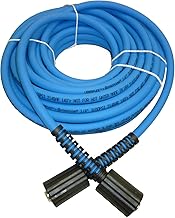
UBERFLEX Kink Resistant 50-Foot Hose
The UBERFLEX 1/4-inch hose is a strong all-purpose choice for homeowners who want easy handling without sacrificing a 3,100 PSI rating. Its kink-resistant construction is particularly useful when working around deck legs, planters, and patio furniture, while the included 22MM fittings simplify replacement on compatible machines.
YAMATIC 3/8-Inch 4,000 PSI Hose
YAMATIC’s 50-foot hose is built for users who want a more robust line, with steel-braided rubber construction and a 4,000 PSI rating. The 360-degree swivel quick connect can reduce twisting during long cleaning sessions, and its stated 15°F–212°F water range offers useful flexibility for demanding applications.
Flexzilla 50-Foot Replacement Hose
Flexzilla’s lightweight 1/4-inch hose is appealing when maneuverability matters more than maximum length or commercial-duty bulk. It is rated to 3,100 PSI, uses M22 fittings, and is designed to resist kinking—helpful for washing vehicles, cushions, railings, and smaller paved areas.
Simpson Monster 100-Foot Hose
For large properties, the Simpson Monster provides a generous 100 feet of reach and a substantial 4,500 PSI rating. Its dual-braided steel-over-polyester construction, polyurethane jacket, four-inch bend protectors, and 3/8-inch quick-connect fittings make it the heavy-duty pick, although its size and weight require more deliberate storage.
YAMATIC 50-Foot 3,200 PSI Hose
This YAMATIC model is a sensible replacement for many popular electric pressure washers, including compatible Ryobi, Greenworks, Troy-Bilt, and Craftsman units. Its 1/4-inch kink-resistant body and solid brass M22-14mm female fittings emphasize straightforward installation and everyday patio-cleaning convenience.
Frequently Asked Questions
Can I use any pressure washer hose with my machine?
No. The hose must match the machine’s connection style and fitting dimensions, as well as meet or exceed its pressure rating. Confirm the washer’s manual or the original hose specifications before buying.
Is a 1/4-inch or 3/8-inch hose better?
A 1/4-inch hose is typically lighter and well suited to many electric pressure washers. A 3/8-inch hose generally favors higher-flow, heavier-duty machines, but it can be bulkier and may not connect directly to compact equipment.
Does a longer hose reduce pressure?
Some pressure loss can occur as hose length increases, particularly with smaller diameters or high-flow machines. In practice, choosing the correct diameter and avoiding unnecessary extra length usually keeps performance consistent.
How should I store a pressure washer hose?
Drain it, release trapped pressure, and coil it in broad loops rather than tight circles. Keep it shaded and away from sharp edges, fuel, and prolonged contact with hot surfaces to protect the jacket and fittings.
Final Thoughts
The UBERFLEX is a well-rounded choice for flexible everyday cleaning, while the Simpson Monster is better suited to large properties and demanding machines. For a lightweight replacement on a compatible electric washer, Flexzilla remains an especially practical option.