Key takeaways
- Compatibility: Confirm the exact blade length, width, and loop configuration recommended by your saw manufacturer before ordering.
- Tooth pitch: A 4 TPI blade clears chips quickly in thicker stock, while 6 TPI or finer teeth can produce a cleaner finish in thinner boards.
- Blade width: Wider blades track more confidently for straight resawing; narrow blades turn tighter for curves and furniture details.
- Tooth construction: Hardened or heat-treated teeth generally last longer in abrasive lumber, reclaimed boards, and outdoor project materials.
- Material and thickness: Match the blade to the wood you cut most often, allowing at least a few teeth to remain engaged in the workpiece during cutting.
What's inside
Choosing a band saw blade for furniture work is less straightforward than it looks. Length, width, tooth pitch, kerf, and saw compatibility all need to line up, while the best choice also depends on whether you are resawing boards, cutting curves, or breaking down rough stock. A blade that feels excellent on pine may struggle in dense hardwood or leave an unnecessarily rough edge.
This guide compares dependable options for home workshops, compact benchtop saws, full-size 14-inch machines, and even small sawmill setups. The recommendations focus on tooth design, practical cutting behavior, fit, and the kind of outdoor-living and furniture projects each blade suits best.
As an Amazon Associate we earn from qualifying purchases.



How to Choose a/an Band Saw Blades For Wood (2026)
- Compatibility: Confirm the exact blade length, width, and loop configuration recommended by your saw manufacturer before ordering.
- Tooth pitch: A 4 TPI blade clears chips quickly in thicker stock, while 6 TPI or finer teeth can produce a cleaner finish in thinner boards.
- Blade width: Wider blades track more confidently for straight resawing; narrow blades turn tighter for curves and furniture details.
- Tooth construction: Hardened or heat-treated teeth generally last longer in abrasive lumber, reclaimed boards, and outdoor project materials.
- Material and thickness: Match the blade to the wood you cut most often, allowing at least a few teeth to remain engaged in the workpiece during cutting.
The Best Band Saw Blades For Wood (2026)s Reviewed
AYAO 70-1/2-Inch 4 TPI Blade
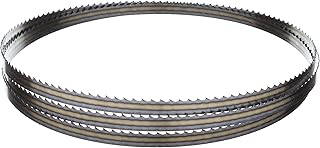
The AYAO Bandsaw Blade 70-1/2 Inch X 1/2 Inch X 4TPI is a practical match for several popular 10-inch saws, including the Craftsman 921400 and Rikon 10-305 and 10-3061. Its hardened teeth and coarse pitch make it well suited to general furniture stock, small beams, and outdoor projects where fast, controlled cuts matter more than a polished edge straight from the saw.
Timber Wolf 72-Inch 4 TPI Blade
The Timber Wolf Bandsaw Blade 1/2" x 72", 4 TPI is a sensible choice for saws using a 72-inch loop. The half-inch width offers a useful middle ground: stable enough for straight cuts through boards, yet flexible enough for moderate curves in table legs, shelf brackets, and garden furniture components.
Timber Wolf 70-1/2-Inch 4 TPI Blade
The Timber Wolf 70 1/2" x 1/2" x 4 tpi Band Saw Blade is aimed at compact machines that require the shorter 70-1/2-inch size. Its coarse tooth pattern is particularly helpful when cutting thicker hardwood or greenish, resinous stock, where fine blades can clog more readily and make the saw work harder.
BOSCH BS80-6H 80-Inch Blade
The BOSCH BS80-6H 80 In. 6 TPI Heavy-Duty Stationary Band Saw Blade is a strong option for compatible stationary saws and general wood applications. Its 6 TPI layout favors a smoother cut than a coarse 4 TPI blade, making it a good fit for joinery preparation, furniture parts, and boards that will receive minimal cleanup.
158-Inch DoubleHard Sawmill Blades
The 158" Sawmill Bandsaw Blades 5-Pack – DoubleHard 10° All-Purpose Sawing is designed for a very different scale of work than ordinary shop blades. This multi-pack makes sense for compact sawmill owners processing logs or rough slabs, especially where durable, all-purpose performance and having replacement blades ready are more important than tight-radius cutting.
Frequently Asked Questions
What TPI is best for cutting wood on a band saw?
For thicker furniture boards and general stock removal, 3 to 4 TPI is often the most versatile range. Choose a finer 6 TPI blade for thinner material or when you want a cleaner cut with less aggressive chip removal.
Can one band saw blade cut both hardwood and softwood?
Yes. A quality general-purpose blade can handle both, although feed pressure should be adjusted to the species and thickness. Dense hardwood benefits from patient feeding, while softwood may permit faster cutting but can produce more resin buildup.
Is a wider blade always better for furniture making?
No. Wider blades track well during straight resawing, but they are less suitable for tight curves. Use the widest blade that comfortably handles the cut, and switch to a narrower blade for shapes, scrollwork, and curved chair or cabinet parts.
How often should a band saw blade be replaced?
Replace it when cuts begin wandering despite correct tension and guides, when excessive force is needed, or when teeth are visibly damaged or dull. Cutting reclaimed wood, bark-covered lumber, or dirty outdoor stock can shorten blade life considerably.
Final Thoughts
For compact 10-inch saws, the AYAO 70-1/2-inch blade is a practical starting point, while the Timber Wolf 72-inch and 70-1/2-inch options are dependable general-purpose choices when their lengths match your machine. For smoother cuts on a compatible stationary saw, the BOSCH BS80-6H is worth considering; serious log and slab work calls for the 158-inch DoubleHard sawmill pack.