Key takeaways
- Blade length: Confirm the exact length specified by your saw; even a well-reviewed blade is unsuitable if it cannot be tensioned correctly.
- Width: Choose the widest blade your guides and wheels can safely accommodate for straighter resaw cuts, while using a narrower option for curves.
- Tooth count: Lower TPI clears sawdust quickly in thick stock, while higher TPI produces a finer finish in thinner material. For general resawing, around 3–6 TPI is a useful starting range.
- Tooth pattern: Hook teeth cut aggressively, raker patterns offer balanced performance, and wavy sets can reduce binding in thinner or variable-density boards.
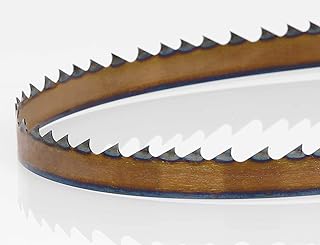
- Blade material: Bimetal blades handle demanding hardwood work and hold their edge well; hardened carbon-steel blades can be economical for occasional furniture projects and softer woods.
What's inside
Resawing turns a thick board into book-matched panels, thin veneers, and useful stock for outdoor tables or built-in furniture—but the blade often determines whether that promise becomes clean lumber or a wandering, overheated cut. Buyers face a confusing mix of tooth counts, widths, steel types, and machine-specific lengths, with specifications that are easy to misread.
This guide focuses on blades suited to practical furniture work, especially when processing hardwood, reclaimed boards, and wider softwood slabs. We look at tooth geometry, blade tension, tracking, and the realities of shop saws so you can match a blade to your machine and cutting style rather than simply choosing the most aggressive option.
As an Amazon Associate we earn from qualifying purchases.


How to Choose a Band Saw Blades For Resawing (2026)
- Blade length: Confirm the exact length specified by your saw; even a well-reviewed blade is unsuitable if it cannot be tensioned correctly.
- Width: Choose the widest blade your guides and wheels can safely accommodate for straighter resaw cuts, while using a narrower option for curves.
- Tooth count: Lower TPI clears sawdust quickly in thick stock, while higher TPI produces a finer finish in thinner material. For general resawing, around 3–6 TPI is a useful starting range.
- Tooth pattern: Hook teeth cut aggressively, raker patterns offer balanced performance, and wavy sets can reduce binding in thinner or variable-density boards.
- Blade material: Bimetal blades handle demanding hardwood work and hold their edge well; hardened carbon-steel blades can be economical for occasional furniture projects and softer woods.
The Best Band Saw Blades For Resawing (2026)s Reviewed
Lenox Classic Tuff Tooth Vari-Raker
The Lenox Classic Tuff Tooth Vari-Raker is a dependable bimetal choice for medium-thickness furniture stock. Its 3/4-inch width and 10–14 TPI range favor controlled cuts and a relatively refined surface, making it appealing when preparing boards for glue-ups or outdoor seating components. Check that your saw accepts its 93-inch length before ordering.
Lenox Classic Pro Vari-Raker
With a 1-inch width and 5–8 TPI configuration, the Lenox Classic Pro Vari-Raker is the strongest fit here for substantial resawing on a larger machine. The broader blade helps resist wandering through tall boards, while its bimetal construction is well suited to repeated cuts in dense hardwood and reclaimed timber.
Lenox Diemaster 2 Hook Tooth
The 6 TPI hook-tooth Lenox Diemaster 2 is built for fast stock removal and carries a generous 154-inch length. It is best considered for large saws with adequate throat capacity and robust blade guides; on a properly tuned machine, its positive rake can make long cuts feel notably more efficient.
Lenox Diemaster 2 Wavy Set
This 14–18 TPI Diemaster 2 uses a wavy tooth set and a slimmer 0.025-inch thickness, giving it a more delicate cutting profile than the heavier resaw options. It is better suited to thinner boards, detail work, or situations where reduced kerf and a smoother cut matter more than maximum feed speed.
AYAO 70-1/2-Inch Hardened-Tooth Blade
The AYAO 70-1/2-inch blade is a practical match for select 10-inch machines, including compatible Craftsman and Rikon models. Its 4 TPI teeth are appropriately open for clearing chips from thicker softwood and modest hardwood cuts, making it a sensible budget-oriented option for home furniture builders who have verified the saw fit.
Frequently Asked Questions
What TPI is best for resawing?
A lower tooth count, commonly 3–6 TPI, is usually best for thick boards because the deep gullets remove sawdust efficiently. Higher-TPI blades can work well on thinner stock but may clog or heat up during deep cuts.
Is a wider blade always better for resawing?
No. A wide blade generally tracks more steadily, but only if your saw can tension and guide it correctly. Use the widest suitable blade your machine supports, and reserve narrower blades for curved cuts or smaller workpieces.
Should I choose a hook-tooth or raker blade?
Hook teeth tend to feed aggressively and clear chips quickly, which is useful in thick material. Raker patterns are more balanced and forgiving for general furniture work, particularly when boards vary in density or contain occasional knots.
How can I get straighter resaw cuts?
Start with a sharp, correctly sized blade, then tune tracking, guide bearing position, and tension according to the saw manufacturer’s instructions. Flatten one face and joint one edge first, use a stable fence, and let the blade cut without forcing the workpiece.
Final Thoughts
For serious, wide-board work, the Lenox Classic Pro Vari-Raker is the standout choice when your saw supports its 1-inch width. The Lenox Classic Tuff Tooth Vari-Raker offers a more versatile profile for medium stock, while the AYAO 70-1/2-inch blade is a practical pick for compatible compact saws and occasional home projects.