Key takeaways
- Blade diameter: Match the blade to your saw’s specification. A 10-inch blade belongs on a 10-inch saw, while a 12-inch model requires a compatible 12-inch miter saw and the correct arbor size.
- Tooth count: Lower tooth counts remove material quickly for framing and rough stock. Higher counts produce smoother crosscuts, making them better for furniture parts, molding, shelving, and visible edges.
- Tooth design: Carbide-tipped teeth generally hold an edge longer than basic steel teeth. Look for a configuration suited to crosscutting rather than assuming that the highest tooth count is always best.
- Kerf and stability: A thin-kerf blade can reduce waste and place less demand on a compact saw, while a heavier blade may feel steadier in dense material. Confirm that the blade is approved for your saw’s speed.
- Project conditions: Outdoor lumber may contain knots, grit, staples, or hidden fasteners. Keep a durable general-purpose blade for rough work and reserve a fine-finish blade for clean, final cuts.
What's inside
Best Saw Blades For Miter Saws (2026) is a practical guide for choosing cleaner, safer cuts when building furniture, repairing a deck, or trimming outdoor projects. The wrong blade can leave torn crosscuts, rough edges, excess noise, and frustrating rework—especially when switching between framing lumber and finished hardwood.
This roundup focuses on tooth count, cut quality, material, and everyday versatility. From economical multi-packs to ultra-fine finishing blades, these options suit different workshop priorities, whether you are cutting pressure-treated boards outdoors or fitting precise trim in a home furniture project.
As an Amazon Associate we earn from qualifying purchases.


How to Choose a/an Saw Blades For Miter Saws (2026)
- Blade diameter: Match the blade to your saw’s specification. A 10-inch blade belongs on a 10-inch saw, while a 12-inch model requires a compatible 12-inch miter saw and the correct arbor size.
- Tooth count: Lower tooth counts remove material quickly for framing and rough stock. Higher counts produce smoother crosscuts, making them better for furniture parts, molding, shelving, and visible edges.
- Tooth design: Carbide-tipped teeth generally hold an edge longer than basic steel teeth. Look for a configuration suited to crosscutting rather than assuming that the highest tooth count is always best.
- Kerf and stability: A thin-kerf blade can reduce waste and place less demand on a compact saw, while a heavier blade may feel steadier in dense material. Confirm that the blade is approved for your saw’s speed.
- Project conditions: Outdoor lumber may contain knots, grit, staples, or hidden fasteners. Keep a durable general-purpose blade for rough work and reserve a fine-finish blade for clean, final cuts.
The Best Saw Blades For Miter Saws (2026)s Reviewed
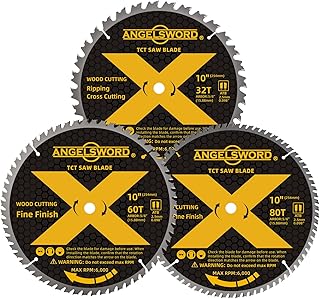
10-Inch 3-Pack, 32T/60T/80T
This three-blade set is a useful starting point for homeowners who move between framing, general woodworking, and finished trim. The 32-tooth blade is suited to faster rough cuts, while the 60-tooth and 80-tooth options let you step up the finish quality when an edge will remain visible.
WEN BL1080 10-Inch 80-Tooth Blade
The WEN BL1080 is aimed at clean, detailed work such as cabinet components, furniture edging, and decorative trim. Its 80-tooth layout favors a smooth finish over speed, so it is best used with properly supported stock and a controlled feed rather than heavy construction lumber.
WEN BL1280 12-Inch 80-Tooth Blade
For compatible 12-inch miter saws, the BL1280 brings a fine-finish tooth count to larger boards and longer crosscuts. It is a sensible choice for users who need polished results from a full-size saw, although the extra diameter means buyers must verify arbor, guard, and saw compatibility before ordering.
WEN BL1060 10-Inch 60-Tooth Blade
The BL1060 occupies the practical middle ground between aggressive cutting and presentation-quality results. Its 60-tooth format is well suited to everyday furniture work, shelving, trim, and many outdoor projects where a reasonably clean cut matters but maximum refinement is unnecessary.
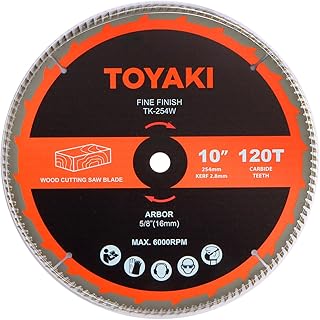
10-Inch 120-Tooth Fine-Finish Blade
A 120-tooth blade is designed for exceptionally smooth cuts in suitable wood and sheet goods, making it attractive for delicate trim and final-fit furniture parts. It is not the fastest option for thick stock, and its fine tooth pattern should be kept away from dirty reclaimed boards, embedded grit, and rough framing tasks.
Frequently Asked Questions
What tooth count is best for a miter saw?
For general crosscutting, 40 to 60 teeth is a versatile range. Choose fewer teeth for fast cuts in construction lumber and more teeth—typically 80 or above—when the cut edge will be highly visible.
Can a miter saw blade be used on a table saw?
Only if the blade is labeled and rated for that application and its diameter, arbor, and maximum speed match the table saw. Always follow the saw and blade manufacturers’ instructions rather than relying on appearance alone.
Is a higher tooth count always better?
No. Higher tooth counts can improve finish quality, but they generally cut more slowly and may struggle in thick or rough material. A clean, properly supported workpiece and the right feed rate matter just as much.
How often should a miter saw blade be replaced?
Replace or professionally sharpen a blade when cuts become rough, burning increases, the saw requires unusual pressure, or teeth are damaged. Outdoor work can shorten blade life because dirt, fasteners, and treated lumber are especially hard on cutting edges.
Final Thoughts
For broad household coverage, the 10-inch 3-pack offers useful tooth-count flexibility. The WEN BL1060 is a strong everyday choice for balanced cuts, while the WEN BL1080 or 120-tooth blade is better suited to highly visible finishing work. If you own a compatible 12-inch saw, the WEN BL1280 provides the larger format needed for substantial furniture and outdoor boards.