Key takeaways
- Use a larger, slower fan for broad patios and a compact model for a small porch or gazebo.
- Verify wet or damp certification before installation; “weather-resistant” wording alone is not a substitute.
- Choose a fan with a light only if its illumination pattern suits the space and existing fixtures.
- Clean blades and housings periodically, and check fasteners when seasonal vibration or wind is common.
What's inside
An outdoor ceiling fan does more than move warm air. The right model can make a covered patio, porch, garage, or gazebo feel noticeably more comfortable while helping prevent stagnant air and reducing reliance on cooling equipment. The wrong one, however, may be too small for the space, unsuitable for moisture exposure, noisy at higher speeds, or difficult to install safely.
This guide explains how to choose an outdoor ceiling fan in 2026, from wet and damp ratings to airflow, blade size, controls, lighting, and mounting height. It also compares practical options for large entertaining areas, compact porches, and spaces where a light or smart control matters as much as ventilation.
As an Amazon Associate we earn from qualifying purchases at no extra cost to you. Product prices and availability are accurate as of the date shown and are subject to change.




🛒 Best Price Today on Amazon
Prime members get fast, free shipping on everything above, plus member-only deals. New members get a 30-day free trial — cancel anytime.
Choose the Right Outdoor Rating
Start with the fan’s location, not its appearance. A wet-rated fan is designed to tolerate direct exposure to rain and splashing, making it the safer choice for open porches and uncovered outdoor areas. A damp-rated fan is intended for protected locations such as covered patios, screened porches, and garages where moisture is present but water does not directly hit the motor and electrical components.
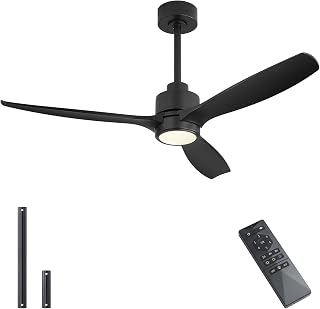
Do not assume that “outdoor” in a product title tells the whole story. Check the manufacturer’s rating and installation instructions. For example, the WINGBO 48-inch fan combines outdoor suitability with a light, while the 65 Inch Outdoor Black Ceiling Fan is aimed at larger covered areas and includes smart-control features. Neither should be installed in a location beyond its certified exposure rating.
Match Blade Span to the Space
Blade span affects both the area a fan can serve and how much visual and physical space it occupies. A 42- to 48-inch fan is often appropriate for a smaller porch, bedroom, or compact sitting area. Fans around 52 to 60 inches suit many patios and medium-sized rooms. Extra-large models, such as the Minislak 72 Inch or Ohniyou 60-inch Industrial fan, are better suited to expansive patios, garages, workshops, and open-plan entertaining areas.
Airflow is just as important as diameter. Look for the published CFM figure—the volume of air the fan moves per minute—rather than judging performance by blade count alone. A large fan running slowly can distribute air more comfortably and quietly than a small fan running at full speed. Leave adequate clearance from walls, beams, lights, and nearby furniture, and follow the specified minimum blade height.
Decide Whether You Need a Light
A fan without a light is often the cleanest choice when the patio already has sconces, recessed lighting, or pendant fixtures. It can also simplify the design in a garage or workshop. The Minislak 72 Inch and Ohniyou 60-inch models are useful examples of no-light fans designed to focus on air movement.
If the fan will be the main fixture above an outdoor table or seating area, integrated lighting may be more practical. Look for dimming and adjustable color temperature rather than brightness alone. The WINGBO offers three color-temperature settings, while the 65-inch smart fan combines illumination with app, remote, and Alexa control. For a smaller, flexible installation, the addlon 20-inch caged fan uses a hanging-hook design and built-in light, making it particularly suitable for gazebos and compact covered spaces.
Compare Motors, Controls, and Noise
DC motors are common in current outdoor fans because they typically offer efficient operation, multiple speed settings, and quieter performance than older motor designs. Reversible operation is valuable too: downdraft mode helps create a cooling breeze in warm weather, while reverse mode can help circulate warm air in cooler months where the installation allows it.
Remote controls are convenient when the fan is mounted high, but app and voice controls can be useful when the fan is part of a connected home. The Ohniyou includes remote and app control, and the 65-inch model adds Alexa compatibility. Choose based on how you actually use the space; a straightforward remote may be more dependable than a smart feature set that requires a strong wireless signal outdoors.
Noise claims should be treated as a guide rather than a guarantee. A stated 35dB motor, as listed for the Ohniyou, suggests quiet operation under particular testing conditions. Installation quality, ceiling movement, blade balance, and the selected speed also affect perceived noise.
Plan the Installation Carefully
Outdoor fans need a properly rated electrical box and secure support. A standard light-fixture box may not be strong enough for a ceiling fan’s weight and movement. If the ceiling is high, a compatible downrod can improve air circulation and make the fan easier to service, while low ceilings may require a flush-mount design.
Measure before buying: record ceiling height, the available mounting surface, the distance to walls, and the position of existing wiring. For sloped ceilings, confirm that the included hardware can accommodate the angle. Electrical connections should be completed by a qualified professional when required by local code, especially in damp or wet locations.
Tips
- Use a larger, slower fan for broad patios and a compact model for a small porch or gazebo.
- Verify wet or damp certification before installation; “weather-resistant” wording alone is not a substitute.
- Choose a fan with a light only if its illumination pattern suits the space and existing fixtures.
- Clean blades and housings periodically, and check fasteners when seasonal vibration or wind is common.
Frequently Asked Questions
What size ceiling fan is best for an outdoor patio?
Many medium patios work well with a 52- to 60-inch fan, while small porches may need 42 to 48 inches. Large, open areas can benefit from a 65- or 72-inch model, provided the ceiling structure and clearances support it.
Can I install a damp-rated fan in an uncovered area?
Usually not. Damp-rated products are intended for protected locations. An uncovered area exposed to rain generally calls for a wet-rated fan specifically approved for direct moisture exposure.
Are outdoor ceiling fans useful in winter?
Yes, if the motor has a reverse setting and the fan is installed according to the manufacturer’s instructions. Reverse operation can circulate warmer air that collects near the ceiling, though it will not replace a heating system.
Is a DC motor worth choosing?
For many installations, yes. DC motors commonly provide quiet operation, efficient power use, several speed options, and convenient reversing. They can cost more initially, so weigh those benefits against how often the fan will run.
Conclusion
The best outdoor ceiling fan is the one correctly matched to exposure, room size, airflow needs, mounting conditions, and control preferences. Large spaces may call for the Minislak or Ohniyou, while the WINGBO and 65-inch smart model add useful lighting. For compact sheltered areas, the addlon is practical, and the 52-inch addlon wood-blade design offers a quieter, more traditional look. Confirm the safety rating and installation requirements first; style and features come second.