Key takeaways
- Tooth count: Choose 24–40 teeth for faster ripping and 60–80 teeth for smoother crosscuts, plywood, laminates, and visible furniture edges.
- Tooth geometry: ATB teeth are versatile for general woodworking, while a more aggressive ripping profile can clear hardwood sawdust more efficiently along the grain.
- Carbide quality: Carbide-tipped teeth generally stay useful longer than basic steel teeth and can tolerate the demanding work of dense hardwoods.
- Blade diameter and arbor: Match the blade diameter, arbor hole, and saw’s maximum specifications exactly. A 10-inch blade is not interchangeable with an 8-1/4-inch model.
- Project conditions: For outdoor furniture, prioritize a clean, controlled cut that reduces sanding and splinter repair, but keep a faster ripping blade available for breaking down thick stock.
What's inside
Hardwood can expose a mediocre table-saw blade in a single cut. Dull carbide, the wrong tooth count, excessive vibration, or a poor match between blade and task can leave burn marks, chipped edges, and frustratingly rough joinery—especially when building outdoor furniture from dense oak, teak, maple, or other weather-resistant stock.
This guide focuses on the practical details that matter in a home workshop: tooth geometry, finish quality, ripping performance, arbor compatibility, and how each blade suits furniture projects ranging from patio benches to hardwood dining tables. The goal is not simply the finest-looking cut, but a blade that behaves predictably through long boards and repeated shop sessions.
As an Amazon Associate we earn from qualifying purchases.


How to Choose a/an Table Saw Blades For Hardwood (2026)
- Tooth count: Choose 24–40 teeth for faster ripping and 60–80 teeth for smoother crosscuts, plywood, laminates, and visible furniture edges.
- Tooth geometry: ATB teeth are versatile for general woodworking, while a more aggressive ripping profile can clear hardwood sawdust more efficiently along the grain.
- Carbide quality: Carbide-tipped teeth generally stay useful longer than basic steel teeth and can tolerate the demanding work of dense hardwoods.
- Blade diameter and arbor: Match the blade diameter, arbor hole, and saw’s maximum specifications exactly. A 10-inch blade is not interchangeable with an 8-1/4-inch model.
- Project conditions: For outdoor furniture, prioritize a clean, controlled cut that reduces sanding and splinter repair, but keep a faster ripping blade available for breaking down thick stock.
The Best Table Saw Blades For Hardwood (2026)s Reviewed
FOXBC 10-Inch 80-Tooth Ultra-Finish Blade
The FOXBC is aimed at furniture makers who care more about a clean edge than maximum feed speed. Its 80-tooth layout is well suited to crosscutting hardwood parts, trimming rails and stiles, and preparing exposed edges that will receive stain or clear finish. It is especially appealing for patio furniture where sanding every component can quickly become the slowest stage of the build.
WEN BL1080 10-Inch 80-Tooth Carbide Blade
WEN’s BL1080 is a practical ultra-fine-finish option for a table saw or miter saw. The carbide-tipped construction and high tooth count make it a sensible choice for clean crosscuts in hardwood, plywood, and trim stock. It favors patience over aggressive stock removal, so use a dedicated ripping blade when dimensioning wide boards.
KENDO 10-Inch 40T/60T Blade Set
The KENDO two-pack offers useful flexibility for a home workshop: the 40-tooth blade is better suited to ripping, while the 60-tooth blade is designed for smoother work in plywood, MDF, laminate, and general furniture parts. For outdoor-living projects, that split lets you move from rough board breakdown to cleaner assembly cuts without buying two unrelated blade systems. It is a strong value-oriented choice for beginners building a versatile setup.
8-1/4-Inch 80-Tooth Ultra-Fine Finish Blade
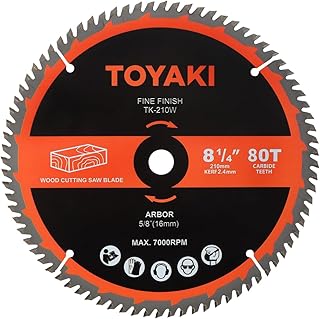
This compact 80-tooth blade is designed for saws that accept an 8-1/4-inch diameter, including compatible table and circular saws. Its fine tooth pattern makes sense for smaller hardwood components, shelving, and furniture trim where edge quality matters. Confirm your saw’s arbor and maximum blade specifications before buying, since the reduced diameter is intended for specific machines rather than as a universal replacement.
SawWorks 12-Inch 60T ATB Carbide Blade
The SawWorks 12-inch blade is built for larger cabinet-shop table saws and miter saws using a 1-inch arbor. Its 60-tooth ATB arrangement balances a clean finish with more practical material removal than an 80-tooth blade, making it a good fit for substantial hardwood furniture and wide stock. The larger format is only an advantage when your equipment is designed for it; never adapt a blade beyond the saw manufacturer’s specifications.
Frequently Asked Questions
What tooth count is best for hardwood?
There is no single best count for every cut. A 40-tooth blade is a useful general-purpose choice for ripping and moderate-finish work, while 60–80 teeth usually produce cleaner crosscuts and more polished edges in hardwood furniture.
Can I use a table-saw blade on a miter saw?
Many woodworking blades are marketed for both machines, but compatibility still depends on diameter, arbor size, kerf, and the tool manufacturer’s limits. Check the blade label and your saw manual before installation.
Why does my hardwood cut burn?
Burning can result from a dull blade, a misaligned fence, a slow feed, or forcing stock against a blade that is not clearing material efficiently. Clean the blade, verify alignment, and use a lower-tooth-count ripping blade for long grain cuts.
Is an 80-tooth blade suitable for ripping?
It can make the cut, but it is usually not the most efficient option. The dense tooth spacing removes less waste per revolution and may increase heat; reserve it for finish cuts and use a ripping-oriented blade for long cuts along the grain.
Final Thoughts
For the cleanest furniture edges, the FOXBC 80-tooth and WEN BL1080 are compelling finish-cut choices, while the KENDO set offers the most useful flexibility for a mixed home workshop. If you run larger professional-style equipment, the SawWorks 12-inch blade provides a sensible balance of finish and capacity for demanding hardwood projects.