Key takeaways
- Tooth count: Stick to 24 teeth for ripping stock over 3/4 inch. Fewer teeth means larger gullets, and larger gullets carry sawdust out of the cut instead of packing it in and cooking the board.
- Kerf width: Thin kerf (roughly 0.094 inch) reduces the load on contractor and jobsite saws considerably. If you’re running a cabinet saw with 3 HP or more, a full kerf blade will track straighter through tall, dense stock.
- Grind geometry: Flat top (FTG) teeth leave a square-bottomed cut, which matters for tenons and grooves. ATB grinds shear the fibers a little cleaner along the face, so they’re the friendlier choice on figured hardwoods.
- Plate quality: Look for tensioned, laser-cut plates with expansion slots. A warped plate will wander no matter how sharp the carbide is, and heat buildup in oak will expose that flaw quickly.
- Arbor and saw match: Nearly every 10-inch North American saw uses a 5/8-inch arbor, but confirm your saw’s maximum blade capacity and check that riving knife alignment matches your chosen kerf.
What's inside
Ripping hardwood is where a table saw earns its keep, and it’s also where the wrong blade shows its weakness fastest. Anyone who has fed a length of white oak through a 60-tooth combination blade knows the symptoms: the motor bogs down mid-cut, the offcut comes out with burn marks along the edge, and the whole board wants to creep away from the fence. Denser species like hard maple, hickory, and ipe make it worse. Those cuts generate heat, and heat is what turns a promising board into a piece you have to joint twice before it’s usable.
The fix is almost always fewer teeth and better gullets. A dedicated ripping blade clears chips instead of grinding them, which keeps the cut cool and the feed rate honest. As someone who spends most of the year building outdoor tables, slatted benches, and pergola components out of thick stock, I lean on ripping blades constantly, and the difference in glue-joint quality is not subtle. Below you’ll find the blades I keep in rotation, plus a straightforward look at kerf, tooth geometry, and when a high-tooth-count blade actually belongs in your saw.
As an Amazon Associate we earn from qualifying purchases.



How to Choose a 10 Table Saw Blade For Ripping Hardwood (2026)
- Tooth count: Stick to 24 teeth for ripping stock over 3/4 inch. Fewer teeth means larger gullets, and larger gullets carry sawdust out of the cut instead of packing it in and cooking the board.
- Kerf width: Thin kerf (roughly 0.094 inch) reduces the load on contractor and jobsite saws considerably. If you’re running a cabinet saw with 3 HP or more, a full kerf blade will track straighter through tall, dense stock.
- Grind geometry: Flat top (FTG) teeth leave a square-bottomed cut, which matters for tenons and grooves. ATB grinds shear the fibers a little cleaner along the face, so they’re the friendlier choice on figured hardwoods.
- Plate quality: Look for tensioned, laser-cut plates with expansion slots. A warped plate will wander no matter how sharp the carbide is, and heat buildup in oak will expose that flaw quickly.
- Arbor and saw match: Nearly every 10-inch North American saw uses a 5/8-inch arbor, but confirm your saw’s maximum blade capacity and check that riving knife alignment matches your chosen kerf.
The Best 10 Table Saw Blade For Ripping Hardwood (2026)s Reviewed
Freud LM75R010 Glue Line Ripping Blade
This is the blade I reach for when a tabletop needs edge joints that go together without a jointer pass. The glue-line grind produces a surface smooth enough to clamp straight from the saw, and the thin kerf keeps a 1.75 HP saw from complaining through 8/4 walnut.
CMT 250.024.10 ITK XTreme Ripping Blade
CMT’s ATB grind gives it an edge on figured and tearout-prone hardwoods where flat-top teeth can leave fuzz along the top face. The anti-vibration slots and PTFE coating do real work on long rips, and pitch wipes off easily at the end of a session.
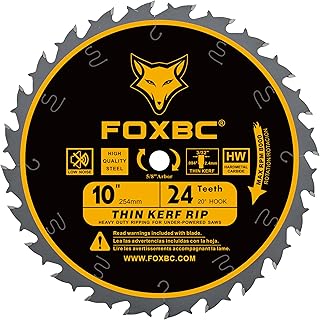
FOXBC 10-Inch 24-Tooth Flat Tooth Ripping Blade
A genuinely strong value blade with proper flat-top geometry, which makes it useful for both ripping and cutting flat-bottomed grooves. Sharpness holds up well through construction lumber and moderate hardwoods, though I’d rotate to a premium blade for critical glue joints.
10-Inch 24T Carbide Ripping Blade with 5/8-Inch Arbor
A sensible thin-kerf workhorse for shops that burn through a lot of rough stock and don’t want to dull an expensive blade doing it. It handles hardwood, softwood, and plywood competently, and the low price makes it easy to keep a spare on the wall.
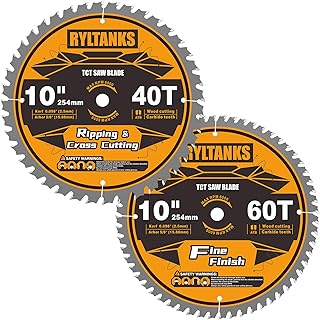
10-Inch 40T and 60T Blade 2-Pack
Not a dedicated ripping setup, but a practical pairing if your saw does double duty for crosscutting and sheet goods. The 40-tooth blade handles light rips in thinner hardwood, and the 60-tooth handles finish cuts in plywood without chipping the veneer.
Frequently Asked Questions
Why does my hardwood burn even with a sharp blade?
Burning usually points to feed rate, fence alignment, or internal tension in the board rather than dull carbide. Feed steadily, check that your fence is parallel to the blade, and use a riving knife or splitter to keep the kerf from closing.
Can one blade handle ripping and crosscutting?
A 40- to 50-tooth combination blade covers both acceptably, but it compromises on each. If you regularly rip hardwood thicker than an inch, a 24-tooth ripper will save you time, motor strain, and cleanup work.
Is a high-tooth-count blade ever right for hardwood?
Yes, for crosscuts and finish work. An 80-tooth blade like the FOXBC ultra-finish leaves a nearly polished edge on miters and plywood, but it will overheat immediately if you try to rip solid stock with it.
How often should ripping blades be sharpened?
Watch performance rather than the calendar. When you notice increased feed resistance, scorching on clean stock, or a rougher cut surface, send it out for sharpening. Quality carbide typically survives several sharpenings.
Final Thoughts
For furniture-grade joints and outdoor dining tables that need to stay flat through humidity swings, the Freud LM75R010 remains the benchmark, and the CMT ITK XTreme is the better pick if you work with figured hardwoods. If you’re outfitting a shop on a budget, start with the FOXBC 24-tooth flat tooth blade and upgrade once your projects demand it.