Key takeaways
- Match sweep to table, not room: Aim for a blade span roughly equal to your table’s width, keeping tips at least 18 inches clear of walls. A 20 to 30 inch fan handles a four-seat table; 42 to 52 inches suits a long farmhouse plank or an open-plan dining zone.
- Respect the 7-foot rule: Blades must clear the floor by seven feet minimum. On eight-foot ceilings that leaves almost no room for a downrod, which is why flush-mount and low-profile fandeliers dominate this category.
- Prioritize DC motors and six-plus speeds: A DC motor sips power and, more importantly, delivers usable low speeds. Speed one should be a whisper you feel but never hear over conversation.
- Choose tunable, dimmable light: A 3000K to 6500K range lets you run warm and low for dinner, then bright and neutral for homework or bill-paying at the same table. Fixed 5000K light makes a beautiful roast look clinical.
- Decide how visible you want blades: Retractable and caged designs read as light fixtures at rest, which matters in formal dining rooms. Exposed farmhouse blades broadcast “fan,” and that is fine if airflow is your priority.
What's inside
Spend enough seasons rigging fans over porches, pergolas, and screened dining areas and you learn something that most indoor buyers discover the hard way: air movement over a table is a completely different problem than air movement over a couch. Diners sit still, upright, and close together under a fixture that has to do two jobs at once. Push too much air and napkins lift, candles gutter, and the soup goes cold. Push too little and the room stagnates the moment the oven comes on. Add a low ceiling, a hanging light you already love, and a table that rarely sits perfectly centered under the junction box, and the average 52-inch great-room fan becomes the wrong tool entirely.
This guide applies covered-patio thinking to the dining room: gentle, wide, layered airflow instead of a single hard column, plus light that flatters food rather than flattening it. Below are six fans worth considering in 2026, from compact caged fandeliers for eight-foot ceilings to retractable-blade models that disappear into a chandelier silhouette when the motor stops. After the picks, you will find a sizing and selection checklist, short expert reviews, and answers to the questions that come up most often once the box is open.
As an Amazon Associate we earn from qualifying purchases.


How to Choose a/an Dining Room Ceiling Fan With Light (2026)
- Match sweep to table, not room: Aim for a blade span roughly equal to your table’s width, keeping tips at least 18 inches clear of walls. A 20 to 30 inch fan handles a four-seat table; 42 to 52 inches suits a long farmhouse plank or an open-plan dining zone.
- Respect the 7-foot rule: Blades must clear the floor by seven feet minimum. On eight-foot ceilings that leaves almost no room for a downrod, which is why flush-mount and low-profile fandeliers dominate this category.
- Prioritize DC motors and six-plus speeds: A DC motor sips power and, more importantly, delivers usable low speeds. Speed one should be a whisper you feel but never hear over conversation.
- Choose tunable, dimmable light: A 3000K to 6500K range lets you run warm and low for dinner, then bright and neutral for homework or bill-paying at the same table. Fixed 5000K light makes a beautiful roast look clinical.
- Decide how visible you want blades: Retractable and caged designs read as light fixtures at rest, which matters in formal dining rooms. Exposed farmhouse blades broadcast “fan,” and that is fine if airflow is your priority.
The Best Dining Room Ceiling Fan With Light (2026)s Reviewed
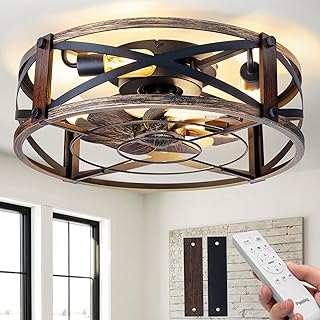
Passky 20″ Caged Fandelier
The most forgiving option for tight eight-foot rooms and breakfast nooks, this caged low-profile fan keeps everything tucked against the ceiling while the reversible DC motor and six speeds give you real control at the table. The 1/2/4-hour timer is a quiet luxury for anyone who lingers over coffee and forgets to switch things off.
48″ Crystal Rose Gold Fandelier
This is the pick for a dining room that wants a chandelier moment without giving up circulation, with crystal detailing and a rose gold finish that carries a formal table on its own. Reserve it for ceilings of nine feet or more, since the ornamental body drops noticeably lower than a flush mount.
52″ Flush Mount Farmhouse Fan
Five reversible blades and a three-light cluster make this the airflow leader here, and it moves enough air to keep a long table comfortable through summer entertaining. The dual-finish blades let you flip between a warmer and cooler wood tone as your palette shifts.
addlon 24″ Fandelier
Engineered for wider airflow than its compact footprint suggests, this one adds app control and a memory function that restores your last dim level and speed automatically. It is the smart-home-friendly choice for small dining rooms and condo layouts.
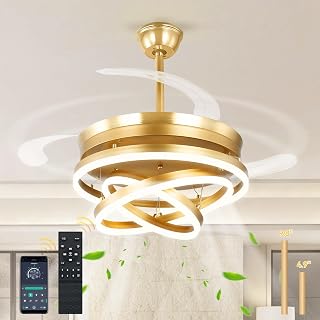
42″ Retractable Gold Fandelier
Blades extend when you want a breeze and retract into a clean gold chandelier profile when you do not, which solves the aesthetic objection most people have to dining room fans. The silent DC motor and 3000K to 6500K dimming make it equally at home over a dinner party or a laptop.
Frequently Asked Questions
Will a ceiling fan blow out candles or disturb place settings?
Not at low speeds, which is exactly why six-speed DC models matter. Run speed one or two during meals and reverse the blades in winter to pull air upward instead of down onto the table.
Can I install one of these over an existing dining table without an electrician?
Only if the box is rated for a fan’s weight and motion. A standard lighting box is not, so confirm you have a fan-rated brace box before hanging anything, and hire a pro if you are unsure.
What color temperature is best for a dining room?
Stay between 2700K and 3000K for meals, since warm light renders food and wood tones far more appetizingly. Tunable models let you jump to 4000K or higher when the table becomes a workspace.
Do retractable fans move less air than fixed-blade fans?
Generally yes, because retractable blades are shorter and shaped for storage as much as thrust. They are an excellent fit for small to mid-size dining rooms, but a large open plan is better served by a 52-inch fixed-blade fan.
Final Thoughts
For most dining rooms, the 42″ Retractable Gold Fandelier hits the best balance of presence and performance, disappearing into chandelier form between meals. Choose the 52″ Flush Mount Farmhouse Fan if you have a long table and want maximum air movement on a low ceiling, or the Passky 20″ Caged Fandelier for compact nooks where every inch of headroom counts.