Key takeaways
- Power source: Electric heaters like the Lerat 500W mini need a shore-power pedestal or a stout battery bank, but they emit zero combustion byproducts. Propane models run anywhere a 1 lb canister or 20 lb tank goes, which makes them the default for dispersed camping and ice shacks.
- Output matched to volume: A 3,800 BTU unit is plenty for a two-person backpacking tent or a small pop-up shelter. Step up to 9,000 BTU for a wall tent, garage bay, or covered patio. Oversizing a small space wastes fuel and forces you to cycle the heater on and off all night.
- Safety hardware: Look for a tip-over cutoff, an oxygen depletion sensor on any propane unit, and overheat protection on electrics. These are non-negotiable, not upsells. Pair every combustion heater with a battery-powered CO alarm placed at head height.
- Stability and footprint: Uneven ground is the norm outdoors. Reinforced bases and foldable tank holders keep a cylinder-mounted heater from becoming top-heavy, and a wide stance matters far more on gravel or frozen mud than it does on a garage floor.
- Runtime and fuel logistics: Small canisters are convenient but expensive per hour. If you camp cold regularly, buy a heater that accepts a hose adapter so you can run a refillable 20 lb tank and cut fuel costs dramatically.
What's inside
Cold seeps into a campsite from the ground up. You can layer sleeping pads, upgrade to a lower-rated bag, and still find yourself awake at 3 a.m. with numb toes and a tent wall beading with condensation. Shoulder-season campers, ice anglers, and hunters all run into the same wall: the gear that keeps you warm while moving does very little once you stop moving. A portable heater fills that gap, taking the edge off a 28-degree morning so you can lace boots and boil water without shivering through it.
The catch is that “camping heater” covers two completely different machines. Electric units sip power and belong at campgrounds with hookups, in RVs, or in truck-camper builds. Propane radiant heaters produce real warmth off-grid but demand respect, ventilation, and a carbon monoxide detector every single time. This guide sorts through both categories, breaks down the specs that actually matter in the field, and covers the safety habits that separate a comfortable trip from a dangerous one.
As an Amazon Associate we earn from qualifying purchases at no extra cost to you. Product prices and availability are accurate as of the date shown and are subject to change.



🛒 Best Price Today on Amazon
Prime members get fast, free shipping on everything above, plus member-only deals. New members get a 30-day free trial — cancel anytime.
How to Choose a Space Heater For Camping (2026)
- Power source: Electric heaters like the Lerat 500W mini need a shore-power pedestal or a stout battery bank, but they emit zero combustion byproducts. Propane models run anywhere a 1 lb canister or 20 lb tank goes, which makes them the default for dispersed camping and ice shacks.
- Output matched to volume: A 3,800 BTU unit is plenty for a two-person backpacking tent or a small pop-up shelter. Step up to 9,000 BTU for a wall tent, garage bay, or covered patio. Oversizing a small space wastes fuel and forces you to cycle the heater on and off all night.
- Safety hardware: Look for a tip-over cutoff, an oxygen depletion sensor on any propane unit, and overheat protection on electrics. These are non-negotiable, not upsells. Pair every combustion heater with a battery-powered CO alarm placed at head height.
- Stability and footprint: Uneven ground is the norm outdoors. Reinforced bases and foldable tank holders keep a cylinder-mounted heater from becoming top-heavy, and a wide stance matters far more on gravel or frozen mud than it does on a garage floor.
- Runtime and fuel logistics: Small canisters are convenient but expensive per hour. If you camp cold regularly, buy a heater that accepts a hose adapter so you can run a refillable 20 lb tank and cut fuel costs dramatically.
The Best Space Heater For Camping (2026)s Reviewed
Mr. Heater 9,000 BTU Portable Buddy
This is the benchmark for a reason: a swiveling regulator, fold-down handle, and tank-top or hose feeding make it flexible enough for a wall tent, an ice house, or a chilly workshop. The oxygen depletion sensor and tip-over switch are genuinely reliable, and on the low setting it stretches a 1 lb canister across a surprising stretch of the night.
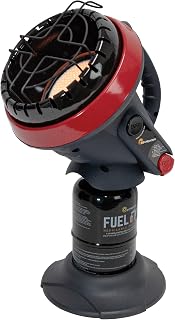
Mr. Heater 3,800 BTU Little Buddy
The Little Buddy trades output for a compact footprint and a stable base, which suits smaller shelters and vestibules where the 9,000 BTU version would quickly become overwhelming. It is the model I recommend to anyone heating a space they can cross in three steps.
Portable Propane Heater with Control Valve and Foldable Tank Holder
The cordless design and integrated control valve give you fine adjustment without a separate regulator, and the folding holder collapses flat for transport. Radiant output arrives fast, which is exactly what you want when you crawl out of a bag at dawn in a properly ventilated tent.
Portable Propane Heater for Camping with Foldable Tank Holder
A strong pick for ice fishing and late-season hunting, where you need directional warmth aimed at a chair or bucket rather than an evenly heated room. The fold-out holder keeps the cylinder secured on snow and ice better than a bare tank-top mount.
Propane Heater with Reinforced Base Tank Holder
The reinforced base is the standout feature here, adding meaningful resistance to knocks in a crowded garage or on a soft campsite pad. It scales well between patio use and camp duty, making it a practical single purchase for people who want warmth in more than one setting.
Frequently Asked Questions
Can I run a propane heater inside my tent?
Only with active ventilation, a working CO alarm, and the heater off while you sleep. Propane combustion consumes oxygen and produces carbon monoxide, which is odorless and has killed campers in sealed tents. Use these heaters to warm a space before bed and again at wake-up, never as overnight heat.
Will a 500W electric heater work off a portable power station?
Yes, but expect short runtime. A 500W draw pulls roughly 500 watt-hours per hour, so a 1,000Wh station gives you about two hours. Electric units make the most sense on campground hookups or in RVs.
How long does a 1 lb propane canister last?
Roughly five to six hours on low with a 3,800 BTU heater, and closer to two to three hours on high with a 9,000 BTU model. Cold weather reduces canister pressure and shortens those numbers further.
Do these heaters work below freezing?
Radiant propane heaters perform well in the cold, though small canisters lose pressure as temperatures drop. Keeping a spare canister inside your jacket or sleeping bag helps it light and burn more consistently.
Final Thoughts
For most campers, the Mr. Heater 9,000 BTU Portable Buddy is the smart buy: proven safety hardware, adjustable output, and the option to run a refillable tank when trips get long. Downsize to the 3,800 BTU Little Buddy for solo tents and tight shelters, and consider the reinforced-base propane heater if you want one unit that moves easily between campsite, patio, and garage. Whichever you choose, budget for a battery-powered CO detector at the same time and treat it as part of the heater, not an accessory.