Key takeaways
- Tooth count: Stay between 24 and 30 teeth for ripping. Fewer teeth means bigger gullets, which clear the long stringy shavings that cedar and pine produce instead of packing them into the kerf and cooking your edge.
- Grind geometry: A flat-top (FTG) grind chisels through fiber fast and is the traditional choice for rough ripping. A triple-chip (TCG) grind costs more but leaves a glue-ready edge, which matters when you are jointing slats for a tabletop without a jointer.
- Kerf width: Thin kerf (roughly 0.090 in) is the right call for 15-amp portable and contractor saws, especially ripping 8/4 outdoor stock. Full kerf is stiffer and better suited to cabinet saws pulling 3 HP or more.
- Hook angle: Around 20 degrees of positive hook gives the aggressive self-feeding action you want on long rips. Anything much steeper gets grabby on a lightweight saw, and negative hook belongs on a miter saw, not a rip blade.
- Arbor and diameter: Confirm 5/8 in arbor and match your saw’s plate size. Compact 8-1/4 in saws will not accept a 10 in blade, and running an undersized blade on a 10 in saw costs you depth of cut on 2x material.
What's inside
Building furniture that lives outdoors starts long before the first coat of finish. It starts at the rip cut. Cedar, cypress, redwood, thermally modified ash and reclaimed ipe all behave differently under a spinning blade, and most of them carry internal stress that wants out the moment you split a board. A blade with too many teeth burns resinous softwood. A blade with too few leaves a fuzzy, waved edge that swallows glue and telegraphs through paint. Either way, you end up back at the jointer or the sander instead of assembling a bench.
This guide looks at rip blades through an outdoor-living lens: long rips in wet-ish decking stock, glue-line edges for slatted tabletops, and mixed duty on portable saws that live in a garage or under a carport. We cover what actually matters in a rip blade for 2026, then break down five options ranging from a dedicated flat-tooth ripper to multi-blade sets that cover framing, ripping and finish cuts for a full patio build.
As an Amazon Associate we earn from qualifying purchases.

How to Choose a Table Saw Rip Blade (2026)
- Tooth count: Stay between 24 and 30 teeth for ripping. Fewer teeth means bigger gullets, which clear the long stringy shavings that cedar and pine produce instead of packing them into the kerf and cooking your edge.
- Grind geometry: A flat-top (FTG) grind chisels through fiber fast and is the traditional choice for rough ripping. A triple-chip (TCG) grind costs more but leaves a glue-ready edge, which matters when you are jointing slats for a tabletop without a jointer.
- Kerf width: Thin kerf (roughly 0.090 in) is the right call for 15-amp portable and contractor saws, especially ripping 8/4 outdoor stock. Full kerf is stiffer and better suited to cabinet saws pulling 3 HP or more.
- Hook angle: Around 20 degrees of positive hook gives the aggressive self-feeding action you want on long rips. Anything much steeper gets grabby on a lightweight saw, and negative hook belongs on a miter saw, not a rip blade.
- Arbor and diameter: Confirm 5/8 in arbor and match your saw’s plate size. Compact 8-1/4 in saws will not accept a 10 in blade, and running an undersized blade on a 10 in saw costs you depth of cut on 2x material.
The Best Table Saw Rip Blades (2026) Reviewed
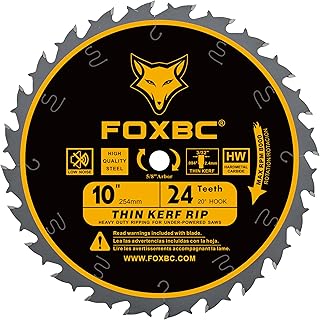
FOXBC 10-Inch 24-Tooth Flat Tooth Ripping Blade
This is the straightforward answer for anyone ripping a stack of cedar fence pickets or 2×6 decking into furniture stock. The flat-top grind and thin kerf keep amp draw low on jobsite saws, and the deep gullets shed the fibrous waste that clogs finer blades on softwood.
Amana Tool 610301 Glue Line Ripping Blade
Amana’s 30-tooth TCG glue-line blade produces an edge clean enough to go straight into a clamp, which is a genuine time saver on slatted tabletops and bench seats. It rewards a well-tuned fence and a saw with real power, so treat it as the precision tool in your rotation rather than your rough-breakdown blade.
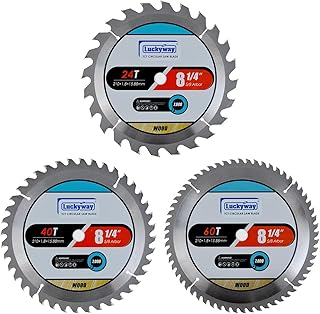
Luckyway 8-1/4 Inch 3-Pack (24T / 40T / 60T)
A sensible starter kit for compact saws, covering framing cuts on pergola members, general ripping and a finish blade for trim details. Carbide quality is entry level compared to premium brands, but for a seasonal deck-and-planter build the value is hard to argue with.
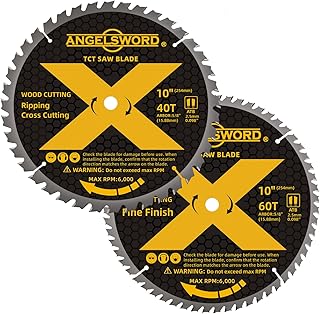
ANGELSWORD 10 Inch 2-Pack (40T / 60T)
The 40-tooth blade is a reasonable compromise for hobbyists who rip and crosscut without swapping blades constantly, and the 60-tooth handles clean edges on plywood or cladding panels. If your projects lean toward mixed cuts in 4/4 stock rather than heavy ripping, this pairing keeps the workflow simple.
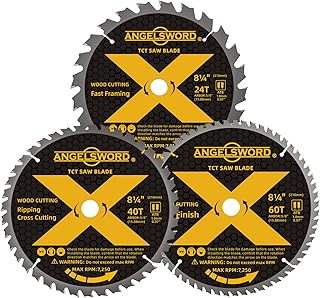
ANGELSWORD 8-1/4 Inch 3-Pack (24T / 40T / 60T)
Same logic as the 10 in set, scaled for the smaller portable saws many people keep for deck work. The 24-tooth blade does the ripping, and having spares on hand means you are not nursing a dull blade through the last few boards of a project.
Frequently Asked Questions
Can I rip pressure-treated lumber with these blades?
Yes, though treated stock is often damp and highly abrasive, which dulls carbide faster. Let boards acclimate and dry if you can, keep the blade clean, and expect to sharpen sooner than you would with kiln-dried hardwood.
Do I really need a separate rip blade if I own a combination blade?
For occasional cuts, no. Once you are ripping more than a few boards at a time, a dedicated 24-tooth blade cuts faster, runs cooler and reduces burn marks noticeably, particularly in pitchy softwoods.
Why does my rip cut close up behind the blade?
That is internal stress releasing, and it is common in outdoor lumber. Always use your riving knife or splitter, feed at a steady rate, and stop if the offcut starts pinching rather than forcing it through.
How do I keep a rip blade cutting well?
Clean pitch off the carbide with a dedicated blade cleaner every few projects. Resin buildup mimics dullness, increases friction and causes most of the burning people blame on the blade itself.
Final Thoughts
For most outdoor furniture builds, the FOXBC 24-tooth flat-tooth blade handles the heavy ripping at a fair price, and the Amana 610301 glue-line blade earns its keep the moment you start edge-joining slats for tabletops and seats. If you are outfitting a compact 8-1/4 in saw from scratch, the Luckyway 3-pack covers framing through finish work without a big outlay.