Key takeaways
- Tooth count vs. stock thickness: 80 to 100 teeth is the sweet spot for chair rails, apron stock, and 1x cedar where the cut face stays visible. Drop to 40–60 teeth for 4×4 posts and pergola beams, since crowded teeth can’t clear chips from a deep cut and will scorch instead.
- Kerf and saw power: Thin-kerf plates (roughly 0.090–0.098 in.) reduce load on 15-amp saws and waste less material across repetitive cuts. Full-kerf plates resist deflection better in wide crosscuts, so favor them if you’re squaring up glued panels.
- Hook angle: Look for a neutral or negative hook on sliding compound saws. Positive-hook blades want to climb into the workpiece and self-feed, which is how thin outdoor slats get grabbed and launched.
- Carbide grade and coating: Micrograin carbide holds a keener edge through abrasive species like ipe and teak. A slick anti-friction coating matters more than people expect with resinous cedar and pressure-treated pine, where pitch builds up fast and turns clean cuts brown.
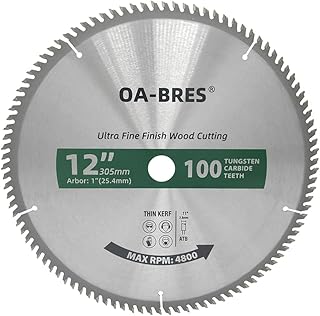
- Plate quality and arbor fit: Confirm a true 1-inch arbor, then check for laser-cut expansion slots and a tensioned plate. Options like the 100-tooth ATB TCT ultra-fine-finish blade advertise those features; they’re what keeps a blade running flat and quiet as it heats up mid-project.
What's inside
Outdoor furniture punishes sloppy miters. A bench arm or planter corner that looks acceptable indoors will telegraph every gap once cedar swells in July humidity and shrinks back in October, and an oil finish does nothing to hide splintered end grain. The blade in your 12-inch miter saw is doing more work on that joint than any clamp or fastener, yet it’s usually the last component anyone upgrades. Most buyers end up choosing between a 100-tooth blade that bogs down in thick stock and a general-purpose blade that leaves fuzz on the exact faces people touch.
This guide sorts through the 12-inch blades worth running on a furniture and outdoor-build bench in 2026, from ultra-fine-finish options like the DEWALT DWA112100 and the FOXBC 100-tooth polished-finish blade to workhorse crosscutters from Diablo, Makita, and Freud. Below you’ll find how to match tooth count, kerf, and carbide grade to the material you actually cut, plus short reviews based on how these blades behave in weather-exposed softwoods, dense tropical hardwoods, and composite trim.
As an Amazon Associate we earn from qualifying purchases.


How to Choose a 12-Inch Miter Saw Blade (2026)
- Tooth count vs. stock thickness: 80 to 100 teeth is the sweet spot for chair rails, apron stock, and 1x cedar where the cut face stays visible. Drop to 40–60 teeth for 4×4 posts and pergola beams, since crowded teeth can’t clear chips from a deep cut and will scorch instead.
- Kerf and saw power: Thin-kerf plates (roughly 0.090–0.098 in.) reduce load on 15-amp saws and waste less material across repetitive cuts. Full-kerf plates resist deflection better in wide crosscuts, so favor them if you’re squaring up glued panels.
- Hook angle: Look for a neutral or negative hook on sliding compound saws. Positive-hook blades want to climb into the workpiece and self-feed, which is how thin outdoor slats get grabbed and launched.
- Carbide grade and coating: Micrograin carbide holds a keener edge through abrasive species like ipe and teak. A slick anti-friction coating matters more than people expect with resinous cedar and pressure-treated pine, where pitch builds up fast and turns clean cuts brown.
- Plate quality and arbor fit: Confirm a true 1-inch arbor, then check for laser-cut expansion slots and a tensioned plate. Options like the 100-tooth ATB TCT ultra-fine-finish blade advertise those features; they’re what keeps a blade running flat and quiet as it heats up mid-project.
The Best 12-Inch Miter Saw Blades (2026) Reviewed
100-Tooth ATB TCT Ultra Fine Finish Blade
An affordable route to glue-ready miters on trim, slat backs, and picture-frame planter caps, with an alternate-top-bevel grind that slices cleanly across figured softwoods. Keep it in 1x and thinner 2x material; ask it to hog through a 4×4 and you’ll hear the feed rate complain.
DEWALT DWA112100
DEWALT’s 100-tooth fine-finish blade is the safe default for furniture work: consistently flat cuts, minimal tearout on veneered plywood, and easy availability when you need a spare mid-build. The carbide is thin enough that a nail strike is unforgiving, so keep it off reclaimed lumber.
Diablo D1280X
At 80 teeth with hi-density carbide and a laser-cut stabilizer vent, the D1280X hits the practical balance for anyone building outdoors — clean enough for exposed bench joinery, open enough to crosscut wet treated lumber without stalling. Its Perma-Shield coating is the standout for resin-heavy cedar and pine.
Makita B-67000
The Max Efficiency grind on this 100-tooth blade cuts with noticeably less effort than its tooth count suggests, thanks to a thin kerf that keeps cordless and 15-amp saws in their power band. It’s the one I reach for on long runs of repetitive miters, where reduced load means less heat and less drift.
Freud LU86R012
At 48 teeth, this thin-kerf general-purpose blade isn’t a finish blade, and it isn’t trying to be — it’s what you mount for framing pergolas, ripping down deck substructure, and breaking down rough stock quickly. Freud’s grind still leaves a surface clean enough to sand rather than re-cut.
Frequently Asked Questions
How many teeth do I need for furniture-grade miters?
80 to 100 teeth in 1x and 2x stock. Beyond 100 you gain little visible improvement while giving up chip clearance, and cuts start burning in anything over an inch and a half thick.
Can I cut composite decking or PVC trim with these?
Yes, and high-tooth-count blades handle it well. Slow your feed and let the blade reach full speed before contact, since melted swarf welding itself to the teeth is the usual failure, not dull carbide.
Is thin kerf worth it on a 12-inch saw?
On most single-bevel and cordless saws, yes. Blades like the Makita B-67000 and Freud LU86R012 draw less amperage and run cooler. If your saw is a heavy dual-bevel slider, a full-kerf plate gives slightly better stability in wide cuts.
Should I sharpen or replace?
Premium blades from Diablo, Freud, and Makita are worth two or three professional sharpenings. Budget 100-tooth blades usually cost less to replace than to service, so treat them as consumables and retire them when cut quality drops.
Final Thoughts
For most people building outdoor furniture, the Diablo D1280X is the smartest single blade to own — clean cuts on show surfaces, enough gullet to handle damp treated lumber, and a coating built for resinous species. If your work leans toward fine joinery and long batches of trim, the Makita B-67000 cuts with less strain than anything else at 100 teeth, and the DEWALT DWA112100 is the reliable, easy-to-replace alternative. Keep the Freud LU86R012 mounted for rough structural work and swap in a finish blade only when it counts.