Key takeaways
- Tooth count: For moulding, aim for 80 teeth or more on a 10-inch blade and 96 to 100+ on a 12-inch. More teeth means smaller bites per tooth, which is exactly what keeps fragile profiles and primed edges intact. Reserve 32T and 40T blades for framing, ripping, and rough exterior stock.
- Tooth geometry: Look for an alternate top bevel (ATB) grind with a high bevel angle. Those knife-like edges slice wood fibers cleanly instead of shoveling them out, which is the difference between a joint that closes and one that needs filler. Triple-chip grinds are better left to laminate and non-ferrous work.
- Hook angle: A low or slightly negative hook angle is what you want on a sliding or chop miter saw. It keeps the blade from grabbing and self-feeding into thin moulding, reducing kickback and preventing the stock from climbing off the fence mid-cut.
- Plate quality and kerf: A flat, tensioned plate with laser-cut expansion slots resists wobble and heat warp. Thin-kerf blades cut faster and strain smaller motors less, but full-kerf plates track straighter on long bevels through hardwood and dense composites.
- Arbor fit: Confirm the bore before you buy. Most 10- and 12-inch consumer saws use a 5/8-inch arbor, while some industrial 12-inch machines take a 1-inch bore. A mismatch is not something to solve with a bushing improvised on site.
What's inside
Trim work on a porch, pergola, or screened-in room is where a blade earns its keep. Moulding is thin, often primed or pre-finished, and almost always cut at an angle, which means every flaw shows up on the visible face at eye level. Buyers usually discover this the hard way: a general-purpose 24- or 40-tooth blade that rips deck framing beautifully will leave splintered heels on a 45-degree crown cut, blow out the back edge of MDF casing, and melt a ragged bead into cellular PVC. Then comes the caulk, the filler, the sanding, and the second trip to the lumber yard.
The fix is rarely a new saw. It is a finish blade with a high tooth count, a stable plate, and a tooth geometry suited to shallow crosscuts in soft, coated material. This guide breaks down what actually matters when you are cutting exterior casing, cedar corner boards, composite trim, and interior moulding, then walks through the blades worth putting on your saw for 2026, including multi-packs that cover framing and finish work in one purchase.
As an Amazon Associate we earn from qualifying purchases.


How to Choose a/an Miter Saw Blade For Moulding (2026)
- Tooth count: For moulding, aim for 80 teeth or more on a 10-inch blade and 96 to 100+ on a 12-inch. More teeth means smaller bites per tooth, which is exactly what keeps fragile profiles and primed edges intact. Reserve 32T and 40T blades for framing, ripping, and rough exterior stock.
- Tooth geometry: Look for an alternate top bevel (ATB) grind with a high bevel angle. Those knife-like edges slice wood fibers cleanly instead of shoveling them out, which is the difference between a joint that closes and one that needs filler. Triple-chip grinds are better left to laminate and non-ferrous work.
- Hook angle: A low or slightly negative hook angle is what you want on a sliding or chop miter saw. It keeps the blade from grabbing and self-feeding into thin moulding, reducing kickback and preventing the stock from climbing off the fence mid-cut.
- Plate quality and kerf: A flat, tensioned plate with laser-cut expansion slots resists wobble and heat warp. Thin-kerf blades cut faster and strain smaller motors less, but full-kerf plates track straighter on long bevels through hardwood and dense composites.
- Arbor fit: Confirm the bore before you buy. Most 10- and 12-inch consumer saws use a 5/8-inch arbor, while some industrial 12-inch machines take a 1-inch bore. A mismatch is not something to solve with a bushing improvised on site.
The Best Miter Saw Blade For Moulding (2026)s Reviewed
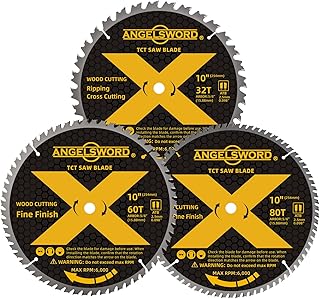
ANGELSWORD 10-Inch 3-Pack (32T, 60T, 80T)
This set is the practical answer for anyone building and trimming in the same weekend: 32T for pergola rafters and deck framing, 60T for general crosscuts, and 80T for the moulding itself. The 80T blade is the one that stays on the saw for casing and cove work, and having the other two on the shelf spares you from cutting trim with a framing blade.
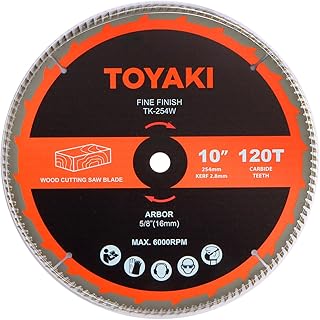
10-Inch 120-Tooth Fine-Finish Blade
At 120 teeth, this is the finest cut you will get from a 10-inch saw, and it shows on painted moulding, thin cedar screen bead, and mitered picture-frame returns. Feed it slowly and let the tooth count do the work; pushing hard into thick stock will generate heat this blade does not need.
DEWALT DWA112100 12-Inch 100-Tooth
DEWALT’s 100-tooth finish blade is the reliable professional pick for 12-inch saws, pairing a rigid plate with sharp carbide that holds an edge through primed pine, poplar, and PVC trim. If you cut wide crown or tall baseboard on a slider, the extra capacity plus this tooth count is the combination that produces glue-ready miters.
LM6300 12-Inch x 100T Miter Joint Blade
Built specifically for tight miter joints, this 100-tooth blade delivers the polished cut face that makes outside corners on porch columns and window casing disappear. Note the 1-inch bore, which suits larger industrial saws rather than typical homeowner machines.
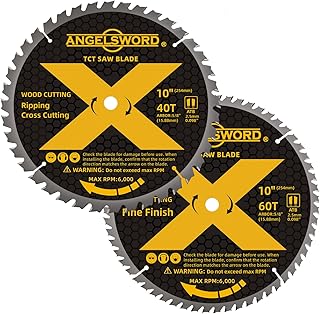
ANGELSWORD 12-Inch 2-Pack (40T, 60T)
A sensible pairing for a 12-inch saw handling both structure and trim: the 40T handles ripping and rough crosscuts, while the 60T covers finish cuts in solid wood. For fine painted moulding, treat the 60T as a good working blade rather than a dedicated finish blade.
Frequently Asked Questions
How many teeth do I actually need for moulding?
Eighty teeth on a 10-inch blade is the practical floor for clean trim cuts, and 100 to 120 gives you noticeably smoother faces. A 60T blade will work in solid softwood, but it struggles with MDF and pre-primed profiles.
Can I use a high-tooth finish blade on PVC and composite trim?
Yes, and it is usually the best choice. Keep the feed rate steady and moderate so the material shears instead of melting, and clear chips between cuts to avoid heat buildup in the gullets.
Why do I still get blowout on the back of the cut?
That is usually a support problem rather than a blade problem. Add a sacrificial backer board or a zero-clearance fence insert so the fibers on the exit side have something to press against.
How long should a finish blade last?
With clean, fastener-free trim, expect hundreds of cuts before performance drops. Rising cut resistance, burn marks, or fuzzy edges mean it is time to have the carbide professionally sharpened rather than replaced.
Final Thoughts
For most 12-inch saws doing porch casing, crown, and exterior trim, the DEWALT DWA112100 is the dependable everyday finish blade. If you are working on a 10-inch saw and want the smoothest possible cut face, the 120-tooth fine-finish blade is hard to beat, while the ANGELSWORD 10-inch three-pack covers framing through fine finish in a single purchase for anyone building and trimming the same project.