Key takeaways
- Tooth count: Lower counts generally favor quicker ripping, while 60- to 80-tooth blades are better suited to smooth crosscuts, trim, and visible furniture parts.
- Kerf: A thin-kerf blade can reduce waste and put less strain on some saws, but confirm that its design suits your saw and cutting setup.
- Material: Carbide-tipped teeth are a sensible choice for regular woodworking because they hold an edge longer than basic steel teeth and can be sharpened when appropriate.
- Arbor and size: Most options here use a 10-inch blade with a 5/8-inch arbor, but always verify both measurements against your table saw before ordering.
- Project type: For outdoor furniture, favor a versatile blade or keep separate rip and finish blades available so rough stock preparation does not compromise final cuts.
What's inside
Choosing a table saw blade for outdoor furniture, deck projects, or general shop work is less straightforward than it looks. Tooth count, kerf, arbor fit, and the balance between fast cuts and clean edges all affect the finished result—and the wrong blade can leave rough joinery, chipped veneer, or a frustratingly slow cut.
This guide focuses on practical woodworking from an outdoor-living perspective, where blades may need to handle hardwood decking, treated lumber, plywood, trim, and occasional rip cuts. We cover the main buying considerations, then review leading 10-inch options for furniture builders, DIY renovators, and weekend workshop users.
As an Amazon Associate we earn from qualifying purchases.


How to Choose a 10 Table Saw Blades (2026)
- Tooth count: Lower counts generally favor quicker ripping, while 60- to 80-tooth blades are better suited to smooth crosscuts, trim, and visible furniture parts.
- Kerf: A thin-kerf blade can reduce waste and put less strain on some saws, but confirm that its design suits your saw and cutting setup.
- Material: Carbide-tipped teeth are a sensible choice for regular woodworking because they hold an edge longer than basic steel teeth and can be sharpened when appropriate.
- Arbor and size: Most options here use a 10-inch blade with a 5/8-inch arbor, but always verify both measurements against your table saw before ordering.
- Project type: For outdoor furniture, favor a versatile blade or keep separate rip and finish blades available so rough stock preparation does not compromise final cuts.
The Best 10 Table Saw Blades (2026)s Reviewed
FOXBC 10-Inch 80-Tooth Ultra Finish Blade
The FOXBC 80-tooth blade is aimed at clean, presentation-ready cuts in furniture components, plywood, trim, and other material where edge quality matters. Its high tooth count makes it a strong fit for crosscutting and final sizing, although a less aggressive blade is usually preferable for long rips through thick stock.
DEWALT 10-Inch 40-Tooth Fine Finish Blade
DEWALT’s DWA11040 offers a useful middle ground for outdoor projects: enough tooth spacing for productive general-purpose work, with a fine-finish design for cleaner visible edges. It is a practical choice when changing blades between every ripping and crosscutting task is inconvenient.
WEN BL1080 10-Inch 80-Tooth Blade
The WEN BL1080 is built around an ultra-fine finish, making it well suited to table-saw crosscuts, cabinet parts, and furniture surfaces that will be seen up close. For a patio table or planter box with exposed edges, this type of blade can help reduce the cleanup required before sanding and finishing.
WEN BL1060 10-Inch 60-Tooth Blade
The BL1060 sits between a fast general-purpose blade and an ultra-fine finishing blade. Its 60-tooth layout is a sensible option for makers who want smooth results on boards and sheet goods without making every cut as slow as an 80-tooth blade.
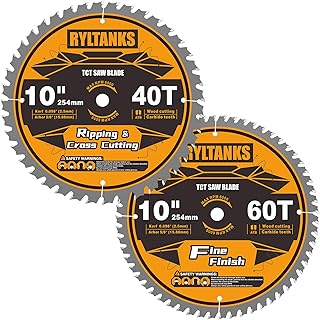
10-Inch 40T/60T Table and Miter Saw Blade 2-Pack
This two-pack is useful for a small workshop because it separates everyday ripping and crosscutting from finer finish work. The 40-tooth blade can handle stock preparation, while the 60-tooth option is better suited to final cuts on outdoor furniture parts and decorative trim.
Frequently Asked Questions
Is a 10-inch blade suitable for outdoor furniture?
Yes. A 10-inch blade is a common size for table saws and can handle many furniture boards, plywood panels, and trim pieces. Match the blade to the material, use suitable dust control, and follow the saw manufacturer’s guidance when cutting treated or reclaimed lumber.
Should I use a 40-tooth or 80-tooth blade?
Choose a 40-tooth blade when you need a versatile balance of speed and finish, particularly for ripping and general construction work. An 80-tooth blade is more appropriate for slower, cleaner crosscuts and visible surfaces where minimizing tear-out is a priority.
Can table-saw blades be used on a miter saw?
Some blades are marketed for both table and miter saws, but compatibility still depends on the tool, blade diameter, arbor, guard clearance, and recommended application. Check the product specifications and your saw manual rather than assuming every 10-inch blade is interchangeable.
How can I get cleaner cuts without changing blades?
Use a sharp, appropriate blade; support the workpiece fully; keep the fence aligned; and feed material steadily without forcing it. A scoring pass, zero-clearance insert, or painter’s tape on vulnerable veneer can also help, depending on the project and saw setup.
Final Thoughts
For a versatile outdoor-living workshop, the DEWALT 40-tooth blade is a strong all-around pick, while the FOXBC and WEN BL1080 are better suited to especially clean finishing cuts. If you frequently switch between rough stock preparation and furniture assembly, the 40T/60T two-pack offers a practical way to keep both jobs covered.