Key takeaways
- Tooth count: For polished crosscuts in hardwood trim, slats, and picture-frame miters, 80 to 100 teeth is the sweet spot. Drop to 40 or 60 teeth when you are ripping wider outdoor stock or cutting thick 2x material, where fewer, larger gullets clear chips instead of packing them.
- Grind geometry: Look for ATB (alternate top bevel) teeth. The angled knife edges slice wood fibers on both faces of the cut, which is what prevents the fuzzy shoulders you get on cedar and the chipped veneer edges on plywood aprons.
- Plate quality and kerf: A tensioned, laser-cut plate with expansion slots stays flat when the blade heats up in dense stock. Thin kerf reduces load on smaller saws; full kerf resists deflection when you are cutting tall crown or stacked outdoor mouldings.
- Carbide grade: Micrograin carbide tips survive far more resharpenings and handle the silica in weathered exterior lumber. If you routinely cut reclaimed decking, a tougher carbide grade is worth more than a few extra teeth.
- Arbor and saw compatibility: Confirm a 1-inch arbor for most 12-inch miter saws, verify maximum RPM exceeds your saw’s rating, and check that hook angle is neutral or slightly negative. Aggressive positive hook on a sliding saw grabs the workpiece.
What's inside
Anyone who has built a cedar bench or trimmed out a pergola knows the moment: the cut looks clean on the saw, then you dry-fit the joint and there it is — a hairline gap, a fuzzy edge, a burn mark right where the miter meets. Outdoor furniture is unforgiving that way. Exterior stock is often wetter, resinier, and less stable than kiln-dried interior lumber, and a blade that leaves tearout on white oak or fuzzes redwood grain turns a tidy 45-degree return into forty minutes of sanding. The blade that shipped with your miter saw was almost certainly built for framing speed, not for the glue-ready faces that outdoor joinery demands.
This guide focuses on 12-inch miter saw blades chosen specifically for fine crosscutting: high tooth counts, alternate top bevel grinds, and carbide that holds an edge through teak oils and reclaimed fir. Below you will find current standouts from ANGELSWORD, DEWALT, and WEN, plus a straightforward buying framework so you can match tooth count to the species and section size you actually work with. Every recommendation is judged on cut quality first, then durability, then value across a season of patio and garden builds.
As an Amazon Associate we earn from qualifying purchases.



How to Choose a 12 Miter Saw Blade For Fine Cuts (2026)
- Tooth count: For polished crosscuts in hardwood trim, slats, and picture-frame miters, 80 to 100 teeth is the sweet spot. Drop to 40 or 60 teeth when you are ripping wider outdoor stock or cutting thick 2x material, where fewer, larger gullets clear chips instead of packing them.
- Grind geometry: Look for ATB (alternate top bevel) teeth. The angled knife edges slice wood fibers on both faces of the cut, which is what prevents the fuzzy shoulders you get on cedar and the chipped veneer edges on plywood aprons.
- Plate quality and kerf: A tensioned, laser-cut plate with expansion slots stays flat when the blade heats up in dense stock. Thin kerf reduces load on smaller saws; full kerf resists deflection when you are cutting tall crown or stacked outdoor mouldings.
- Carbide grade: Micrograin carbide tips survive far more resharpenings and handle the silica in weathered exterior lumber. If you routinely cut reclaimed decking, a tougher carbide grade is worth more than a few extra teeth.
- Arbor and saw compatibility: Confirm a 1-inch arbor for most 12-inch miter saws, verify maximum RPM exceeds your saw’s rating, and check that hook angle is neutral or slightly negative. Aggressive positive hook on a sliding saw grabs the workpiece.
The Best 12 Miter Saw Blade For Fine Cuts (2026)s Reviewed
ANGELSWORD 12-Inch 100T Ultra Fine Finish, 2 Pack
The two-pack format is the real argument here: keep one blade fresh for finish miters on visible outdoor furniture faces and run the other for rough breakdown, so your good edge never touches gritty reclaimed stock. Cut quality on maple and sapele slats is genuinely glue-ready with minimal cleanup.
DEWALT 12-Inch 100 Tooth Fine Finish (DWA112100)
This is the reference blade for anyone who wants predictable results without thinking about it — tight tooth spacing, well-balanced plate, and carbide that stays sharp through repetitive trim work. It shines on precise returns and long, slow crosscuts in dense hardwoods where lesser blades start to burn.
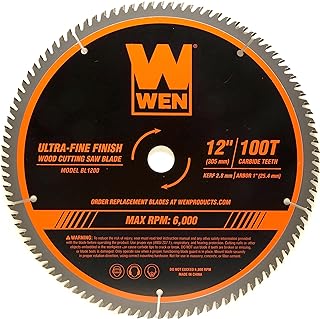
WEN BL1200 12-Inch 100-Tooth Carbide-Tipped
An excellent value pick that punches well above its price for polished crosscuts in softwoods, hardwood trim, and plywood panels. Feed it deliberately rather than fast and the finish rivals blades costing considerably more.
WEN BL1280 12-Inch 80-Tooth Fine Finish
Eighty teeth is the practical compromise for outdoor builders working thicker sections: still smooth enough for visible miters, but with roomier gullets that clear resinous cedar and pressure-treated stock without gumming. It doubles nicely on a table saw for crosscut sleds.
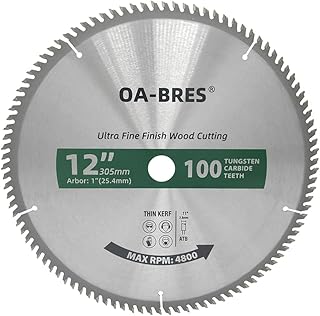
12-Inch 100-Tooth ATB TCT with 1-Inch Arbor
A no-nonsense ATB grind on a 1-inch arbor that fits the overwhelming majority of 12-inch miter saws. It is a sensible spare to keep in the shop drawer for when your primary finish blade goes off to be resharpened.
Frequently Asked Questions
Is 100 teeth always better than 80?
No. More teeth mean a finer surface but slower feed rates and more heat. For stock under an inch thick, 100 teeth is ideal. For 2x outdoor framing members and thick bench legs, 80 teeth or fewer cuts cooler and cleaner.
Why is my fine blade burning the wood?
Usually a feed problem, not a blade problem. Pausing mid-cut, forcing the blade, or a slightly misaligned fence all cause burning. Resin buildup on the plate is the second most common cause, so clean the blade regularly.
Can I use these blades on a table saw?
The WEN blades are rated for both, but confirm arbor size and maximum RPM. High-tooth-count crosscut blades are poor rippers regardless, so use them in a crosscut sled rather than for ripping.
Should I use a fine blade on pressure-treated lumber?
You can, but the moisture and preservatives are hard on carbide. Reserve a lower-tooth-count blade for treated stock and save your finish blade for dry hardwoods and cedar.
Final Thoughts
For most outdoor furniture builders, the DEWALT DWA112100 is the safest investment in cut quality, while the WEN BL1200 delivers close to the same finish for far less money. If you want a workflow that protects your best edge, the ANGELSWORD 100T two-pack is the smartest buy on this list.