Key takeaways
- Airflow: Compare CFM at 90 PSI rather than horsepower alone. Higher CFM supports demanding tools such as sanders, grinders, and framing equipment with fewer pauses.
- Power requirements: Check voltage, phase, amperage, and whether a plug is included before ordering. Many large compressors require a dedicated 230V circuit and professional installation.
- Pump design: Oil-lubricated, two-stage pumps generally suit frequent heavy use, while oil-free models can simplify maintenance and avoid oil contamination around finishing work.
- Noise and placement: A quiet-rated compressor is valuable near the house or an attached garage. Leave clearance around the unit, keep it level, and protect it from rain and standing moisture.
- Drainage and maintenance: Automatic drains, accessible filters, belt guards, and a straightforward tank-drain routine can make a large difference in ownership convenience.
What's inside
An 80-gallon air compressor can become the backbone of a serious garage or workshop, but choosing one is rarely as simple as comparing horsepower. Buyers must balance electrical requirements, noise, airflow, pump design, maintenance, and the space needed for a tall stationary machine—especially when the compressor will share a wall or outbuilding with furniture projects, finishing work, or weekend repairs.
This guide focuses on the details that matter in real outdoor-living and home-workshop settings: usable airflow for pneumatic tools, tank capacity, duty demands, installation considerations, and long-term serviceability. The selections below cover quiet operation, heavy-duty production work, and dependable all-purpose shop use.
As an Amazon Associate we earn from qualifying purchases.




How to Choose an 80 Gallon Air Compressor (2026)
- Airflow: Compare CFM at 90 PSI rather than horsepower alone. Higher CFM supports demanding tools such as sanders, grinders, and framing equipment with fewer pauses.
- Power requirements: Check voltage, phase, amperage, and whether a plug is included before ordering. Many large compressors require a dedicated 230V circuit and professional installation.
- Pump design: Oil-lubricated, two-stage pumps generally suit frequent heavy use, while oil-free models can simplify maintenance and avoid oil contamination around finishing work.
- Noise and placement: A quiet-rated compressor is valuable near the house or an attached garage. Leave clearance around the unit, keep it level, and protect it from rain and standing moisture.
- Drainage and maintenance: Automatic drains, accessible filters, belt guards, and a straightforward tank-drain routine can make a large difference in ownership convenience.
The Best 80 Gallon Air Compressor (2026)s Reviewed
VEVOR 80 Gallon Oil-Free Compressor
This 220V single-phase VEVOR model is an appealing option for workshops that want a large reserve tank without adding oil-pump maintenance. Its listed 145 PSI maximum and 15.5 SCFM at 90 PSI make it a practical match for general pneumatic tools, inflation, fastening, and intermittent spraying, while the quiet-oriented design is better suited to a home setting than many industrial machines.
Campbell Hausfeld 80-Gallon Vertical Compressor
Campbell Hausfeld’s 5 HP vertical compressor is a straightforward choice for homeowners who need more capacity than a portable unit can provide. With a listed 140 PSI maximum, it is well suited to routine garage work and furniture-building tasks; just confirm the electrical circuit and available ceiling clearance before installation.
VEVOR 80-Gallon Heavy-Duty Compressor
This VEVOR model steps up to a 10 HP motor, 17 SCFM at 90 PSI, and a listed 175 PSI maximum, making it the more appropriate choice for demanding workloads and multiple pneumatic tools. Its 230V three-phase configuration and lack of a plug are significant installation requirements, so it belongs in a properly equipped commercial or large workshop rather than a typical household garage.
NorthStar 7.5 HP 80-Gallon Compressor
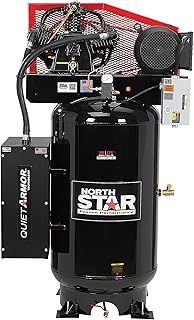
The NorthStar combines a 7.5 HP motor with 26 CFM and a quiet Armor design, giving serious users substantial airflow without making the compressor unnecessarily intrusive. It is a strong fit for sustained pneumatic-tool work, and the maintenance-friendly access should appeal to owners who plan to keep the machine working for years.
Industrial Plus Silent 7.5 HP Compressor
With 31 CFM, a 230V power requirement, and a pressure-lubricated pump, this Industrial Plus unit is built for high-output workshop duty. Its automatic drain system and energy-conscious design add convenience, while the vertical two-stage configuration makes it especially interesting for users who need production-level air in a space-conscious layout.
Frequently Asked Questions
Is an 80-gallon air compressor too large for home use?
Not necessarily. The tank provides a useful reserve for tools that draw air in bursts, but the compressor’s footprint, noise, electrical demand, and weight make it best for a dedicated garage, barn, or workshop rather than a small utility room.
What CFM should I look for?
Choose a compressor based on the tool with the highest continuous air demand. For occasional fastening or inflation, modest airflow may be enough; sanding, grinding, blasting, and professional spraying generally call for substantially more CFM at 90 PSI.
Do I need a two-stage compressor?
A two-stage pump is often worthwhile for frequent, demanding use because it is designed to reach higher pressures efficiently and support heavier workloads. For lighter intermittent tasks, a single-stage model may provide adequate performance at a lower overall cost.
Can I install one outdoors?
Stationary compressors should be sheltered from rain, snow, direct weather exposure, and freezing conditions. A ventilated, dry outbuilding can work, but electrical installation, condensation control, and manufacturer clearance requirements should be handled carefully.
Final Thoughts
For a quieter home workshop, the VEVOR oil-free 80-gallon model is a sensible starting point, while the Campbell Hausfeld offers a familiar all-purpose configuration. For high-demand shop production, the NorthStar and Industrial Plus Silent models stand out for their airflow and workshop-focused features.