Key takeaways
- Airflow: Compare the compressor’s CFM at 90 PSI with your spray gun’s stated requirement. A modest reserve helps prevent pressure dips during longer passes.
- Tank size: A larger tank provides a useful buffer for short painting sessions, although it does not replace adequate continuous CFM.
- Air quality: Oil-free designs simplify maintenance, but every painting setup still benefits from a water separator, regulator, and appropriate inline filtration.
- Noise: Quieter operation matters in a residential garage or shared workspace, especially when the compressor cycles repeatedly during preparation and spraying.
- Mobility: Wheels and a vertical footprint make it easier to position the compressor near the work area without sacrificing valuable floor space.
What's inside
Auto painting puts unusual demands on a compressor. A small unit may run a nail gun or inflate tires perfectly well, yet struggle to maintain the steady, clean airflow a spray gun needs. That can lead to uneven coverage, pulsing fan patterns, excessive overspray, and frustrating pauses while the tank rebuilds pressure.
This guide focuses on practical workshop concerns: usable airflow at spray-gun pressure, tank capacity, noise, portability, maintenance, and the realities of painting in a garage or outdoor work area. The best choice depends on whether you are touching up panels, spraying furniture-sized parts, or tackling larger vehicle projects.
As an Amazon Associate we earn from qualifying purchases.


How to Choose a/an Air Compressor For Auto Painting (2026)
- Airflow: Compare the compressor’s CFM at 90 PSI with your spray gun’s stated requirement. A modest reserve helps prevent pressure dips during longer passes.
- Tank size: A larger tank provides a useful buffer for short painting sessions, although it does not replace adequate continuous CFM.
- Air quality: Oil-free designs simplify maintenance, but every painting setup still benefits from a water separator, regulator, and appropriate inline filtration.
- Noise: Quieter operation matters in a residential garage or shared workspace, especially when the compressor cycles repeatedly during preparation and spraying.
- Mobility: Wheels and a vertical footprint make it easier to position the compressor near the work area without sacrificing valuable floor space.
The Best Air Compressor For Auto Painting (2026)s Reviewed
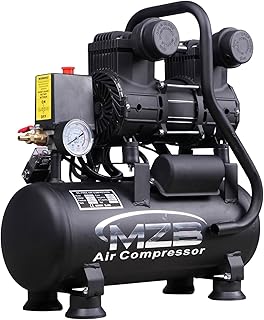
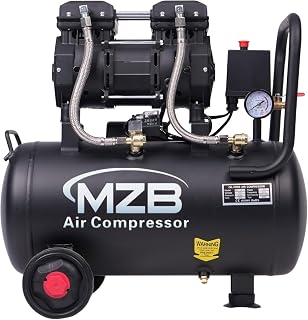
MZB 2.4-Gallon Ultra Quiet Air Compressor
The compact MZB 2.4-Gallon model is a sensible pick for occasional touch-ups, small parts, and detail work where storage space is limited. Its listed 5.65 CFM output, oil-free design, and 70dB noise rating make it approachable for a home workshop, though its smaller tank is better suited to shorter spray cycles than full-vehicle coverage.
MAX 18.5-Gallon Upright Air Compressor
The MAX 18.5-Gallon upright offers substantially more reserve capacity than compact pancake-style units, making it a more comfortable choice for repeated passes and general garage work. Its vertical layout is particularly useful where floor space is tight, but buyers should still match its actual airflow to the requirements of their chosen spray gun.
VEVOR 13-Gallon Air Compressor
With a 2HP motor, 4.6 SCFM at 90 PSI, and a stated 125 PSI maximum, the VEVOR 13-Gallon model balances portability with useful capacity. Its 66dB quiet-operation rating and wheeled, thickened-steel design suit a home garage, while the oil-free tank keeps routine upkeep straightforward for painting, repairs, and woodworking.
Klutch 29-Gallon Air Compressor
The Klutch 29-Gallon unit is the strongest fit here for users who want a larger air reserve and quick recovery for more demanding workshop sessions. Its listed 5.1 CFM at 90 PSI, 175 PSI maximum, vertical configuration, large wheels, and accessible tank drain make it a practical choice for painting-related jobs and broader garage use.
AAIN 6.3-Gallon Ultra Quiet Air Compressor
The AAIN 6.3-Gallon compressor occupies a useful middle ground between compact convenience and larger-tank endurance. Its listed 6 CFM output, 1.5HP oil-free motor, 116 PSI maximum, and wheels make it attractive for small automotive projects, trim work, and occasional spray painting in a residential setting.
Frequently Asked Questions
What size air compressor is best for auto painting?
There is no single size for every spray gun or project. For occasional touch-ups, a compact compressor can work, while larger tanks and stronger continuous airflow are more appropriate for panel work or extended spraying. Always use the spray gun’s CFM requirement as the starting point.
Is an oil-free compressor suitable for spray painting?
Yes. Oil-free compressors can be convenient for home users because they avoid oil changes and reduce maintenance. However, clean paint requires more than compressor type: use a regulator, moisture separator, and suitable filtration to help keep water and contamination out of the paint stream.
Can a quiet compressor be used in a garage?
Yes, and lower noise can make a major difference in a residential workspace. A quiet rating does not mean silent operation, so place the unit on a stable surface, leave ventilation around it, and keep it as far from the immediate work area as practical.
Do I need a large tank for automotive paint?
A large tank is helpful because it provides an air reserve and can reduce how frequently the motor cycles during short bursts. It cannot compensate for insufficient CFM, though. For continuous spraying, the compressor must be capable of meeting the gun’s airflow demand while maintaining stable pressure.
Final Thoughts
For compact home setups, the MZB 2.4-Gallon is easy to position and store. The VEVOR 13-Gallon offers a balanced mix of capacity, quiet operation, and mobility, while the Klutch 29-Gallon is the better choice for demanding garage sessions and longer painting jobs.