Key takeaways
- Airflow: Compare the spray gun’s required CFM with the compressor’s delivered CFM at working pressure, not merely its peak PSI. A little reserve helps prevent pulsing and uneven coverage.
- Tank capacity: Larger tanks provide a calmer air supply and longer spray intervals, while compact tanks are easier to move around a workshop or outdoor project area.
- Moisture control: Painting requires dry air. Look for a regulator and moisture trap, and add an inline water separator when spraying in humid weather or during long sessions.
- Noise and placement: Quiet, oil-free designs are friendlier in residential garages. Even so, place the compressor on a stable surface with ventilation and enough room for maintenance.
- Spray application: HVLP or LVLP work generally needs more sustained airflow than airbrush detailing. Match the compressor to the tool, paint viscosity, and size of the surface.
What's inside
Automotive painting at home often fails for a reason that has little to do with the spray gun: the compressor cannot deliver steady, clean air. A unit may look powerful on paper yet struggle with continuous spraying, introduce moisture into the finish, or create so much noise that working in a garage becomes unpleasant.
This guide focuses on practical compressor choices for furniture makers, DIY restorers, and outdoor-living enthusiasts who may be painting patio furniture, metal frames, trailers, or vehicle parts. The recommendations weigh airflow, tank size, noise, portability, moisture control, and the difference between broad automotive coverage and fine-detail airbrushing.
As an Amazon Associate we earn from qualifying purchases.


How to Choose a/an Air Compressor For Automotive Painting (2026)
- Airflow: Compare the spray gun’s required CFM with the compressor’s delivered CFM at working pressure, not merely its peak PSI. A little reserve helps prevent pulsing and uneven coverage.
- Tank capacity: Larger tanks provide a calmer air supply and longer spray intervals, while compact tanks are easier to move around a workshop or outdoor project area.
- Moisture control: Painting requires dry air. Look for a regulator and moisture trap, and add an inline water separator when spraying in humid weather or during long sessions.
- Noise and placement: Quiet, oil-free designs are friendlier in residential garages. Even so, place the compressor on a stable surface with ventilation and enough room for maintenance.
- Spray application: HVLP or LVLP work generally needs more sustained airflow than airbrush detailing. Match the compressor to the tool, paint viscosity, and size of the surface.
The Best Air Compressor For Automotive Painting (2026)s Reviewed
California Air Tools 8010 PK
The California Air Tools 8010 PK combines an eight-gallon steel tank with an LVLP spray-painting kit, making it a practical starting point for panels, outdoor furniture, and medium-sized restoration jobs. Its 60 dBA rating and wheeled design are particularly appealing when the compressor must share space with other household activities.
Klutch 29-Gallon Vertical Compressor
For longer painting sessions, the Klutch 29-Gallon Air Compressor offers the most substantial tank in this group and a vertical layout that conserves floor space. Its 2.5 HP motor, 175 PSI maximum rating, and 5.1 CFM at 90 PSI give it useful capacity for nailing and painting, although its larger footprint is better suited to a semi-permanent workshop position.
California Air Tools CAT-4610AC
The CAT-4610AC is a nimble choice for makers who value portability and low operating noise over maximum endurance. Its oil-free aluminum twin-tank design is well suited to trim work, spot repairs, and smaller spray jobs where moving around a patio, shed, or garage matters more than running a large gun continuously.
VEVOR 13-Gallon Air Compressor
With a 13-gallon tank, 2 HP motor, and 4.6 SCFM at 90 PSI, the VEVOR offers a useful middle ground for automotive repairs and occasional spray painting. Its 66 dB operation, wheels, and 125 PSI maximum pressure make it versatile for a home workshop, though serious full-panel spraying should still be paired with a gun whose airflow demand remains comfortably below the compressor’s output.
Timbertech ABPST08 Airbrush Compressor
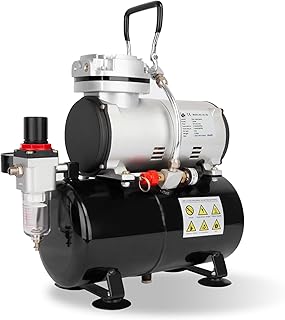
The Timbertech ABPST08 is designed for precision rather than broad automotive panels. Its three-liter tank, regulator, moisture trap, cooling fan, and oil-free single-piston pump suit automotive graphics, model work, touch-ups, and detail painting where consistent low-volume air is more important than high continuous CFM.
Frequently Asked Questions
What size compressor is best for automotive painting?
For small parts and touch-ups, a compact tank can work well, but larger panels generally benefit from a compressor with a tank of at least eight to 13 gallons and enough delivered airflow for the spray gun. Always use the gun manufacturer’s CFM requirement as the deciding reference.
Is an oil-free compressor suitable for painting?
Yes. Oil-free models are convenient and reduce the risk of oil contamination, but they still need clean intake air and proper moisture management. Drain the tank regularly and use a quality inline filter or water separator near the spray gun.
Can a quiet compressor spray an entire car?
A quiet compressor can handle detail work and smaller components, but “quiet” does not mean unlimited airflow. A complete vehicle generally calls for a higher-output compressor, careful duty-cycle management, and a spray gun selected for efficient air consumption.
Is the Timbertech AS186 useful for automotive work?
The Timbertech AS186 is another compact three-liter airbrush compressor suited to automotive graphics, cake decoration, hobby work, and cosmetic detailing. It is a sensible alternative to the ABPST08 for fine spraying, but neither mini compressor is intended for sustained full-size panel painting.
Final Thoughts
For the broadest mix of quiet operation, portability, and beginner-friendly spraying, the California Air Tools 8010 PK is a strong all-around pick. Choose the Klutch 29-Gallon model for longer workshop sessions, the VEVOR for a versatile middle ground, or the Timbertech ABPST08 when your automotive projects center on graphics and fine detail.