Key takeaways
- Connection size: Match the separator’s NPT inlet and outlet to your hose, regulator, or manifold. A reducer can work, but it may restrict airflow.
- Filtration stages: A basic moisture trap handles liquid water, while multi-stage systems can also target particulates, oil mist, and finer aerosol moisture.
- Pressure rating: Choose a unit rated above your compressor’s maximum working pressure, not merely its normal operating setting.
- Drain design: Automatic drains are convenient for frequent use, while semi-automatic drains require more attention but can be simpler to monitor.
- Air demand: Check the separator’s stated flow capacity against tools such as spray guns, plasma cutters, and sandblasters, especially when running long hose lengths.
What's inside
Best Air Compressor Water Separator (2026) — Moisture is one of the easiest ways to turn an otherwise capable compressor into a source of trouble. In a workshop, damp compressed air can cloud spray finishes, encourage corrosion inside tools, contaminate abrasive media, and leave outdoor furniture projects looking uneven.
This guide focuses on separators and dryer systems that suit practical home workshops, garage bays, and covered outdoor work areas. We look at filtration stages, connection size, pressure capacity, drainage, airflow, and the type of finish or pneumatic tool each unit is best equipped to support.
As an Amazon Associate we earn from qualifying purchases.




How to Choose an Air Compressor Water Separator (2026)
- Connection size: Match the separator’s NPT inlet and outlet to your hose, regulator, or manifold. A reducer can work, but it may restrict airflow.
- Filtration stages: A basic moisture trap handles liquid water, while multi-stage systems can also target particulates, oil mist, and finer aerosol moisture.
- Pressure rating: Choose a unit rated above your compressor’s maximum working pressure, not merely its normal operating setting.
- Drain design: Automatic drains are convenient for frequent use, while semi-automatic drains require more attention but can be simpler to monitor.
- Air demand: Check the separator’s stated flow capacity against tools such as spray guns, plasma cutters, and sandblasters, especially when running long hose lengths.
The Best Air Compressor Water Separators (2026) Reviewed
3/4-Inch NPT Industrial 4-Stage Air Drying System
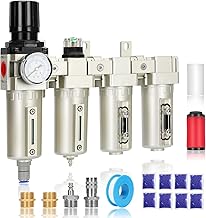
This high-flow 3/4-inch system is a strong fit for a dedicated workshop line, particularly where sandblasting or spray painting places sustained demands on the compressor. Its four-stage layout, regulator, and automatic drain offer a more complete approach to separating oil and water than a small inline trap, although the larger fittings are best suited to substantial plumbing rather than a compact portable compressor.
1/2-Inch NPT 3-Stage Air Drying System
The 1/2-inch NPT model balances workshop capacity with manageable installation. Its particulate filter, coalescing filter, desiccant dryer, metal bowl, regulator, and automatic drain make it a versatile choice for users who want cleaner air for finishing work without moving to a larger 3/4-inch network.
3/8-Inch NPT Double Air Filter Dryer
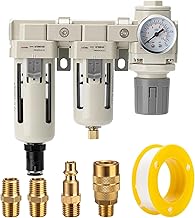
This 3/8-inch system is a practical middle-ground option for a home garage. The paired filters and 0–150 PSI regulator provide useful separation and pressure control for general pneumatic tools, trim work, and occasional finishing tasks; its semi-automatic drain means the owner should include routine bowl checks in the workshop maintenance schedule.
LE LEMATEC AI303 1/4-Inch Inline Filter
The LE LEMATEC AI303 is the most compact pick here and an easy choice for a short hose run, paint gun, or plasma cutter connection. Its 1/4-inch inline format is convenient near the tool, where it can capture moisture that forms downstream, but it is not a substitute for a properly sized primary separator on a demanding shop-wide air line.
1/2-Inch NPT 4-Stage Air Dryer, 141 CFM
For buyers prioritizing airflow and layered filtration, this 1/2-inch, four-stage dryer offers an appealing specification set. The stated 141 CFM capacity and 0–240 PSI rating make it worth considering for plasma cutting and spray applications, while the automatic drain reduces interruptions during longer sessions. Confirm actual system requirements and fittings before installation.
Frequently Asked Questions
Why does compressed air produce water?
Air naturally contains moisture. When a compressor compresses and heats that air, water vapor can condense as the air cools inside the tank, hose, and downstream piping. The effect is often more noticeable in humid weather or in an unheated garage.
Where should an air separator be installed?
Install the main separator downstream of the compressor and tank, allowing the air to cool before filtration. A second small inline filter near a sensitive tool can provide additional protection, particularly for spray guns and plasma cutters.
Is a water separator the same as an air dryer?
Not always. A conventional separator removes condensed liquid and larger contaminants, while a dryer system may add coalescing filtration or desiccant material to reduce finer moisture and oil aerosols. The right choice depends on the tool and finish quality required.
How often should the bowl and drain be checked?
Check them before each substantial project until you understand how quickly your system collects moisture. Drain the compressor tank as well; a separator cannot compensate for a neglected tank full of accumulated water.
Final Thoughts
For a large workshop or high-demand finishing setup, the 3/4-inch 4-stage system is the most substantial choice. The 1/2-inch 3-stage dryer suits many home workshops, while the LE LEMATEC AI303 is a convenient tool-side solution for compact equipment and short runs. Whichever you choose, correct sizing, cool air before filtration, and regular draining matter just as much as the separator itself.