Key takeaways
- Table height: Dining-height bistro tables are commonly 28–30 inches high. Counter-height tables around 34–36 inches require taller stools and usually feel less suitable for a narrow balcony.
- Seat height: A 17–19 inch seat pairs well with a standard dining table. Leave about 10–12 inches between the seat surface and the underside of the tabletop for knee room.
- Table diameter: A 24-inch round table works for coffee, drinks, and light meals. A 28–30 inch table is more practical for two plates, glasses, and serving dishes.
- Chair width: Narrow chairs may be 16–18 inches wide, but 19–22 inches is more comfortable for extended sitting. Measure both chair width and the clearance between the table legs.
- Clearance: Keep at least 24 inches for a passageway and 30–36 inches where someone must pull out a chair and stand.
- Capacity: Look for a published chair weight limit of at least 250 pounds per seat. If the manufacturer gives no capacity, avoid assuming that a lightweight frame is suitable for heavier daily use.
Best Bistro Sets for Small Patios and Balconies
The best bistro sets for a small patio or balcony are usually two-person sets with a table no wider than 24–30 inches, chairs that can be pushed fully underneath, and a total footprint that leaves at least 24 inches of walking clearance.
Start by measuring the usable floor area, not the advertised balcony size. Include the door swing, railing, drain, air-conditioning equipment, and any space needed to pull a chair out. A compact 24-inch round table with two narrow chairs can fit comfortably in an area about 5 by 6 feet, while a 30-inch square table generally needs closer to 6 by 6 feet for practical use. If the available area is narrower than 5 feet, choose folding chairs or a half-moon table that sits against the wall.

Qsun 3 Pieces Patio Furniture Set Rocking Bistro Set Outdoor Rattan Conversation with Coffee Table for Garden Balcony Backyard Poolside (Grey Cushion)
Included for 'Best Bistro Sets for Small Patios and Balconies' as a relevant option in this category; details come from the product listing.
View on Amazon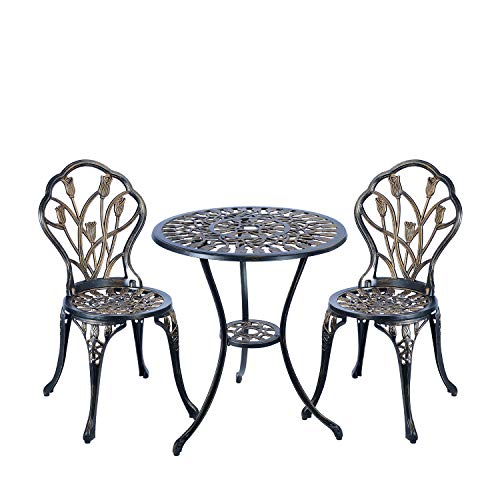
C/G 3 Piece Bistro Set,Outdoor Patio Set,Anti-Rust Cast Aluminum Bistro Table Set for Park Yard Front Porch Furniture(Antique Copper)
Included for 'Best Bistro Sets for Small Patios and Balconies' because the listing specifies Outdoor Patio Set, details this guide uses to compare options.
View on Amazon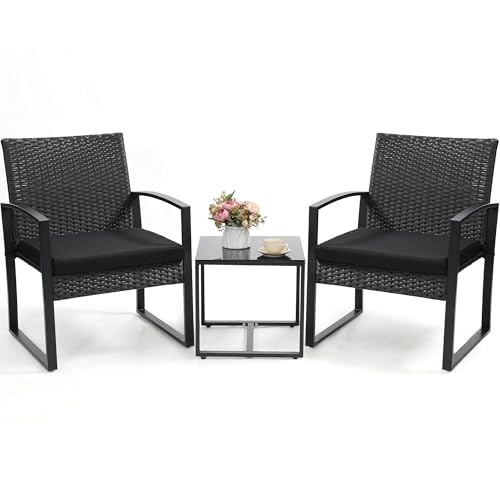
Murago Outdoor 3-Piece Wicker Bistro Set, Patio Conversation Set
Included for 'Best Bistro Sets for Small Patios and Balconies' because the listing specifies Patio Conversation Set, details this guide uses to compare options.
View on Amazon
Best Choice Products 3-Piece Outdoor Bistro Set, Stackable Modern Steel Furniture for Porch, Garden w/ 2 Chairs, Table, Geometric Decor - Peacock Blue
Included for 'Best Bistro Sets for Small Patios and Balconies' because the listing specifies Stackable Modern Steel Furniture for Porch and Garden w/ 2 Chairs, details this guide uses to compare options.
View on AmazonQuick picks by situation
| Situation | Best set type | Useful specifications | Main compromise |
|---|---|---|---|
| Small apartment balcony | Folding metal bistro set | 20–24 in. table; chairs under 18 in. wide | Less cushioning and sometimes more movement on smooth floors |
| Renters who need storage | Folding set with a wall-friendly table | Table under 25 lb; folded depth under 8 in. | Folding joints need occasional tightening |
| Children or pets | Powder-coated steel or aluminum with a stable base | Rounded edges; locking hinges; 250–300 lb chair capacity | Metal can become hot or cold outdoors |
| Back discomfort | Supportive armchair-style chairs | Seat height 17–19 in.; back height at least 28 in. | Wider chairs require more floor space |
| Year-round covered patio | Solid wood or rust-resistant metal | Protective finish; replaceable feet or glides | Wood needs more finish maintenance |
Folding versus fixed bistro sets
Folding sets: best when floor space has multiple uses
Folding chairs and tables are the most flexible choice for a balcony that also serves as a laundry, exercise, or storage area. A chair that folds to roughly 3–8 inches deep can be stored behind a door or hung from a suitable wall rack. Many folding tables use a drop-leaf or folding-leg design, allowing them to be moved indoors during storms.
Look for a positive locking mechanism rather than a hinge that simply relies on friction. Check that the table cannot collapse when someone leans on one edge, and confirm that the chair locks open before sitting down. Folding hardware is also the part most likely to loosen first, so choose visible bolts that can be tightened rather than permanently covered rivets.
The disadvantages are a slightly less rigid feel and fewer ergonomic features. Thin slatted seats can become uncomfortable after 30–45 minutes, particularly without a cushion. Cushions should have ties or non-slip backing, and they must be stored dry because compact balcony sets often receive less airflow than open patios.
Fixed sets: better stability and everyday comfort
A fixed bistro set is preferable when it will stay in the same position. Welded metal frames usually feel more stable than lightweight folding frames, and molded or woven seats can provide better contouring. Fixed chairs are also more likely to have a supportive back and a seat wide enough for relaxed dining.
Allow extra room around fixed furniture. A table and two chairs may occupy only 4 by 4 feet on paper, but a usable arrangement generally needs 24 inches behind each occupied chair. If the chairs face a railing or wall, allow at least 30 inches so a person can stand without twisting sideways.
Materials compared: what survives outdoors?
| Material | Strengths | Weak points | Best use |
|---|---|---|---|
| Powder-coated steel | Rigid, affordable, often heavier and stable | Can rust where the coating chips; gets hot in direct sun | Windy patios and covered balconies |
| Aluminum | Lightweight, naturally corrosion-resistant, easy to move | Can feel less substantial; thin frames may dent | Renters and frequent storage |
| Solid acacia or eucalyptus | Warm appearance and good structural strength | Needs periodic oiling or sealing; can crack if neglected | Covered patios and sheltered balconies |
| Engineered wood | Consistent surfaces and lower cost | Water intrusion at edges can cause swelling | Fully covered, dry locations only |
| Textilene or outdoor polyester | Dries quickly and adds flexible seating | May sag or fade; seams are vulnerable to standing water | Warm climates with good drainage |
| Olefin or solution-dyed acrylic fabric | Better fade resistance than ordinary indoor fabric | Costs more and still needs cleaning | Sunny areas where cushions remain outside |
For exposed balconies, material alone does not make a set weatherproof. Water collects under feet, inside hollow frames, and beneath seat cushions. Look for drainage holes, capped tubing, stainless-steel or galvanized fasteners, and replaceable floor glides. A furniture cover is useful only if air can circulate underneath; a tightly wrapped wet set can develop mildew and corrosion faster.
Measurements that make a compact set comfortable
- Table height: Dining-height bistro tables are commonly 28–30 inches high. Counter-height tables around 34–36 inches require taller stools and usually feel less suitable for a narrow balcony.
- Seat height: A 17–19 inch seat pairs well with a standard dining table. Leave about 10–12 inches between the seat surface and the underside of the tabletop for knee room.
- Table diameter: A 24-inch round table works for coffee, drinks, and light meals. A 28–30 inch table is more practical for two plates, glasses, and serving dishes.
- Chair width: Narrow chairs may be 16–18 inches wide, but 19–22 inches is more comfortable for extended sitting. Measure both chair width and the clearance between the table legs.
- Clearance: Keep at least 24 inches for a passageway and 30–36 inches where someone must pull out a chair and stand.
- Capacity: Look for a published chair weight limit of at least 250 pounds per seat. If the manufacturer gives no capacity, avoid assuming that a lightweight frame is suitable for heavier daily use.
For a balcony measuring 4 by 8 feet, a 20–24 inch round or square table placed at one end usually works better than a rectangular table centered in the space. For a 6 by 10 foot balcony, a 28–30 inch table with two 18–20 inch chairs can leave a useful route to the door. A 10 by 12 foot patio offers more freedom: a 30-inch table, two armchairs, and a 24-inch circulation path can fit without making the space feel crowded.
Comfort: the feature compact furniture often misses
Compact does not need to mean stiff. A gently curved back, a seat that slopes slightly backward, and a front edge that does not press into the thighs matter more than thick cushions alone. For longer meals, choose a back that reaches at least the shoulder blades and a seat depth around 16–18 inches. Deep seats can be uncomfortable for shorter users unless they use a firm cushion behind the lower back.
If cushions are included, check whether the covers unzip for washing and whether replacement cushions are available in a standard size. Outdoor foam should drain quickly; ordinary indoor foam can retain water and develop odors. Cushions around 2–3 inches thick are usually a practical balance between comfort and preserving knee clearance beneath a small table.
Assembly, moving, and durability realities
Before ordering, measure the narrowest doorway, stair landing, elevator, and balcony entrance. A fixed chair may be only 22 inches wide but still arrive in a carton over 30 inches wide. A complete metal set commonly weighs about 35–70 pounds, while a solid-wood set may weigh 60–100 pounds. Dividing the load into separate chair and table cartons makes upstairs delivery easier.
Assembly is usually limited to attaching legs, braces, or tabletop sections. Budget 30–90 minutes for a two-chair set, use a level surface, and leave bolts slightly loose until all parts are aligned. Fully tightening one side early can make the remaining holes difficult to line up. After several weeks of use, inspect leg joints, hinge bolts, welds, and plastic feet. Replace missing feet promptly: a bare metal leg can damage waterproofing or tile and may allow water to sit inside the frame.
The first wear points are normally the finish on chair arms, folding hinges, cushion seams, and feet—not the tabletop. Keep the set level, wipe away salty or chlorinated residue, and store cushions indoors during prolonged rain. For wood, follow the finish manufacturer’s maintenance schedule; for coated metal, touch up chips before rust spreads beneath the coating.
How to choose among the best bistro sets
- Measure the usable area and mark a 24-inch minimum walking route with painter’s tape.
- Choose the largest tabletop that still leaves chair and door clearance; for two people, this is often 24–30 inches.
- Decide whether the set must disappear. If yes, prioritize folded dimensions, locking hardware, and manageable weight over armrests.
- Match the material to exposure: aluminum for easy movement, coated steel for stability, and finished solid wood for a sheltered setting.
- Confirm seat height, chair capacity, cushion drainage, and replacement parts before comparing appearance or price.
- Inspect the assembly instructions and carton dimensions so the set can reach the balcony without a difficult lift or return.
Most well-made compact bistro sets fall in the general market range of $150–$600, with premium solid wood, high-quality outdoor fabric, and heavier corrosion-resistant frames costing more. The best value is not necessarily the lowest price: a slightly narrower set with replaceable feet, washable cushions, and repairable hardware can remain useful longer than a larger set that leaves no room to move.