Our Top Picks
For most builders the best Corsair water cooler is a 240 mm or 280 mm iCUE LINK or Elite-series all-in-one for mainstream gaming processors, a 360 mm model for high-power chips, and a 120 mm or 240 mm entry model for compact or budget builds. Corsair sells sealed all-in-one (AIO) liquid coolers in several radiator sizes, so the right pick depends on your processor, case radiator support and how much cooling noise you will accept.
How Corsair’s AIO Range Is Organised
Corsair groups its sealed liquid coolers into families that differ mainly in fan quality, pump head features, lighting and software. The maker’s own product pages list radiator sizes of 120 mm, 240 mm, 280 mm, 360 mm and, on some models, 420 mm. Higher tiers add a screen or LED pump head, a bundle of fans that connect through a single digital cable, and control through the iCUE software. The H-series naming reflects radiator length: an H100-class model uses a 240 mm radiator, an H150-class model uses 360 mm, and so on. Model names change between generations, so check the maker’s current page for exact specs and socket support.
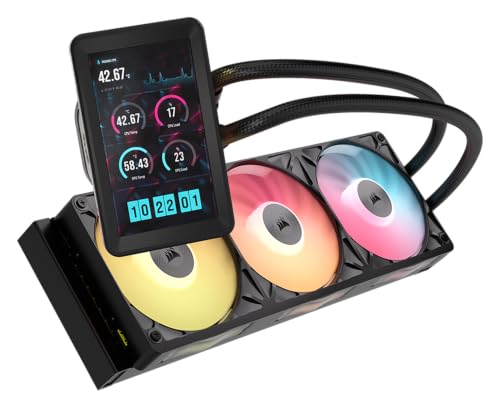
CORSAIR iCUE LINK TITAN II 360 RX LCD AIO Liquid CPU Cooler – Black | 5" IPS LCD DisplayPort Screen, RX II RGB Unified Fans Included, AMD AM5/AM4, Intel LGA 1954/1851/1700, System Hub Included
Chosen because it specifies Black and 5" IPS LCD DisplayPort Screen.
View on Amazon
CORSAIR Nautilus 360 RS ARGB Low-Noise Liquid CPU Cooler – Black | 360mm AIO, Daisy-Chain, Intel LGA 1851/1700, AMD AM5/AM4, 3x RS120 ARGB Fans Included
Chosen because it specifies Black and 360mm AIO.
View on Amazon
CORSAIR iCUE LINK TITAN II 360 RX RGB AIO Liquid CPU Cooler – White | RX II RGB Unified Fans Included, AMD AM5/AM4, Intel LGA 1954/1851/1700, FlowDrive Gen 2 Pump, System Hub Included
Chosen because it specifies White and RX II RGB Unified Fans Included.
View on AmazonAll current Corsair AIOs are meant to be maintenance-free sealed loops. Buyers should confirm that their motherboard socket is listed: current models cover recent AMD and Intel desktop sockets, and Corsair publishes socket compatibility on every product page.
At a Glance: Corsair AIO Choices
| Family (current generation) | Radiator sizes | Best for | Key stated points | Limits |
|---|---|---|---|---|
| iCUE LINK TITAN series | 240 mm, 280 mm, 360 mm, 420 mm | High-end builds that want a clean cable layout | The maker lists a daisy-chained fan and cable system and an LCD or LED pump head on some versions | Needs a compatible iCUE LINK hub; higher cost tier |
| iCUE Elite / Elite CAPELLIX series | 240 mm, 280 mm, 360 mm | Overclockers who want lighting and software control | RGB pump head and fans, iCUE control | More cable runs than the LINK system |
| H-series (H100i, H115i, H150i families) | 240 mm to 360 mm | Mid-range builds focused on cooling per dollar | Standard pump head, 120 mm or 140 mm PWM fans | Fewer lighting and display options |
| H60 / H80-class (older or entry) | 120 mm | Compact builds and budget machines | Single radiator, simple installation | Limited headroom for high-power chips |
| Hydro X custom loop parts | Custom | Enthusiasts building bespoke loops | Blocks, radiators, pumps sold separately | Requires experience and routine maintenance |
Choosing a Radiator Size
Radiator length is the biggest single factor. A 120 mm unit suits low-power processors in small cases. A 240 mm or 280 mm unit is the practical default for mid-range and many high-end gaming chips. A 360 mm or 420 mm unit gives the most surface area and lets fans run slower and quieter at the same temperatures, which reviewers often cite as the main benefit of larger radiators. Check your processor’s stated power rating, and remember that sustained all-core workloads like rendering stress a cooler more than gaming does.
iCUE LINK Versus Standard Fan Connections
The iCUE LINK system lets fans and pump heads connect in a chain using a single cable to a hub, which reduces clutter. The trade-off is that it is a proprietary system and needs the hub, usually supplied in the box. The Elite-series coolers use conventional connections plus a USB header for lighting, which are easier to mix with third-party hardware. Choose LINK if cable tidiness and software control matter, and Elite or H-series if you prefer standard connectors.
Fit, Size and Compatibility Notes
- Case radiator support: confirm your case lists support for the radiator size at the front, top or rear. Top mounting can clash with tall memory modules on some boards.
- Radiator thickness: thicker radiators plus fans can leave less clearance. Check the case maker’s clearance numbers.
- Socket support: the maker lists AMD AM4 and AM5 and Intel LGA 1700 and 1851 on current models. Older sockets are covered on older products only.
- Memory clearance: front-mounted radiators avoid memory conflicts; top-mounted ones sometimes do not.
- Tube length: large cases with a top radiator and a distant pump may need longer tubing than some coolers include.
- Software: iCUE is optional for basic operation, but features like fan curves and lighting need it.
Care and Safety Notes
Sealed AIOs should not be opened or refilled. Turn the system off and unplug it before installing or moving the cooler. Keep tubing from sharp bends and avoid pinching it against case panels. Clean dust from radiators and fans with compressed air every few months, holding fans still so they do not spin. If you ever see liquid inside the case, switch the machine off, unplug it, and contact the maker’s support for a warranty claim rather than continuing to use it.
Trade-Offs by Budget Tier
- Budget: 120 mm and basic 240 mm H-series models. They offer simple installation and decent cooling for mainstream chips but fewer features.
- Mid-range: Elite series 240 mm or 280 mm coolers with better fans and software control.
- Premium: iCUE LINK TITAN models with 360 mm or 420 mm radiators, displays and refined cable management, aimed at high-power processors.
Pick X If: Decision Table
| If you… | Pick | Why |
|---|---|---|
| Build in a small case | 120 mm or 240 mm H-series | Fits tight radiator mounts |
| Play games on a mainstream chip | 240 mm or 280 mm Elite or H-series | Balanced cooling and noise |
| Run a high-power chip or render | 360 mm or 420 mm TITAN or Elite | Largest cooling surface |
| Care about clean cabling | iCUE LINK TITAN | Single-cable daisy chain |
| Want a custom, serviceable loop | Hydro X parts | Replaceable components |
Alternatives to Consider
- Arctic Liquid Freezer series: reviewers often point to it as strong value among AIOs, with integrated VRM fan on some versions.
- NZXT Kraken family: offers customizable display pump heads and similar radiator sizes.
- Large air coolers: the Noctua NH-D15 and be quiet! Dark Rock Pro 5 are frequently cited as quiet, pump-free alternatives with no leak risk.
- Lian Li and Thermalright: competing AIO families with various radiator sizes and display options.
Frequently Asked Questions
Which Corsair radiator size should I choose?
Match it to your processor’s power and your case. A 240 mm or 280 mm model covers most mainstream builds, while 360 mm suits high-power chips and sustained workloads. Check your case’s radiator support before buying.
Is iCUE software required?
Basic cooling works without it. You need iCUE for features like custom fan curves, lighting effects and display content on supported pump heads.
Are Corsair AIOs compatible with AMD AM5 and Intel LGA 1851?
The maker lists support for current sockets on its recent models, but older units may not include brackets for them. Check the product page’s socket list for the exact model.
How long do AIO coolers last?
Makers typically offer multi-year warranties, but actual life depends on the pump, coolant loss and conditions. Rising temperatures or pump noise can signal it is time to replace the unit.
Is an air cooler better than an AIO?
Not necessarily. Large tower air coolers can match smaller AIOs while avoiding pumps and coolant. AIOs generally suit cases where a tower would not fit or where better airflow around the board is wanted.
Can I refill a Corsair AIO?
The maker describes these as sealed, maintenance-free units. Do not open them. If the loop fails, contact the maker about warranty support.