Key takeaways
- Runner material and fit: UHMW bars glide smoothly and shrug off humidity swings in an unheated garage or shop shed. Aluminum rails are stiffer and often adjustable, which matters if your miter slots are slightly oversized. Either way, look for a design that lets you dial out side-to-side slop, since that play is where squareness errors originate.
- Capacity versus footprint: A wide sled handles 24-inch bench slats, but it also eats space on a jobsite saw and adds weight you have to shove through every cut. Small-parts sleds excel at chair spindles, tenon cheeks, and trim, so many woodworkers end up owning both rather than compromising on one.
- Zero-clearance support: The kerf should be cut by your own blade on first use, and the fence should back up the workpiece right at the blade. That combination is what keeps splintery ends off cedar, redwood, and plywood veneer.
- Fence squaring and T-track: Adjustable fences with a five-cut-method-friendly pivot are worth the extra step. T-track lets you add stop blocks for repeat cuts, which is the single biggest time saver when you are producing forty identical deck chair slats.
- Kit versus finished jig: Hardware kits cost less and let you size the base to your saw, but you supply the plywood and the patience. Assembled sleds ship ready to square up and use, which suits anyone who would rather build furniture than build tooling.
What's inside
Anyone who has built a cedar bistro chair or a slatted planter bench knows the moment the project starts to unravel: the crosscuts. A miter gauge that wanders half a degree turns a set of four identical apron pieces into four almost-identical apron pieces, and by the time you clamp up, the joints are gapping and the seat is rocking on the patio flagstones. Outdoor furniture punishes sloppy crosscuts more than indoor work does, because thermal movement and rain exposure widen every gap you leave behind.
A crosscut sled fixes the root cause. It rides the miter slots on dedicated runners, supports the workpiece on both sides of the blade, and gives you a zero-clearance kerf that stops tearout on the show face of your teak or white oak. This guide covers the sleds and sled kits worth your money in 2026, from compact small-parts jigs for dowels and tenon shoulders to full hardware kits you assemble around your own baseplate. I have framed the picks around the work that actually matters for outdoor builds: repeatable slat lengths, square rail ends, and safe handling of short offcuts.
As an Amazon Associate we earn from qualifying purchases.


How to Choose a Crosscut Sled For Table Saw (2026)
- Runner material and fit: UHMW bars glide smoothly and shrug off humidity swings in an unheated garage or shop shed. Aluminum rails are stiffer and often adjustable, which matters if your miter slots are slightly oversized. Either way, look for a design that lets you dial out side-to-side slop, since that play is where squareness errors originate.
- Capacity versus footprint: A wide sled handles 24-inch bench slats, but it also eats space on a jobsite saw and adds weight you have to shove through every cut. Small-parts sleds excel at chair spindles, tenon cheeks, and trim, so many woodworkers end up owning both rather than compromising on one.
- Zero-clearance support: The kerf should be cut by your own blade on first use, and the fence should back up the workpiece right at the blade. That combination is what keeps splintery ends off cedar, redwood, and plywood veneer.
- Fence squaring and T-track: Adjustable fences with a five-cut-method-friendly pivot are worth the extra step. T-track lets you add stop blocks for repeat cuts, which is the single biggest time saver when you are producing forty identical deck chair slats.
- Kit versus finished jig: Hardware kits cost less and let you size the base to your saw, but you supply the plywood and the patience. Assembled sleds ship ready to square up and use, which suits anyone who would rather build furniture than build tooling.
The Best Crosscut Sled For Table Saw (2026)s Reviewed
Small Crosscut Sled with Zero-Gap Support and Aluminum Rails
Built for the fiddly cuts that make outdoor seating look finished, this compact sled handles 90-degree crosscuts on thin dowels, tenons, and decorative molding without the offcut diving toward the blade. The aluminum slide rails fit most saws and stay predictable through seasonal humidity changes, and the zero-gap support keeps the ends crisp enough to glue straight from the saw.
Rockler Small Parts Crosscut Sled
Rockler’s small-parts sled solves the safety problem first: your hands stay well clear while short stock is held firmly against a zero-clearance surface. It is the sled I reach for when trimming chair stretchers and plug stock, and the build quality justifies the premium over shop-made alternatives.
POWERTEC 71403 Table Saw Crosscut Sled Kit
This jig and hardware kit is the practical middle ground, supplying the runners, fence hardware, and fittings while you cut a base sized to your own saw and typical stock. Once squared with the five-cut method, it delivers repeatable results that rival far more expensive commercial sleds.
UHMW Miter Bars, 3/4″ x 3/8″ x 17″ (4-Pack)
Four UHMW bars give you the foundation for a sled, a tenoning jig, and a couple of fixtures with material left over. UHMW is the right choice for shops that see damp mornings, since it will not swell or corrode the way wood or steel runners can.
21P Table Saw Sled Kit with T-Track and UHMW Bars
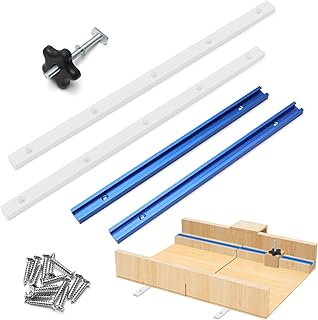
The most complete starting point here, with two aluminum T-tracks, two UHMW miter bars, predrilled holes, knobs, and screws. The T-track is the standout feature, letting you mount adjustable stop blocks for batching slats and rails at identical lengths.
Frequently Asked Questions
Do I still need a miter gauge?
For most crosscutting, no. A sled is more accurate and safer. Keep the gauge for angled cuts beyond your sled’s range or when a sled would not fit the workpiece.
How do I square the fence?
Use the five-cut method. It multiplies any error across four cuts, letting you measure a deviation too small to see and correct it with a light fence adjustment.
Will a sled fit my portable jobsite saw?
Usually, but measure your miter slots and check table depth first. Smaller saws favor compact sleds, since an oversized base can tip past the front edge mid-cut.
What wood should I use for the base?
Flat, stable plywood or MDF, ideally sealed on both faces. Sealing matters most if your shop is a garage or outbuilding with swinging humidity.
Final Thoughts
For most outdoor furniture builders, the 21P Table Saw Sled Kit offers the best combination of value and expandability thanks to its T-track and UHMW bars, while the POWERTEC 71403 is the cleaner choice if you want the hardware sorted and a base built to your own dimensions. Add the Rockler Small Parts Crosscut Sled for chair spindles, tenons, and short trim, and you have the crosscutting side of the shop fully covered.