Key takeaways
- Voltage and circuit: Anything above roughly 1,800W needs a dedicated 240V circuit. Confirm you have an open double-pole breaker and the right gauge wire before you buy, and budget for an electrician if the unit is hardwired rather than plug-in.
- Wattage to square footage: Plan on about 10 watts per square foot in an insulated garage and closer to 15 to 20 in an uninsulated or high-ceilinged one. A 5,000W unit comfortably handles a two-car bay; 7,500W suits a larger shop or pole barn.
- Mounting style: Ceiling and wall mounts keep the unit clear of sawdust, vehicles, and tripping hazards, and they let you aim the airflow down into the work zone. Portable models make sense if you heat more than one space or rent.
- Controls that save energy: A digital thermostat cycling on and off costs far less to run than a manual dial left wide open. Timers and remotes matter more than they sound when the unit is mounted ten feet up.
- Safety and certification: Look for ETL or UL listing, tip-over shutoff on portables, and overheat protection on everything. Keep clearances honest around fuel, finishes, and stored gear.
What's inside
A garage in January is a different animal from the rest of the house. Uninsulated slab, a big steel door that leaks air around every edge, and often a single wall of block between you and the weather. If you have ever tried to warm that space with the little ceramic heater from the guest bedroom, you already know how that ends: a warm circle three feet wide, a tripped breaker, and hands too cold to hold a socket wrench. The same problem shows up in detached shops, potting sheds, and three-season porches where the season keeps getting cut short.
The fix is a heater built for the volume of air you are actually trying to move. This guide walks through what separates a real shop heater from a household unit, how to match wattage to your square footage without over-buying, and which mounting style makes sense for a working space where floor area is currency. Below are six units worth considering in 2026, spanning hardwired ceiling workhorses to plug-in radiant options for patios and smaller bays.
As an Amazon Associate we earn from qualifying purchases.


How to Choose a Garage Electric Space Heater (2026)
- Voltage and circuit: Anything above roughly 1,800W needs a dedicated 240V circuit. Confirm you have an open double-pole breaker and the right gauge wire before you buy, and budget for an electrician if the unit is hardwired rather than plug-in.
- Wattage to square footage: Plan on about 10 watts per square foot in an insulated garage and closer to 15 to 20 in an uninsulated or high-ceilinged one. A 5,000W unit comfortably handles a two-car bay; 7,500W suits a larger shop or pole barn.
- Mounting style: Ceiling and wall mounts keep the unit clear of sawdust, vehicles, and tripping hazards, and they let you aim the airflow down into the work zone. Portable models make sense if you heat more than one space or rent.
- Controls that save energy: A digital thermostat cycling on and off costs far less to run than a manual dial left wide open. Timers and remotes matter more than they sound when the unit is mounted ten feet up.
- Safety and certification: Look for ETL or UL listing, tip-over shutoff on portables, and overheat protection on everything. Keep clearances honest around fuel, finishes, and stored gear.
The Best Garage Electric Space Heaters of 2026, Reviewed
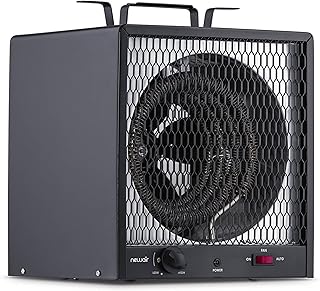
NewAir 240V Portable Garage Heater
The strongest pick if you want industrial output without committing to a permanent install, since it plugs into a 240V outlet and can follow you from garage to shed. The steel housing and carry handle are built for a working environment, not a living room.
Comfort Zone 5000W Ceiling Mounted Garage Heater
A no-nonsense hardwired unit with three heat settings that covers a standard two-car garage well, and the ceiling mount frees up every inch of wall and floor. Straightforward controls make it a good fit if you would rather set it and forget it than manage an app or a menu.
5000W Fan-Forced Heater with Remote and Digital Thermostat
This one earns its keep on the control side: a digital thermostat, a 1 to 9 hour timer, and a remote that spares you the ladder trip. Rated for around 500 square feet, it also does well in greenhouses where holding a steady temperature overnight matters more than raw output.
TEMPWARE 7500W Hardwired Garage Heater
The heavy hitter here, and the right call for oversized shops, pole barns, and warehouse bays where 5,000W simply cannot keep up. The 12-hour timer and remote-driven digital thermostat give it genuine set-and-forget behavior once an electrician has it wired in.
Shinic Radiant Quartz Heater with Work Light
Radiant quartz warms people and surfaces directly rather than heating all the air, which makes it the most practical option for open patios, carports, and drafty single bays. The 90-degree rotation and built-in work light are a genuinely useful combination over a workbench.
Frequently Asked Questions
Do I really need a 240V heater?
For a full garage, usually yes. A 120V unit caps out near 1,500W, which is enough to take the edge off a small insulated space but not enough to bring a cold two-car garage up to working temperature in reasonable time.
Can I run a garage heater on an extension cord?
Avoid it. High-wattage heaters draw sustained current that thin cords are not rated for, and it is a common cause of overheating. Use a properly rated outlet, or hardwire the unit.
What size heater does my garage need?
Measure the square footage and multiply by 10 to 20 watts depending on insulation and ceiling height. A typical 400 to 500 square foot two-car garage lands squarely in 5,000W territory.
Are these safe for a covered patio or porch?
Radiant models are the better choice outdoors, since fan-forced heat dissipates quickly in moving air. Confirm the unit’s rating for damp locations and keep it under solid cover, out of direct rain and snow.
Final Thoughts
For most two-car garages, the Comfort Zone 5000W ceiling unit hits the sweet spot of output, simplicity, and price. Step up to the TEMPWARE 7500W if you are heating a large shop or barn, and choose the Shinic radiant quartz heater when the goal is warming people on a patio or in an open bay rather than sealing and heating a whole room.