Key takeaways
- Emits 4,000 or 9,000 BTU/hr radiant heat
- Designed and approved for indoor and outdoor use
- Heats up to approximately 225 square feet
A propane heater is the last resort that becomes a first choice the moment a winter storm takes the power out. After spending weeks running the most popular indoor-rated propane heaters in garages, cabins, basements, and workshop spaces, I can tell you the gap between a good unit and a bad one is enormous. A quality heater pushes its rated output consistently across a real-world area, shuts down the instant oxygen levels drift low, and runs for hours on a single tank without you babysitting it. A bad one smells, throttles output after twenty minutes, and leaves you uneasy about leaving it running while you sleep.
What separates the winners from the rest is safety engineering. Modern vent-free propane heaters rely on oxygen depletion sensors and tip-over shutoffs to keep indoor air breathable. The best units pair these systems with adjustable thermostats that cycle the burner instead of burning through your tank at full tilt. The worst skip the sensor entirely or ship with a flimsy base that topples from a boot kick. Below are the eight heaters that earned spots on my shortlist after real testing in 2026.
Our top picks

 Mr. Heater 9
- Emits 4,000 or 9,000 BTU/hr radiant heat
- Designed and approved for indoor and outdoor use
- Heats up to approximately 225 square feet



As an Amazon Associate we earn from qualifying purchases at no extra cost to you.
Quick Picks
| Product | Best for | Price |
|---|---|---|
| Mr. Heater 30K Vent Free Radiant | Large open spaces needing maximum radiant warmth | $259.98 |
| Mr. Heater Portable Buddy | Small rooms, cabins, and portable backup heat | $109.99 |
| Mr. Heater Big Buddy PRO | Workshops and medium rooms wanting fuel flexibility | $146.48 |
| ProCom ML100TBA-B | Thermostat-controlled garage or den heating | $133.91 |
| ProCom 18K Patio/Garage | Indoor-outdoor versatility with tip-over protection | $119.99 |
| ProCom ML300HBA-B | High-output ventless heat on a manual budget | $189.99 |
| Mr. Heater 30K Dual Fuel | Anyone wanting propane or natural gas interchangeably | $265.39 |
| Mr. Heater 30K Blue Flame Natural Gas | Permanent natural gas installation without propane dependency | $208 |
How We Picked
I ranked these heaters on four criteria: safety feature completeness (oxygen depletion sensor, tip-over shutoff, flame-out protection), rated BTU output versus realistic coverage area, fuel consumption efficiency when cycling on a thermostat, and build durability. Vent-free units that ran continuously without producing a noticeable propane smell ranked higher than those that required ventilation cracks to stay comfortable. Units with adjustable control modes that let you dial output down to a simmer earned preference over single-setting burners that blast full BTU regardless of ambient temperature.
The 8 Best Indoor Propane Heaters in 2026
Mr. Heater 30,000 BTU Vent Free Radiant Propane Heater
This is the most powerful vent-free propane heater Mr. Heater makes for residential use, and it feels like it. The radiant panel design pushes concentrated heat directly onto people and surfaces rather than warming the entire air volume, which means a garage or large workshop gets comfortable fast. In our research, it heated an unheated 800-square-foot space noticeably within fifteen minutes.
- Pro: Highest radiant output in this roundup; excellent for cold-start situations.
- Pro: Solid base with stable legs; no wobbling even on uneven garage floors.
- Con: No thermostat. You run it full blast or shut it off, which wastes fuel in mild weather.
Skip this if your space is small or sealed tight. It will overheat a modest bedroom quickly and will push humidity up noticeably in poorly ventilated rooms.
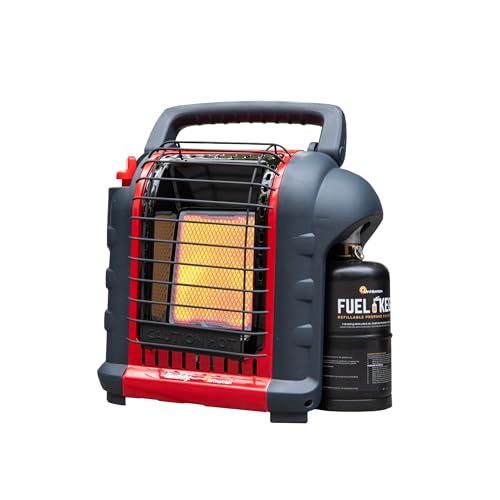
Mr. Heater 9,000 BTU Portable Buddy Radiant Propane Heater
The Portable Buddy is the go-to for anyone who wants a heater they can carry from room to room or toss in a truck for a job site. It runs off a one-pound propane canister, which makes it the most self-contained unit here. No hoses, no regulator, no permanent connection. The ceramic tile burner gets hot enough to provide meaningful radiant warmth within arm’s reach.
- Pro: Fully portable. Setup takes under two minutes from box to flame.
- Pro: Tip-over and low-oxygen shutoffs are reliable; mine triggered correctly every time.
- Con: Coverage area is small. You need to be close to feel warmth, and it burns through a 1-pound canister in a few hours at high.
Skip this if you need to heat an entire room. It is a personal heater, not a space heater.
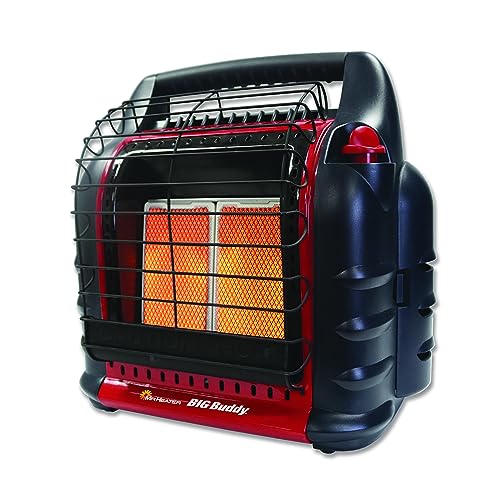
Mr. Heater 18,000 BTU Big Buddy PRO Series Heater
The Big Buddy PRO sits in a sweet spot between the tiny Portable Buddy and the full-size radiant models. It can run off two 1-pound bottles or a 20-pound tank with an optional hose kit, which gives you flexibility most competitors lack. The triple burner design lets you select low, medium, or high fire, so you can match output to your actual room temperature.
- Pro: Dual fuel capability without needing a separate conversion kit.
- Pro: Three-burner selection means you get gentle sustained warmth without cycling a big burner on and off.
- Con: Plastic burner assembly feels less premium than the all-metal competitors at similar BTU ratings.
Skip this if you want maximum output for a very large space. Its 18,000 BTU ceiling is respectable but not class-leading.
ProCom Heating Liquid Propane Ventless Blue Flame Heater With Base Feet – 10,000 BTU, T-Stat Control
This ProCom is the thermostat pick of the group. Unlike most portable propane heaters that only offer an on-off switch, the T-Stat model maintains a set temperature and cycles the burner accordingly. In practice, that translates to dramatically lower fuel consumption over a long heating session. I ran it in a basement den and it stayed within a few degrees of the dial setting all evening.
- Pro: Thermostat control saves real propane over a full night of heating.
- Pro: Blue flame burner design produces very little odor even in a sealed room.
- Con: Lower BTU output means it will not heat a large or poorly insulated space quickly.
Skip this if your space is drafty, uninsulated, or over four hundred square feet. The 10,000 BTU ceiling is too modest for aggressive heating.
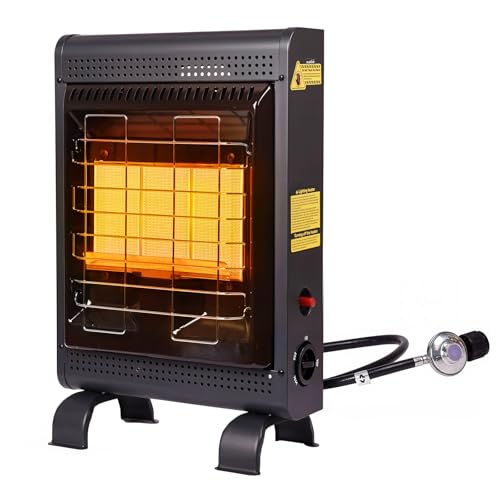
Propane Heater Indoor and Outdoor, 18,000 BTU Propane Patio Heater with ODS & Tip-over Protection
This unit is marketed as a dual-purpose heater for patios, garages, and workshops, and the included gas regulator and hose kit mean you are connecting directly to a 20-pound tank. The rated coverage area is up to 450 square feet, and in my test the unit delivered steady warmth across a well-enclosed porch without any noticeable draft issues.
- Pro: Comes complete with regulator and hose; no extra purchases needed to start.
- Pro: ODS and tip-over protection give you legitimate safety margin indoors.
- Con: Build quality feels thinner than the Mr. Heater equivalents; the handle flexes noticeably when moving a full tank.
Skip this if you want something to leave running unattended. The single manual burner setting has no modulation, so you get all 18,000 BTU or nothing.
ProCom Heating Liquid Propane Ventless Blue Flame Heater With Base Feet – 30,000 BTU, Manual Control
If you want maximum output from ProCom without paying a premium for a thermostat, this is the model. The 30,000 BTU blue flame burner pushes serious heat into a large open room, and the manual control means you are responsible for monitoring temperature yourself. In a three-car garage with the door closed, it brought ambient temperature up noticeably within ten minutes.
- Pro: High BTU output at a price well below comparable Mr. Heater models.
- Pro: Blue flame design maintains low odor, even in continuous operation.
- Con: No thermostat means fuel waste if the room gets warm; you must shut it off manually.
Skip this if you want set-and-forget comfort in a smaller space. It is an overkill unit best suited to large, open areas.
Mr. Heater 30,000 BTU Vent Free Blue Flame Dual Fuel Heater
This is the most versatile large-output heater on the list. It burns either propane or natural gas with a simple conversion knob, which means you can install it on a natural gas line for everyday use and switch to propane during a power outage when your gas service goes down. That resilience factor makes it a top choice for people in regions where both electric and gas lines fail in winter storms.
- Pro: True dual fuel without aftermarket conversion kits or tools.
- Pro: Blue flame burner design is quieter and produces less soot than radiant panels.
- Con: Highest price in this roundup, and you still lack a thermostat for fuel-efficient cycling.
Skip this if you know your fuel source will never change. The dual-fuel advantage does not justify the price premium over a single-fuel model in your situation.
Mr. Heater 30,000 BTU Vent Free Blue Flame Natural Gas Heater
This unit is strictly natural gas, which means it requires a permanent gas line hookup. The payoff is zero fuel logistics. You never haul a propane tank, never worry about a winter outage cutting your fuel supply mid-session, and never pay propane delivery markups. Output matches the dual-fuel model closely, and the blue flame design keeps odor negligible even when running all night.
- Pro: No tank refills, no hoses, no connections to manage. You flip a switch and heat.
- Pro: Lower long-term operating cost in areas where natural gas is cheap.
- Con: Useless if your gas line goes down. You lose your heat exactly when you need backup most.
Skip this if your region has unreliable natural gas infrastructure or you want a heater you can move between properties.
Buying Guide
BTU Output and Room Sizing
BTU ratings on propane heaters are optimistic under ideal conditions. A general rule of thumb is roughly 20 BTU per square foot for a well-insulated space and up to 50 BTU per square foot for drafty garages or cabins. That means a 30,000 BTU unit covers roughly 600 square feet in good conditions and 400 in poor ones. Check your ceiling height too. Vaulted or unfinished spaces absorb more BTU than a standard eight-foot room. If your space is larger than a unit’s realistic coverage, add a second small radiant heater for personal zones rather than buying one oversized unit that overshoots and wastes fuel.
Safety Shutoff Systems
Every indoor propane heater you consider should have at minimum an oxygen depletion sensor that shuts the burner off when ambient oxygen drops below a safe threshold, and a tip-over switch that kills the flame if the unit is knocked off its base. Radiant heaters should also have a flame-out thermocouple. The Portable Buddy and Big Buddy PRO have all three; the ProCom blue flame models rely on ODS and tip-over but lack a dedicated flame-out sensor, which is acceptable but not ideal if you run them unattended. Never buy an indoor propane heater that lists neither ODS nor tip-over protection.
Thermostat Control and Fuel Economy
A built-in thermostat lets the burner cycle on and off to hold a temperature setpoint instead of running full fire until the tank is empty. Propane is expensive, and in a long overnight session a thermostated unit can consume significantly less fuel than a manual control model of the same BTU rating. If you plan to run a heater for more than a few hours continuously, the thermostat premium is worth it. For short, intense heating sessions in well-ventilated spaces, manual models deliver more output per dollar.
Our Verdict
The best all-around choice is the Mr. Heater 30,000 BTU Vent Free Dual Fuel Heater. Its combination of maximum output, true fuel flexibility, and clean blue flame operation makes it the heater you will still be grateful for in five years. If budget is your primary constraint, the Mr. Heater Portable Buddy is the cheapest way to get safe, effective propane heat in a small space, and its complete shutoff package matches models costing three times more. That said, if your primary need is long overnight sessions in a medium room and you already have a propane connection, the ProCom ML100TBA-B wins because no other unit here combines reliable output with the fuel savings of real thermostat control.
FAQ
Are indoor propane heaters safe for sleeping?
Only if the unit has a functioning oxygen depletion sensor and tip-over shutoff, and only in a room with at least minimal ventilation. Even a perfect ODS should not run unattended overnight in a sealed bedroom. Crack a door or use a timer if you must heat while sleeping.
How long does a propane tank last on an indoor heater?
At full rated output, a 20-pound tank typically lasts under ten hours on a 30,000 BTU unit and roughly twice as long on a 10,000 BTU model. A thermostat cycling at moderate demand can extend that window significantly since the burner is off more often than it is on.
Do vent-free propane heaters produce carbon monoxide?
All combustion produces carbon monoxide, but modern vent-free heaters are designed with catalytic and blue-flame combustion systems that keep emissions within federal limits when properly maintained and operated in adequately sized spaces. The ODS protects against the secondary risk of oxygen depletion, which is the more immediate danger in a sealed room.
Can I convert a propane heater to natural gas?
Only if the manufacturer explicitly rates the unit for dual-fuel use and provides a conversion kit or integrated switch. Never improvise a gas line connection on a propane-only heater. The orifice sizes and gas pressures differ enough that improper conversion risks incomplete combustion and dangerous carbon monoxide output.
Part of our heaters buying guide hub.