Our Top Picks
The best laptop cooling pads balance three things: enough airflow for your laptop’s heat output, noise low enough for calls and concentration, and a height range that does not turn a desk into an uncomfortable workstation.
Quick picks by situation
| Your situation | Best cooling-pad type | Specifications to look for | Why it fits |
|---|---|---|---|
| Small desk or apartment | Compact single-fan pad | 14–16 inch support, 15–25 dBA, under 1.5 lb | Uses little desk space and creates less background noise |
| Gaming or rendering laptop | Large high-airflow pad | 17–18 inch support, two or more fans, adjustable speed, 30–40 dBA | Moves more air through a hot chassis during sustained loads |
| Video calls and shared rooms | Low-noise mesh pad | 20–28 dBA at normal speed, rubber feet, no rattling grille | Less likely to enter a microphone or disturb other people |
| Neck or shoulder discomfort | Multi-angle ergonomic pad | At least 20–35 degrees of elevation, stable front lip, separate keyboard | Raises the screen, but allows the keyboard and mouse to stay at a usable height |
| Travel or hot-desk use | Low-profile USB pad | Under 1.2 inches folded, under 2 lb, one USB pass-through port | Fits more easily in a laptop bag and does not require a wall outlet |
How to compare the best laptop cooling pads
Fan size and airflow
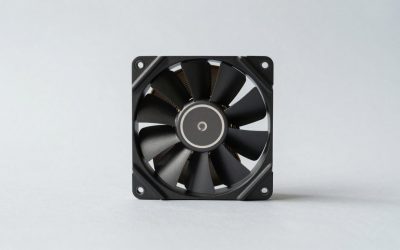
Fan diameter matters, but it is not the only measure of cooling. A single 140–200 mm fan often spreads air across a laptop base more evenly and can run at a lower speed than several small fans. This usually makes it a good choice for an office laptop or a gaming laptop with intake vents concentrated near the center.
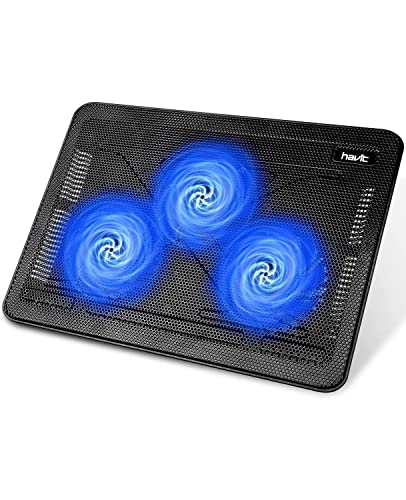
havit HV-F2056 Laptop Cooling Pad for 15.6-17 Inch Laptops, Black
Chosen because it specifies Black.
View on Amazon
Kootek Laptop Cooling Pad Cooler Stand with 5 Quiet Fans for 12"-17" Laptop
Picked as a relevant option in this category.
View on Amazon
TECKNET Laptop Cooling Pad, Portable Slim Laptop Cooler for 12"-17" Laptops
Chosen because it specifies Portable Slim Laptop Cooler for 12"-17" Laptops.
View on Amazon
Razer Laptop Cooling Pad Adaptive Smart, Intelligent Fan Control
Chosen because it specifies Intelligent Fan Control.
View on AmazonTwo or more 70–100 mm fans can direct air toward separate intake zones, which is useful when a laptop has vents near both corners. The trade-off is a higher-pitched sound and more potential for motor vibration. Look for adjustable fan speed rather than an on/off switch; maximum airflow is useful for gaming, while a lower setting is usually sufficient for browsing or office work.
A cooling pad cannot overcome blocked laptop vents or a clogged internal heatsink. Its most useful job is to supply cooler room air to the intake openings and create a small air gap under the chassis. Pads with a perforated metal surface generally transfer airflow better than fully solid plastic surfaces, although a solid surface can be quieter and easier to clean.
Noise levels: what the numbers mean
Manufacturers measure noise under different conditions, so published decibel figures are best used as a rough comparison. A pad rated around 20–25 dBA may blend into a quiet room at its lowest setting. Around 30 dBA is noticeable but generally manageable for desk work. At 35–40 dBA, fan noise can compete with speech in a video call, particularly if the sound has a high-pitched tone.
Do not judge noise only by the number of fans. Bearing quality, grille design, imbalance and desk vibration can matter just as much. A rubber-isolated fan and wide non-slip feet are preferable to a nominally quiet fan that rattles against a hard desktop.
Height adjustment and desk ergonomics
Many cooling pads offer several tilt positions, but the highest setting is not automatically the most comfortable. A laptop keyboard raised by more than about 10–15 degrees can make prolonged typing harder on the wrists. Higher angles are more appropriate when the laptop is being used as a secondary screen with an external keyboard and mouse.
A typical desk is about 28–30 inches high, while an office chair’s seat is commonly adjustable from roughly 17–22 inches. If the pad adds 2–4 inches at the rear, check that your elbows can remain near 90 degrees without lifting your shoulders. For a laptop used as the main display, the top of the screen should be close to eye level; a separate keyboard is often a better ergonomic investment than simply selecting the tallest pad.
Check the front retaining lip before buying. A deep lip can prevent a laptop from sliding but may press into your wrists. A low rubber strip is usually more comfortable, provided it securely supports the computer at the intended angle.
Laptop size compatibility is more than screen size
A “15.6-inch” pad may not fit every 15.6-inch laptop equally well. Measure the laptop’s actual width and depth, including rear vents and any protruding hinges. Choose a support surface at least 0.5–1 inch wider than the computer and deep enough that all feet remain on the pad.
| Laptop category | Typical laptop footprint | Recommended pad platform | Useful fan coverage |
|---|---|---|---|
| 12–14-inch ultraportable | 11–13 inches wide, 7.5–9 inches deep | Up to 14 inches | One 120–160 mm fan or a quiet low-profile design |
| 15–16-inch office laptop | 13.5–15 inches wide, 9–10.5 inches deep | 15.6–16 inches | One large fan or two 80–100 mm fans |
| 16–17.3-inch gaming laptop | 14–16 inches wide, 10–12 inches deep | 17–18 inches | Two or more fans with adjustable speed |
Pay special attention to thick gaming laptops. A pad’s retaining ledge must be tall enough to secure the front edge without blocking front-facing speakers, while its rear stop should not interfere with a large hinge or exhaust vent. If the laptop has intake openings only along the rear half, a pad whose fan sits too far forward may provide little benefit.
Choose by construction and everyday practicality
| Construction | Advantages | Trade-offs | Best use |
|---|---|---|---|
| Perforated steel or aluminum | Rigid, durable, good airflow, easy to wipe clean | Can transmit vibration and add weight | Heavy laptops and sustained workloads |
| ABS plastic | Light, inexpensive, often quieter and easier to carry | May flex under a large laptop; plastic feet can wear | Portable office setups |
| Mesh fabric surface | Comfortable contact point and lower vibration | Collects dust and may sag or fray over time | Quiet home-office use |
| Metal frame with plastic hinges | Good balance of rigidity and weight | Hinges and angle locks are common wear points | Frequent height adjustment |
Check the stated weight capacity against the laptop’s actual weight, not merely its screen size. Most standard pads support approximately 10–15 lb, which covers typical notebooks, but the platform can still flex if the computer is large and the pad is supported only at its corners. A wide, rigid base and a front support strip are more important than an impressive maximum-load figure.
Desk-space and cable details that are easy to miss
Measure the available depth from the front edge of the desk to the monitor stand or wall. A full-size pad may occupy 11–14 inches of depth, and its rear tilt can extend farther than the flat dimensions suggest. Leave at least 2 inches behind the pad for the laptop’s exhaust air and cable bends. On a 24-inch-deep desk, a 13-inch pad can leave too little room for a separate keyboard unless the monitor is wall-mounted or placed on a narrow stand.
USB-powered pads generally draw power from the laptop and do not need a separate adapter. A USB pass-through port helps recover the port used for power, but it may not provide enough power for hard drives or high-draw accessories. Route the cable toward the back or side so it does not pull the pad out of alignment when the laptop is tilted.
Buying recommendations by workload
For office work, study and browsing
Choose a low-noise pad with one large fan, modest height adjustment and a surface sized close to the laptop. Cooling needs are usually moderate, so quiet operation and a stable typing angle matter more than maximum airflow. A 20–28 dBA design with a platform for your laptop’s actual footprint is a sensible target.
For gaming, editing and development
Prioritize coverage under the intake vents, fan-speed control and a rigid platform. A large 17–18-inch pad with two or more fans can be worthwhile for a thick performance laptop, especially during long rendering or gaming sessions. Expect more audible airflow at high speed, and use an external keyboard if the raised angle causes wrist strain.
For shared rooms and video calls
Favor a smooth, low-pitched fan over raw airflow. Keep the pad several inches away from a laptop microphone and select the lowest speed that prevents heat buildup. Avoid decorative lighting if it reflects into a camera or distracts during meetings; it adds little cooling value.
Maintenance and durability
Dust is the main long-term enemy. Every few weeks, unplug the pad and clean its intake grille, fan blades and feet with a soft brush or compressed air used carefully. Do not place it on a bed, blanket or thick rug, where fabric can block the intake and pull lint into the fan.
The parts most likely to wear first are tilt hinges, rubber feet, USB cables and fan bearings. A pad used daily for several years benefits from replaceable or standard USB cables, firm angle locks and feet that are bonded rather than lightly glued. If the fan begins clicking, scraping or pulsing, stop using it at high speed; the vibration can make the laptop unstable.
Bottom line
The best laptop cooling pads for most home offices are quiet, height-adjustable models with a rigid perforated or well-supported surface, a platform matched to the laptop’s real dimensions and enough clearance for unobstructed exhaust. Pick a large multi-fan design for sustained gaming or rendering, a compact low-noise pad for a small desk, and a lower-angle model when the laptop keyboard will remain your primary input device.