Key takeaways
- Measure deck-to-water, not pool height: Take the drop from your finished deck surface to the water line, then match it against the ladder’s adjustment range. Confer’s 6000X spans 42 to 56 inches, which covers most 48- and 52-inch walls with a raised deck on top.
- Weight rating with a margin: Look for a stated capacity and assume real-world use exceeds it — teenagers cannonball, adults climb out with pool floats in hand. Heavy-duty resin or 304-grade stainless both work; thin tubing does not.
- Step depth and tread: Wet feet need at least a few inches of platform and a molded non-slip surface. Narrow rungs are the single most common cause of slips on above-ground entries.
- Anchoring method: Deck ladders need to bolt through the frame, not just rest against it. Check whether hardware is included and whether it’s stainless — plated steel bolts will bleed rust into your decking within two seasons.
- Removability and access control: If children use the yard, prioritize a ladder that lifts out or locks in the up position. Snap-lock designs handle this without tools, which matters when you’re doing it daily.
What's inside
The gap between a deck rail and the waterline is where most above-ground pool setups quietly fall apart. A ladder that’s an inch too short leaves swimmers hopping down onto a wobbling step; one that’s too tall bows under load and scuffs the liner. Add a season of chlorine, UV, and wet feet, and a poorly matched deck ladder goes from minor annoyance to genuine hazard. Mid ladder decks — the in-pool half of a deck-mounted entry system — carry the bulk of that stress, which is exactly why they deserve more thought than they usually get.
This guide looks at the deck-mounted ladders worth installing in 2026, with an eye toward adjustable height ranges, corrosion behavior in salt and chlorine, step geometry for bare feet, and how each unit anchors to a wood or composite deck. I’ve also flagged a couple of listings that surface under this search term but have nothing to do with pools, so you don’t end up with the wrong kind of deck in a box.
As an Amazon Associate we earn from qualifying purchases.


How to Choose a Mid Ladder Decks (2026)
- Measure deck-to-water, not pool height: Take the drop from your finished deck surface to the water line, then match it against the ladder’s adjustment range. Confer’s 6000X spans 42 to 56 inches, which covers most 48- and 52-inch walls with a raised deck on top.
- Weight rating with a margin: Look for a stated capacity and assume real-world use exceeds it — teenagers cannonball, adults climb out with pool floats in hand. Heavy-duty resin or 304-grade stainless both work; thin tubing does not.
- Step depth and tread: Wet feet need at least a few inches of platform and a molded non-slip surface. Narrow rungs are the single most common cause of slips on above-ground entries.
- Anchoring method: Deck ladders need to bolt through the frame, not just rest against it. Check whether hardware is included and whether it’s stainless — plated steel bolts will bleed rust into your decking within two seasons.
- Removability and access control: If children use the yard, prioritize a ladder that lifts out or locks in the up position. Snap-lock designs handle this without tools, which matters when you’re doing it daily.
The Best Mid Ladder Decks (2026)s Reviewed
Confer Plastics 6000X Heavy Duty In-Pool Deck Ladder
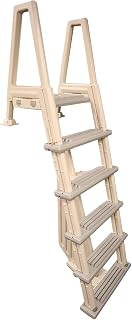
This is the workhorse of the category: a heavy-gauge resin in-pool ladder with a 42-to-56-inch adjustment range, meaning one SKU fits nearly every deck-over-pool configuration without shimming or custom brackets. The wide, ribbed steps feel secure barefoot, and because there’s no metal in the wet zone, salt systems and high-chlorine shock treatments don’t touch it.
SLD Snap-Lock Deck Ladder, Taupe
The snap-lock mechanism is the draw here — the ladder releases and lifts clear of the water in seconds, no fasteners, no wrestling. Taupe blends into cedar, redwood, and most composite decking better than bright white, which is a small thing until you’re looking at it every day from the patio.
SLD Snap-Lock Deck Ladder, White
Mechanically identical to the taupe version, with the same tool-free lift-out security, and the better choice against white vinyl fencing or a painted deck. White resin does show algae staining sooner, so plan on an occasional wipe-down with a soft brush.
Blue Wave Premium Stainless Steel In-Pool Ladder
For deep decks and heavier daily traffic, stainless gives you a rigidity resin can’t match, with slip-resistant treads and a genuinely solid feel underfoot. Reserve it for standard chlorine pools — salt water demands diligent rinsing to keep the finish from pitting at the weld points.
A Note on the Powell Peralta and Exodus “Deck” Listings
The Powell Peralta Bucky Lasek Tortoise Flight deck and the Exodus Deep Concave Fingerboard Deck (Ladder Natural Stain) are skateboard and fingerboard decks — they appear in these results because of keyword overlap only. Excellent products in their own right, but they have no role in a pool entry system.
Frequently Asked Questions
What exactly is a “mid ladder”?
It’s the in-pool section of a two-part deck entry: stairs or a deck bring you to the pool edge, and the mid ladder carries you from the top rail down into the water. It bolts to the deck rather than straddling the wall like an A-frame.
Do I still need an outside ladder?
No — that’s the point of a deck installation. The deck replaces the exterior climb, so you only need the in-pool half, which also removes the easiest unsupervised access route into the water.
Resin or stainless steel?
Resin for salt systems, coastal humidity, and lower maintenance. Stainless for maximum rigidity and a more finished look, provided you rinse it and inspect the fasteners annually.
Can I install one myself?
Most homeowners can, with a drill and a helper. The critical step is hitting solid framing with the mounting bolts rather than decking boards alone, and using stainless hardware throughout.
Final Thoughts
For most decks, the Confer 6000X is the safe call — its 42-to-56-inch range removes the guesswork and the all-resin build shrugs off salt and shock. Choose the SLD Snap-Lock in taupe or white if daily lift-out security is your priority, and step up to the Blue Wave stainless model when you want the most rigid in-pool ladder available and don’t mind a little upkeep.