Key takeaways
- Running watts, not peak watts: Add up what must stay alive at once, typically a fridge, a sump pump, a few circuits of lighting, and a router. Then leave 20 to 25 percent headroom for startup surge on motors. A 4,000 to 4,500-watt unit covers most essentials; 9,000 running watts and up starts reaching central air and well pumps.
- Noise measured where you sit: Ratings in the low 50s dBA are conversational. Anything above 65 dBA will dominate a patio and travel to your neighbor’s bedroom window. Open-frame designs run louder than enclosed ones, so factor in where the generator will actually live during a multi-day outage.
- Built-in CO shutoff: Non-negotiable on any gas model. Sensors that cut the engine when carbon monoxide accumulates protect against the single most common generator fatality. Even with that feature, run gas units well away from walls, eaves, and screened enclosures.
- Fuel strategy and runtime: Gas gives you long runtime and refuelable range but needs stabilized fuel and off-season maintenance. Lithium power stations give you silent, fumeless operation indoors with zero upkeep, at the cost of a fixed energy ceiling. Many households end up owning one of each.
- Portability and connection points: Check dry weight, handle design, and whether wheels are included. Then confirm the outlet panel matches your plan, a 30-amp TT-30 for RV use, or a 30/50-amp locking outlet if you intend to feed a manual transfer switch through an interlock kit installed by a licensed electrician.
What's inside
An outage rarely announces itself politely. It shows up mid-cookout, right when the string lights over the pergola wink out, the deck fridge starts sweating, and the ceiling fan on the screened porch coasts to a stop. Anyone who has spent years building out a comfortable outdoor room learns fast that the weak link is not the furniture or the shade structure, it is the electricity feeding it. Older contractor-style generators solved that problem loudly, throwing off dirty power that made cheap work lights buzz and refused to charge sensitive electronics at all.
Inverter generators changed the equation. They throttle down to match the load, sip fuel while doing it, and produce clean sine-wave power safe for a laptop, a mini-split, or the induction burner in an outdoor kitchen. This guide walks through how to size a unit for real household demand, what noise numbers actually mean once you are standing 20 feet away on a patio, why carbon monoxide protection matters more than any spec sheet figure, and where battery power stations now beat gas outright. Below are the models worth your attention going into 2026.
As an Amazon Associate we earn from qualifying purchases.


How to Choose a Portable Inverter Generator For Home Backup (2026)
- Running watts, not peak watts: Add up what must stay alive at once, typically a fridge, a sump pump, a few circuits of lighting, and a router. Then leave 20 to 25 percent headroom for startup surge on motors. A 4,000 to 4,500-watt unit covers most essentials; 9,000 running watts and up starts reaching central air and well pumps.
- Noise measured where you sit: Ratings in the low 50s dBA are conversational. Anything above 65 dBA will dominate a patio and travel to your neighbor’s bedroom window. Open-frame designs run louder than enclosed ones, so factor in where the generator will actually live during a multi-day outage.
- Built-in CO shutoff: Non-negotiable on any gas model. Sensors that cut the engine when carbon monoxide accumulates protect against the single most common generator fatality. Even with that feature, run gas units well away from walls, eaves, and screened enclosures.
- Fuel strategy and runtime: Gas gives you long runtime and refuelable range but needs stabilized fuel and off-season maintenance. Lithium power stations give you silent, fumeless operation indoors with zero upkeep, at the cost of a fixed energy ceiling. Many households end up owning one of each.
- Portability and connection points: Check dry weight, handle design, and whether wheels are included. Then confirm the outlet panel matches your plan, a 30-amp TT-30 for RV use, or a 30/50-amp locking outlet if you intend to feed a manual transfer switch through an interlock kit installed by a licensed electrician.
The Best Portable Inverter Generators for Home Backup (2026), Reviewed
Champion 11,000-Watt Remote Start Inverter Generator
This is the one to buy when you want backup that feels close to normal life, enough capacity for a well pump, central air, and the rest of the house rather than a triaged handful of circuits. Wireless remote start means you never step into a storm to get it running, and the three-year warranty signals real confidence in the platform.
Champion 4500-Watt RV Ready Inverter Generator
The sweet spot for most homes and the model I recommend most often. It carries a full refrigerator, freezer, lighting, and electronics comfortably while staying quiet enough that an evening on the deck remains pleasant, and the RV-ready outlet doubles its usefulness for travel.
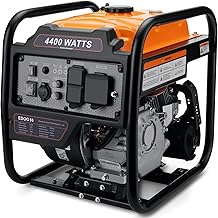
Oxseryn 4400-Watt Open Frame Inverter Generator
An open-frame build keeps the price and weight down while still delivering inverter-clean power and an ECO mode that stretches fuel on light loads. Expect more mechanical noise than an enclosed unit, so place it at a distance and treat it as the value play in the mid-wattage class.
maXpeedingrods MXR4000 Inverter Generator
The Bluetooth app monitoring is more than a gimmick during a long outage, letting you watch load and fuel status from inside without repeated trips outdoors. Add a CO alarm and RV-ready outlet, and it makes a capable 4,000-watt backup for households that like data.
BLUETTI Elite 100 V2 Power Station
With 1,024Wh of LiFePO4 storage, 1,800W output, and 10ms UPS switching, this runs silently indoors and keeps a desk, router, and medical devices online through the flicker phase of a storm. The 70-minute fast charge and solar input make it the cleanest complement to a gas unit.
Frequently Asked Questions
How many watts do I need for home backup?
Most households cover essentials with 3,500 to 4,500 running watts. If you need central air conditioning, a well pump, or an electric range, plan on 9,000 watts or more.
Can I run a generator on a covered patio or screened porch?
No. Gas generators require open air well away from doors, windows, vents, and overhangs, since carbon monoxide pools under any roof structure. Battery power stations are the only option for enclosed spaces.
Why choose an inverter over a conventional generator?
Inverters produce power with very low harmonic distortion, generally under 3 percent, which protects electronics and appliance control boards. They also run quieter and burn less fuel by matching engine speed to demand.
Can I connect one to my home’s electrical panel?
Only through a properly installed manual transfer switch or interlock kit wired by a licensed electrician. Never backfeed through a dryer outlet or extension cord, which endangers utility crews and your household.
Final Thoughts
For genuine whole-home coverage with hands-off starting, the Champion 11,000-Watt remote start unit is the strongest pick of 2026. The Champion 4500-Watt RV Ready model remains the best balance of capacity, noise, and price for typical households, and the Champion 2500-Watt Ultralight is worth a look if portability rules your decision. Pair any of them with the BLUETTI Elite 100 V2 and you get silent indoor power for electronics alongside the runtime only gas can deliver.