Key takeaways
- Tooth count: Blades with more teeth usually produce smoother crosscuts, while lower counts remove material faster and suit rough or dimensional lumber.
- Blade diameter and arbor: Match the blade diameter and arbor hole to your saw exactly. A 10-inch blade generally uses a 5/8-inch arbor, while many 12-inch saws use a 1-inch arbor.
- Tooth design: ATB teeth are well suited to clean wood crosscuts. TCG profiles can be a better choice for laminates, aluminum, and abrasive sheet materials when the blade is specifically rated for them.
- Kerf and motor load: A thin-kerf blade can reduce resistance on smaller saws, but confirm that its design is compatible with your machine and cutting demands.
- Material and maintenance: Carbide-tipped teeth hold an edge well, but resin and pitch still need occasional cleaning. Store blades dry, especially if your workshop is in a garage or outdoor shed.
What's inside
Choosing the right miter saw blade can be surprisingly difficult. Tooth count, kerf, arbor size, material, and finish quality all affect whether a cut looks furniture-grade or leaves splintered edges and extra sanding. Outdoor projects add another concern: blades may also encounter treated lumber, moisture-swollen boards, or rough stock carrying embedded grit.
This guide focuses on practical blade selection for furniture building, trim work, decking details, and general home projects. We compare fine-finish options, versatile blade sets, and higher-tooth-count designs so you can match a blade to your saw, material, and preferred working style.
As an Amazon Associate we earn from qualifying purchases.


How to Choose a Saw Blade For Miter Saw (2026)
- Tooth count: Blades with more teeth usually produce smoother crosscuts, while lower counts remove material faster and suit rough or dimensional lumber.
- Blade diameter and arbor: Match the blade diameter and arbor hole to your saw exactly. A 10-inch blade generally uses a 5/8-inch arbor, while many 12-inch saws use a 1-inch arbor.
- Tooth design: ATB teeth are well suited to clean wood crosscuts. TCG profiles can be a better choice for laminates, aluminum, and abrasive sheet materials when the blade is specifically rated for them.
- Kerf and motor load: A thin-kerf blade can reduce resistance on smaller saws, but confirm that its design is compatible with your machine and cutting demands.
- Material and maintenance: Carbide-tipped teeth hold an edge well, but resin and pitch still need occasional cleaning. Store blades dry, especially if your workshop is in a garage or outdoor shed.
The Best Saw Blade For Miter Saw (2026)s Reviewed
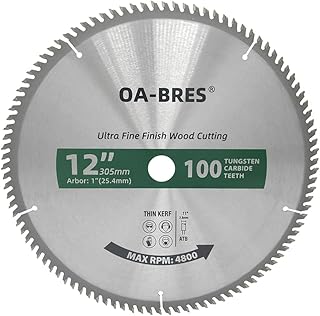
12-Inch 100-Tooth Ultra-Fine Finish Blade
This high-tooth-count ATB blade is aimed at polished crosscuts in hardwood, trim, cabinet components, and other visible work. Its 1-inch arbor suits many 12-inch miter saws, but verify your saw’s specifications before ordering; the dense tooth pattern favors finish quality over fast cutting.
10-Inch 120-Tooth TCG Aluminum-Working Blade
The 120-tooth TCG profile makes this an interesting option for exceptionally clean cuts and certain nonferrous or laminate applications. It is best treated as a specialist blade rather than an all-purpose lumber cutter, and users should confirm the manufacturer’s material guidance before cutting anything other than approved stock.
KENDO 10-Inch 40T/60T Blade Set
This two-pack offers useful flexibility for homeowners who move between rough sizing and cleaner panel work. The 40-tooth blade is suited to faster cuts, while the 60-tooth option is a more practical choice for plywood, MDF, laminate, and general furniture components.
10-Inch 80-Tooth Fine-Finish Wood Blade
An 80-tooth blade is a sensible middle ground for detailed woodworking: smoother than a framing blade without being as specialized as a very high-tooth-count trim blade. The stated 7,000 RPM maximum is important for safe selection, so compare it with your saw’s no-load speed before use.
WEN BL1080 10-Inch 80-Tooth Blade
The WEN BL1080 is designed for clean wood crosscuts on compatible miter and table saws. Its carbide-tipped teeth and 80-tooth layout make it a strong candidate for trim, shelving, face frames, and small furniture parts where reducing tear-out matters more than cutting speed.
Frequently Asked Questions
What tooth count is best for a miter saw?
For clean furniture and trim cuts, 60 to 80 teeth is a useful starting range on a 10-inch blade. Blades with 100 or more teeth can deliver an even finer finish, although they generally cut more slowly and are less suitable for rough stock.
Can I use a table-saw blade on a miter saw?
Often, yes, provided the blade diameter, arbor, kerf, RPM rating, and tooth design are compatible with the miter saw. Always follow the saw and blade manufacturers’ instructions, and avoid installing a blade that is not approved for the intended material.
Which blade is best for outdoor woodworking?
For outdoor furniture and construction projects, a versatile 40-tooth or 60-tooth carbide blade is usually more useful than an ultra-fine trim blade. Rough or treated lumber can dull fine teeth faster, so keep a general-purpose blade available and reserve premium finish blades for clean, prepared boards.
How can I reduce tear-out when cutting wood?
Use a sharp blade with an appropriate tooth count, support the workpiece firmly, and let the saw reach full speed before entering the material. Painter’s tape, a sacrificial support, and cutting with the finished face positioned correctly can also improve the edge.
Final Thoughts
For a flexible household setup, the KENDO 40T/60T set covers the widest range of everyday work. Choose the WEN BL1080 for dependable fine crosscuts, or step up to the 12-inch 100-tooth blade when an especially smooth finish is the priority. Whichever you select, confirm the arbor, diameter, RPM rating, and material compatibility before making the cut.