Key takeaways
- Handrail geometry: A rail that stops at knee height is decoration. Look for a grip that sits roughly waist-to-chest level when you’re standing on the second-to-top tread, so there’s something to hold while your other hand is busy.
- Tread depth over step count: A pedal wide and deep enough for the whole foot, ideally 4 inches or more front to back, lets the arch carry the load instead of the toes. Shallow rungs force a tiptoe stance that undoes any balance advantage.
- Positive locking: Friction hinges drift. Look for a spreader bar, safety latch, or audible click that confirms the frame is locked open, and check that it can be released without kneeling on the floor.
- Weight rating with headroom: Add body weight plus the heaviest thing likely to be carried up, then choose a rating well above that number. A 330 lb frame flexes noticeably at 250 lb; a 500 lb frame doesn’t, and that stiffness is what you actually feel underfoot.
- Carry weight and storage: If it’s too heavy to move one-handed, it stays where it was left and the chair comes out again. Around 12 to 18 pounds is the sweet spot for a folding steel model, with aluminum lighter still.
What's inside
Reaching a top shelf shouldn’t feel like a gamble. Yet for a lot of older adults, that’s exactly what happens: a wobbly kitchen chair gets pressed into service, or an ancient wooden ladder with worn treads comes out of the garage. I spend most of my working life on patios, in potting sheds, and up on deck rails, and the pattern I see indoors mirrors what I see outside. The failure point is almost never strength. It’s balance, and specifically the moment when both hands leave a stable surface at the same time.
This guide looks at step ladders through that lens. I’m weighing handrail height and grip position first, then tread depth, then the locking mechanism, because those three things decide whether a climb feels secure or nerve-wracking. Below you’ll find six models worth shortlisting for 2026, from a compact two-step for the pantry to an 800-pound-rated five-step that earns its keep in a workshop or under a covered porch. Each one has been chosen for how it behaves at the top step, not just how it looks folded flat.
As an Amazon Associate we earn from qualifying purchases.




How to Choose a Step Ladder For Elderly (2026)
- Handrail geometry: A rail that stops at knee height is decoration. Look for a grip that sits roughly waist-to-chest level when you’re standing on the second-to-top tread, so there’s something to hold while your other hand is busy.
- Tread depth over step count: A pedal wide and deep enough for the whole foot, ideally 4 inches or more front to back, lets the arch carry the load instead of the toes. Shallow rungs force a tiptoe stance that undoes any balance advantage.
- Positive locking: Friction hinges drift. Look for a spreader bar, safety latch, or audible click that confirms the frame is locked open, and check that it can be released without kneeling on the floor.
- Weight rating with headroom: Add body weight plus the heaviest thing likely to be carried up, then choose a rating well above that number. A 330 lb frame flexes noticeably at 250 lb; a 500 lb frame doesn’t, and that stiffness is what you actually feel underfoot.
- Carry weight and storage: If it’s too heavy to move one-handed, it stays where it was left and the chair comes out again. Around 12 to 18 pounds is the sweet spot for a folding steel model, with aluminum lighter still.
The Best Step Ladder For Elderly (2026)s Reviewed
HBTower Folding Step Stool with Handrail
The most sensible everyday pick for anyone who mainly needs one or two steps of lift. The wide anti-slip pedals and single continuous handrail make short work of upper cabinets, and at this weight it’s genuinely easy to carry from kitchen to laundry room without setting it down halfway.
HBTower 4 Step Ladder with Handrails and Tool Bag
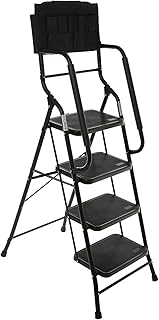
Same design language, more reach, and the twin handrails give you something to grip on both sides during the transition onto the top tread, which is where most missteps happen. The attachable bag is more useful than it sounds: it keeps screwdrivers, bulbs, and pruning snips off the steps.
HillhutApex Aluminum 3 Step Ladder (Walnut)
Aluminum construction keeps this one light enough to lift with one hand, and the walnut finish means it can live in a hallway or sunroom without looking like tool storage. The 330 lb rating suits lighter users; heavier users will prefer a steel frame for the extra rigidity.
WiberWi 4 Step Ladder, 500 lb Capacity
My pick when confidence is the priority. The 500 lb steel frame simply doesn’t flex, and that solid feeling underfoot does more for a hesitant climber than any other single feature. Deep non-slip pedals and full-length handrails round out a very well-judged package.
Heavy Duty Step Stool with Handle for Seniors
A one-step solution built around a tall vertical grab handle, which makes it the safest option for someone who needs help stepping up rather than climbing. Rated to 350 lb, it’s ideal beside a bed, a high vehicle seat, or a raised deck threshold.
Frequently Asked Questions
How many steps is safe for an older adult?
Two to four is the practical range for unassisted use. Beyond four, the height of the fall matters more than the ladder’s quality, and a spotter or a different solution is the better call.
Steel or aluminum?
Steel for stability, aluminum for portability. If the ladder will be carried often, go aluminum. If it lives in one spot and confidence matters most, go steel.
Can these be used outdoors?
Occasionally, yes, on firm and level ground such as a paved patio. Avoid soft soil, mulch, and wet decking, and wipe the frame dry before storing to keep the finish intact.
How do I know when to replace one?
Check the treads for worn or missing grip pads, the rivets for play, and the lock for a crisp engagement. Any looseness in the hinge or a step that flexes underfoot means it’s done.
Final Thoughts
For most households, the WiberWi 4 Step is the one I’d buy: the 500 lb frame delivers the rock-solid feel that makes climbing feel routine rather than risky. The HBTower folding step stool with handrail is the better everyday choice if you only need a step or two, and the KINGRACK 5 Step is worth the extra footprint if you need real height with an 800 lb margin behind you.