Key takeaways
- Compatibility: Check your saw’s miter-slot dimensions, T-track size, fence clearance, and available mounting space before ordering.
- Control: Look for featherboards, push blocks, and guides that keep stock firmly against the fence without making adjustments awkward.
- Repeatability: Positive stops, flip stops, indexed angles, and clearly marked settings save time on batches of identical parts.
- Material quality: Non-marring contact surfaces, durable nylon, aluminum, and replaceable wear parts generally hold up better in active workshops.
- Workshop fit: Compact accessories are valuable in small sheds or portable setups, while larger fences and gauges suit permanent benches.
What's inside
A table saw can produce remarkably clean furniture parts, but accuracy and control depend on more than the blade. Without the right featherboard, push block, miter gauge, or setup aid, boards can wander, narrow strips can pinch, and repeat cuts can become tiring and inconsistent—especially in a compact garage or outdoor workshop where work surfaces and conditions are not always perfect.
This guide focuses on practical accessories that improve safety, repeatability, and setup speed. The selection includes tools for ripping, crosscutting, alignment, and hand placement, with an emphasis on features that matter when building cabinets, benches, planters, and other home-furniture projects.
As an Amazon Associate we earn from qualifying purchases.



How to Choose a Table Saw Accessories (2026)
- Compatibility: Check your saw’s miter-slot dimensions, T-track size, fence clearance, and available mounting space before ordering.
- Control: Look for featherboards, push blocks, and guides that keep stock firmly against the fence without making adjustments awkward.
- Repeatability: Positive stops, flip stops, indexed angles, and clearly marked settings save time on batches of identical parts.
- Material quality: Non-marring contact surfaces, durable nylon, aluminum, and replaceable wear parts generally hold up better in active workshops.
- Workshop fit: Compact accessories are valuable in small sheds or portable setups, while larger fences and gauges suit permanent benches.
The Best Table Saw Accessories (2026)s Reviewed
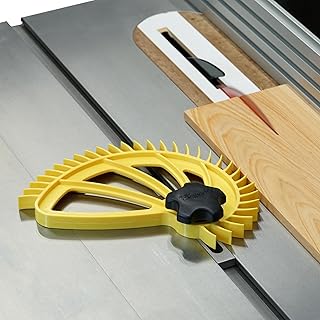
Hedgehog Spiral-Shaped Safety Featherboard
The Hedgehog featherboard is a smart choice for improving stock control during rip cuts. Its spiral shape and one-knob adjustment make repositioning quick, while the DuPont nylon construction is designed to resist kickback without scuffing finished timber. It is especially useful when working with long boards outdoors, where uneven support can make feeding less predictable.
GOINGMAKE Thin Rip Jig
For shelves, edging, splines, and other narrow strips, the GOINGMAKE Thin Rip Jig offers a more controlled alternative to repeatedly measuring from the blade. It is designed for repetitive thin ripping and fits common 3/8-by-3/4-inch T-slots. Confirm your machine’s slot dimensions first, but for suitable saws this jig can make batch work substantially faster and more consistent.
BOW Products EVA Featherboard
The BOW Products EVA Featherboard combines a non-marring EVA body with replaceable feathers and a tool-free adjustment system. Its AnchorPRO miter bar helps secure the board in compatible slots, while the advertised kickback resistance adds confidence when routing or ripping. It is a versatile pick for a workshop that shares accessories between a table saw, router table, and band saw.
Milescraft 3406 GrabberPRO
A dependable push block is one of the simplest ways to keep hands away from the blade while maintaining forward pressure. The Milescraft GrabberPRO is shaped for controlled feeding and can also serve on router tables, band saws, and jointers. It is a practical everyday accessory for furniture makers who want a reusable alternative to improvised scrap-wood push sticks.
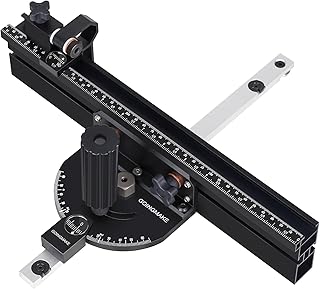
GOINGMAKE Compact Table Saw Miter Gauge
The GOINGMAKE Compact Miter Gauge pairs a 360mm fence with a multifunction flip stop and positive angle stops. Those features are valuable for crosscutting rails, braces, and repeated frame components, particularly when the factory gauge feels loose or lacks useful indexing. It fits a 3/4-by-3/8-inch slot, so measure carefully before purchasing.
Frequently Asked Questions
Which accessory should I buy first?
Start with a quality push block or push stick, followed by a featherboard. These accessories address hand safety and stock control before you spend money on specialized measuring or cutting jigs.
Are featherboards necessary on a table saw?
They are not mandatory for every cut, but they can make feeding smoother and help keep material against the fence. Use one when appropriate, while following the saw manufacturer’s instructions and keeping it positioned so it cannot force stock into the blade.
How can I improve table saw accuracy?
Begin by checking blade alignment, fence parallelism, and miter-slot condition. A reliable miter gauge, a thin-rip guide, and Table Setup Blocks for Woodworking—the 14-piece aluminum alloy precision set—can then help establish repeatable fence, depth, height, and angle settings.
Can one featherboard fit every saw?
No. Featherboards may use miter bars, T-bolts, or other mounting systems, and slot sizes vary between saws. Verify the dimensions and available clearance around your fence before relying on a particular model.
Final Thoughts
For everyday safety and stock control, the Milescraft GrabberPRO and Hedgehog Spiral-Shaped Safety Featherboard are strong starting points. Add the GOINGMAKE Thin Rip Jig for narrow-strip work or the GOINGMAKE Compact Miter Gauge for repeatable crosscuts, and your table saw becomes a more capable, predictable tool for furniture projects.