Key takeaways
- Jaw width vs. real workpieces: Measure what you actually build. Railing spindles and furniture legs live happily in a 4-1/2″ to 5″ jaw; fence posts, gate hardware, and 4×4 stock want 6″ or 8″. Wider jaws also spread pressure so softwoods like cedar and redwood crush less.
- Throat depth matters more than force: Throat depth determines how far down a board you can reach before the vise body blocks you. Four inches or more lets you clamp mid-panel on a planter side rather than only at the very edge — a constant need in outdoor casework.
- Pipe jaws and an anvil surface: Irrigation lines, shade-sail tensioners, and umbrella poles all involve round stock. Integrated pipe jaws grip tubing without deforming it, and a flat anvil area lets you flatten a bent bracket without moving to a second station.
- Swivel base and true lockdown: A 270° or 360° swivel lets you angle a miter into good light instead of contorting around the bench. What actually counts is how firmly the base locks — test that it does not creep under a heavy file stroke.
- Casting quality and corrosion resistance: Ductile or high-grade cast iron survives the shock loads of outdoor repair work. If your bench lives in a carport or open shed, prioritize a thick powder-coat finish and plan on wiping the screw and slide with light oil seasonally.
What's inside
Anyone who has tried to plane a cedar board or square up a gate frame on a bare workbench knows the frustration: the piece walks, the cut wanders, and you end up bracing it with a knee. For outdoor-living projects in particular — pergola brackets, deck railing spindles, planter boxes, patio furniture repairs — the workpieces are heavy, awkwardly shaped, and often wet-treated lumber or galvanized pipe. A vise that shrugs off a 6-foot post and still handles a delicate teak repair is the difference between a weekend build and a weekend of do-overs.
This guide looks at bench vises through the lens of exterior and patio work, where corrosion, mixed materials, and irregular stock are the norm rather than the exception. We cover jaw width, throat depth, swivel and pipe-jaw features, and how much clamping force you actually need before spending more. Below are the models worth your bench space in 2026, followed by the specs that separate a genuine workhorse from a painted casting.
As an Amazon Associate we earn from qualifying purchases.


![[Upgraded Version] Multi-Purpose Bench Vise 3.3", Table Vice For Workbench, Universal Clamping Vise With Heavy Duty Cast Iron, Multi-Jaw, Swivel Base, Easy Adjustment for Woodworking (3.3 Inch)](https://m.media-amazon.com/images/I/81OQd8+Ga+L._AC_UL320_.jpg)

How to Choose a/an Vise For Workbench (2026)
- Jaw width vs. real workpieces: Measure what you actually build. Railing spindles and furniture legs live happily in a 4-1/2″ to 5″ jaw; fence posts, gate hardware, and 4×4 stock want 6″ or 8″. Wider jaws also spread pressure so softwoods like cedar and redwood crush less.
- Throat depth matters more than force: Throat depth determines how far down a board you can reach before the vise body blocks you. Four inches or more lets you clamp mid-panel on a planter side rather than only at the very edge — a constant need in outdoor casework.
- Pipe jaws and an anvil surface: Irrigation lines, shade-sail tensioners, and umbrella poles all involve round stock. Integrated pipe jaws grip tubing without deforming it, and a flat anvil area lets you flatten a bent bracket without moving to a second station.
- Swivel base and true lockdown: A 270° or 360° swivel lets you angle a miter into good light instead of contorting around the bench. What actually counts is how firmly the base locks — test that it does not creep under a heavy file stroke.
- Casting quality and corrosion resistance: Ductile or high-grade cast iron survives the shock loads of outdoor repair work. If your bench lives in a carport or open shed, prioritize a thick powder-coat finish and plan on wiping the screw and slide with light oil seasonally.
The Best Vise For Workbench (2026)s Reviewed
Forward CR80A 8″ Bench Vise
With an 8″ jaw, 9″ opening, and 4.1″ throat, this is the vise for anyone regularly wrestling gate frames, post brackets, or heavy galvanized fittings. The 12,000 lb clamping figure is more than most home shops will ever call on, but the mass behind it is what keeps hammer work from ringing the whole bench.
PONY 5″ Heavy Duty Bench Vise
The dual 360° swivel — base and head — is genuinely useful when you are dressing a compound cut on a railing or chamfering an arbor end at an odd angle. At 5″ with integrated pipe jaws and an anvil, it hits the sweet spot for patio furniture rebuilds and light metal fabrication without dominating a small bench.
6″ 2-in-1 Multi-Purpose Bench Vise
Two sets of multifunctional jaws let you switch between flat stock and round tubing quickly, which suits mixed outdoor projects where a shade structure involves both lumber and pipe. The 270° swivel and 6″ width make it a strong middle option for builders who want capacity but not an 8″ footprint.
WORKPRO 4-1/2″ Combination Bench Vise
A sensible, honest utility vise for the gardener-slash-woodworker doing planter assembly, trellis repairs, and hose fitting work. The combination pipe jaws punch above the price, though I would keep genuinely heavy pounding to a larger casting.
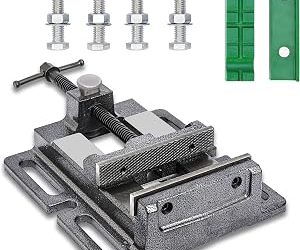
Upgraded Multi-Purpose 3.3″ Bench Vise
The 3.3″ jaw and multi-jaw design make this the pick for detail work — chair spindles, hardware fitting, cushion-snap repairs — on benches where space is scarce. Add soft jaw pads before clamping finished teak or powder-coated aluminum.
Frequently Asked Questions
What jaw size do I actually need for patio and deck projects?
Most outdoor-living work is well served by 5″ to 6″. Below 4″ you will fight anything wider than a 2×4; above 6″ you gain post-and-gate capacity but sacrifice bench real estate and portability.
Will a bench vise mar cedar, teak, or powder-coated furniture?
Serrated steel jaws will bite softwoods and finished surfaces. Use magnetic or slip-on soft jaw covers, or cut a pair of hardwood cauls — a two-minute step that saves refinishing later.
How do I mount a vise on an outdoor or portable workbench?
Through-bolt into solid material with washers on the underside; lag screws into a thin top will eventually loosen. If the bench lives outside, use stainless or hot-dipped hardware and add a backing plate under the top to spread load.
Does clamping force really matter for home use?
Less than the marketing suggests. Above roughly 5,000 lb, casting rigidity, throat depth, and screw quality determine your results far more than the headline force number.
Final Thoughts
For most outdoor-living builders, the PONY 5″ is the best all-around choice — dual swivel, pipe jaws, and an anvil in a size that fits a real bench. Step up to the Forward CR80A 8″ if gates, posts, and heavy metal repair are routine, and consider the 6″ 2-in-1 if you want jaw versatility for mixed lumber-and-pipe projects like pergolas and shade structures.