Key takeaways
- Grip and weight: A palm router you can steady with one hand while feeding stock with the other is worth more to a beginner than raw power. Anything in the 3 to 5 pound range with a body you can wrap a hand around will feel controllable on a long cedar rail.
- Variable speed: Fixed-speed routers scream at one RPM whether you are cutting a small roundover in pine or a wide profile in ipe. Six-step speed control lets you slow down for hardwoods and large-diameter bits, which reduces burn marks and chipping on visible outdoor surfaces.
- Guides included: An edge guide keeps a groove parallel to a board’s face; a roller guide follows curved edges like the arc on an Adirondack armrest. Buying these separately later usually costs more than the price gap between models that include them.
- Collet quality: Nearly every compact router uses a 1/4″ collet, but the fit varies. A collet that grips evenly means less bit slippage and less vibration — check that the wrenches provided actually let you tighten firmly without rounding the nut.
- Dust management: Routing produces fine chips that bury your cut line. A dust hood that accepts a shop vac hose keeps the workpiece visible, which matters more than most first-time buyers expect, especially when following a pencil layout on rough sawn lumber.
What's inside
Building your own outdoor furniture has a way of exposing every rough edge — literally. You cut a cedar bench seat, sand it smooth, and it still looks homemade because the corners are square and sharp instead of softened and shaped. A router is the tool that closes that gap. It rounds over armrests so they feel good under a forearm, cuts the grooves that let planter boxes drain, and trims edge banding flush on a potting bench top. For anyone who spends more time on a patio than in a workshop, it is the single tool that most changes how finished a project looks.
The problem is that router shopping gets confusing fast. Full-size plunge routers with 2-plus horsepower motors are overkill for a first build and heavy enough to be genuinely intimidating. Compact palm routers are the better entry point, but the listings blur together: wattage claims, RPM numbers, bit sets of varying quality. This guide sorts through the compact routers that actually make sense for a beginner working on decks, garden furniture, and outdoor storage in 2026 — what to look for, which models earn their spot, and where the compromises hide.
As an Amazon Associate we earn from qualifying purchases.



How to Choose a Wood Router For Beginner (2026)
- Grip and weight: A palm router you can steady with one hand while feeding stock with the other is worth more to a beginner than raw power. Anything in the 3 to 5 pound range with a body you can wrap a hand around will feel controllable on a long cedar rail.
- Variable speed: Fixed-speed routers scream at one RPM whether you are cutting a small roundover in pine or a wide profile in ipe. Six-step speed control lets you slow down for hardwoods and large-diameter bits, which reduces burn marks and chipping on visible outdoor surfaces.
- Guides included: An edge guide keeps a groove parallel to a board’s face; a roller guide follows curved edges like the arc on an Adirondack armrest. Buying these separately later usually costs more than the price gap between models that include them.
- Collet quality: Nearly every compact router uses a 1/4″ collet, but the fit varies. A collet that grips evenly means less bit slippage and less vibration — check that the wrenches provided actually let you tighten firmly without rounding the nut.
- Dust management: Routing produces fine chips that bury your cut line. A dust hood that accepts a shop vac hose keeps the workpiece visible, which matters more than most first-time buyers expect, especially when following a pencil layout on rough sawn lumber.
The Best Wood Router For Beginner (2026)s Reviewed
AVID POWER 6.5 Amp 1.25 HP Compact Router
This is the most complete beginner package here: six variable speeds, an edge guide, a roller guide, and a dust hood in one box, with a fixed base that holds depth reliably once locked. The 1.25 HP motor handles roundovers and chamfers in cedar, redwood, and pressure-treated pine without bogging, which covers most outdoor furniture work.
TwoWin 800W Compact Wood Router with 15-Piece Bit Set
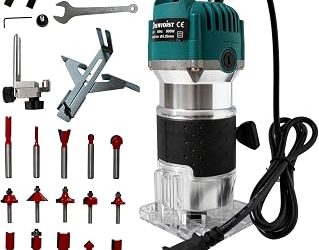
A strong value pick if you own no bits yet — the tungsten carbide set covers straight, roundover, chamfer, and cove profiles, enough to detail a whole patio table. The router itself is a straightforward laminate trimmer; the bits are respectable for learning on softwood, though you may upgrade the ones you use most.
800W Electric Palm Router, 32,000 RPM
The high 32,000 RPM ceiling gives clean cuts in plywood and composite decking board offcuts, where slower speeds tend to tear. Edge and roller guides are included, making it a capable grooving and edging tool, but confirm whether speed is adjustable before committing to hardwood projects.
800W Compact Router with 15PC Bit Set
Another bit-inclusive option built around slotting, trimming, and carving, and light enough for extended freehand work like decorative detail on a garden gate. Treat it as a starter platform: the motor and body are adequate, and the included bits let you experiment without a second purchase.
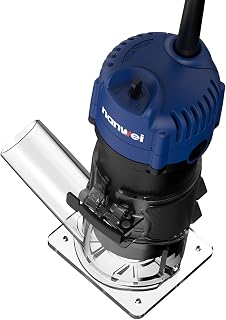
NANWEI 450W Compact Edge Trimmer
The lightest and least powerful of the group, and it ships without bits — best suited to trimming laminate, flush-cutting edge banding, and small roundovers rather than heavy profile work. If your projects are outdoor storage boxes and side tables rather than thick bench slabs, its low weight is a genuine advantage.
Frequently Asked Questions
Do I need a plunge base as a beginner?
Not for most outdoor furniture. Edge profiling, flush trimming, and grooving with an edge guide all work from a fixed base. Plunge capability matters when you need to start a cut in the middle of a board, such as an inlay recess or a stopped mortise.
Which router bits should I buy first?
A 1/4″ roundover, a 45-degree chamfer, a flush-trim bit, and a couple of straight bits will handle nearly every outdoor project. Buy carbide-tipped rather than high-speed steel; cedar and pressure-treated lumber dull steel quickly.
Can I use a compact router on hardwood decking like ipe?
Yes, but take shallow passes and reduce speed if your router allows. Dense tropical hardwoods generate significant heat, so removing material in two or three light passes protects both the bit and the edge quality.
How do I avoid burn marks on visible surfaces?
Keep the router moving at a steady pace, cut in the correct direction relative to bit rotation, and never pause mid-pass. Burns come from dwelling in one spot, and they are far easier to prevent than to sand out of a finished armrest.
Final Thoughts
For a first router aimed at decks, benches, and garden furniture, the AVID POWER 6.5 Amp Compact Router is the most sensible starting point — variable speed plus both guides and a dust hood means fewer follow-up purchases and better results on hardwoods. The TwoWin 800W with its 15-piece carbide set is the better buy if you need bits immediately, and the NANWEI 450W trimmer suits anyone whose projects stay light and whose priority is a tool that never feels heavy.