A fruit juicer machine is one of those kitchen tools that promises to save you money on store-bought juice and delivers fresh, unfiltered nutrition straight to your glass. The reality, though, is that the gap between a good juicer and a frustrating one comes down to a handful of practical factors: how much prep work the feed chute demands, whether pulp clogs the mechanism after two sessions, and how long it takes to disassemble and rinse. A $14 citrus press that handles everything except leafy greens might be the right answer for one person, while a $200 masticating model with a cold-press chamber makes sense for another who juices daily.
The eight models below span centrifugal, cold-press, and citrus-specific designs, ranging from under $14 to just under $200. We compared published wattage, chute dimensions, speed settings, capacity, and verified owner feedback on noise, yield, and cleaning effort to identify which machines genuinely reduce friction in a daily juice routine and which ones create new headaches you did not have before. This roundup is current as of 2026.
Our top picks
 Juicer Machine 800W Centrifugal Juicer with Wide
- Upgraded 800W Motor - Centrifugal juicer machine with…
- Dual Speed Juicer Machine - Juicer Machine with…
- Centrifugal Juicer with Wide Mouth - Centrifugal juicers…
 EanOruus Juicer Machines
- 3-in-1 Versatility for Wellness: Equipped with two interchangeable…
- 6.5-Inch Mega-Wide Chute: Featuring an extra-wide 6.5-inch feed…
- 100oz Hopper: Designed for the modern family and…
 Ninja NeverClog Cold Press Juicer
- This powerful masticating juicer’s high-torque motor powers through…
- Includes 2 interchangeable pulp filters so you can…
- Easy operation with 2 convenient programs: Start/Stop and…
| Product | Key specs | |
|---|---|---|
| Juicer Machine 800W Centrifugal Juicer with Wide | Upgraded 800W Motor - Centrifugal juicer machine with… Dual Speed Juicer Machine - Juicer Machine with… Centrifugal Juicer with Wide Mouth - Centrifugal juicers… | Check price |
| EanOruus Juicer Machines | 3-in-1 Versatility for Wellness: Equipped with two interchangeable… 6.5-Inch Mega-Wide Chute: Featuring an extra-wide 6.5-inch feed… 100oz Hopper: Designed for the modern family and… | Check price |
| Ninja NeverClog Cold Press Juicer | This powerful masticating juicer’s high-torque motor powers through… Includes 2 interchangeable pulp filters so you can… Easy operation with 2 convenient programs: Start/Stop and… | Check price |
 Juicer Machines Juicer Machines | New and Improved - Our Newest Centrifugal Juicer… Are you tired of long juicing times -The… Are you looking for a juicer with a… | Check price |
 Godspeeds 6-inch Chute Cold Press Juicer Machine Godspeeds 6-inch Chute Cold Press Juicer Machine | 6-INCH WIDE CHUTE, LESS PREP WORK: Featuring a… 58 RPM SLOW COLD PRESS, HIGH JUICE YIELD… Simple 3-step assembly for quick setup | Check price |
 Elite Gourmet ETS623 Electric Citrus Juicer Elite Gourmet ETS623 Electric Citrus Juicer | Equipped with a stronger 40W motor and auto-reversing… 24 OZ (3-CUP) CAPACITY Dual-direction rotation helps extract more juice from oranges,… | Check price |
 EanOruus Juicer Machines EanOruus Juicer Machines | 3-in-1 Versatility for Wellness: Equipped with two interchangeable… 6.5-Inch Mega-Wide Chute: Featuring an extra-wide 6.5-inch feed… 100oz Hopper: Designed for the modern family and… | Check price |
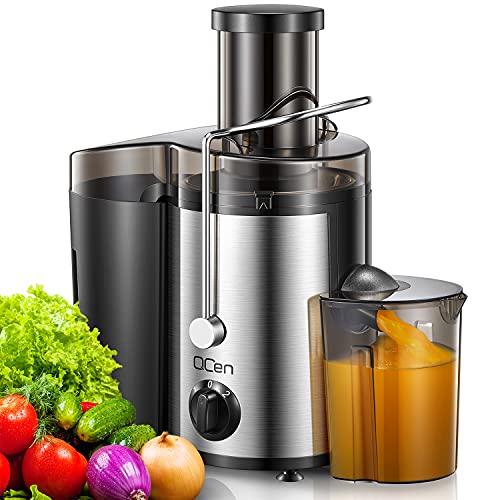 QCen Juicer Machine 500W Centrifugal Juicer with QCen Juicer Machine 500W Centrifugal Juicer with | Upgraded 500W Motor - Centrifugal juicer machine with… Dual Speed Juicer Machine - Juicer Machine with… Centrifugal Juicer with Wide Mouth - Centrifugal juicers… | Check price |
As an Amazon Associate we earn from qualifying purchases at no extra cost to you.
Quick Picks
| Product | Best for | Price |
|---|---|---|
| Juicer Machine 800W Centrifugal | Fast hard-fruit juicing on a tight budget | $35.97 |
| EanOruus 3-in-1 Cold Press (Bright White) | Versatility across citrus, cold-press, and smoothies | $139.99 |
| Ninja NeverClog Cold Press JC151 | Low-maintenance daily juicing | $129.95 |
| Juilist 3″ Wide Mouth 800W | Whole-apple convenience without pre-cutting | $39.99 |
| Godspeeds 6-inch Chute Cold Press | Hands-off prep with large produce | $80.99 |
| Elite Gourmet ETS623 Citrus Juicer | Oranges, lemons, and grapefruit only | $13.99 |
| EanOruus 3-in-1 Cold Press (Premium Gray) | Premium build with multi-function output | $199.99 |
| QCen 500W Centrifugal | Entry-level speed at the lowest non-citrus price | $34.19 |
How We Picked
We weighted four criteria that consistently separate satisfying juicers from abandoned countertop ornaments. First, feed-chute geometry relative to motor power, because a wide chute on a weak motor will stall on dense produce. Second, cleaning complexity: centrifugal models with fine mesh strainers demand more effort than cold-press augers that rinse in under a minute. Third, pulp and juice capacity, which determines how many glasses you can make before stopping to empty or refill. Fourth, verified owner feedback on longevity and noise, since a machine that vibrates off the counter or loses suction after three months fails the daily-use test regardless of its spec sheet.
The 8 Best Fruit Juicer Machine in 2026
Juicer Machine 800W Centrifugal Juicer with Wide Mouth Feed Chute
This is the straightforward answer for anyone who mostly juices apples, carrots, and beets and wants a glass of juice in under two minutes. The 800-watt motor spins fast enough to handle dense produce without the pre-cutting anxiety that plagues cheaper models, and the wide mouth feed chute accommodates large chunks with minimal knife work.
- Pro: High wattage-to-price ratio means it pulls through hard vegetables without stalling.
- Pro: Wide chute reduces prep time compared to narrower centrifugal competitors at similar cost.
- Con: Owner feedback notes that the fine-mesh strainer requires a brush or soaking to fully clear pulp residue.
Skip this if you want leafy greens or wheatgrass, which centrifugal designs struggle to extract efficiently, or if cleaning a disassembled strainer after every use would discourage daily use.
EanOruus Juicer Machines, 3-in-1 Cold Press Juicer, Bright White
Three functions in one footprint: cold-press masticating, citrus squeezing, and smoothie blending. This suits households where one person wants green juice and another wants a morning orange, without buying three separate machines. The slow auger preserves nutrients better than centrifugal alternatives, and the cold-press output is noticeably drier in pulp compared to fast spinners.
- Pro: Multi-function design covers citrus, leafy greens, and hard produce without switching appliances.
- Pro: Slow-speed extraction generates less heat and oxidation, producing juice that holds longer.
- Con: The cold-press cycle takes meaningfully longer than centrifugal models; expect five to seven minutes per batch.
Skip this if speed is your priority or if you need more than a single serving at a time, since the batch volume is modest.
Ninja NeverClog Cold Press Juicer, 24oz Jug, 36oz Pulp, Charcoal, JC151
Ninja addresses the single most common cold-press complaint: clogging. The NeverClog auger design and 36-ounce pulp chamber let you process a full session of produce before stopping to empty anything. With a 24-ounce juice jug, most households get a completed batch in one run. Owner reviews consistently highlight the near-silent operation compared to centrifugal rivals.
- Pro: Large pulp and juice capacities reduce mid-session interruptions significantly.
- Pro: The never-clog auger and rinse cycle keep maintenance under three minutes.
- Con: The charcoal finish shows fingerprints and light-colored residue more visibly than stainless housings.
Skip this if you need a citrus-specific pressing function, since it relies on the same slow auger for all produce types, which is less efficient for soft citrus segments.
Juicer Machines, Juilist 3″ Wide Mouth, Max 800W, 3-Speed 400W Easy-Clean
The defining feature here is a 3-inch chute wide enough to swallow whole small apples and halved larger ones, cutting prep dramatically. The 800-watt peak motor with a 400-watt continuous rating gives enough torque for carrots and beets, and three speed settings let you dial down for softer fruits. Owner feedback praises the easy-clean design relative to similarly priced centrifugal models.
- Pro: A genuinely wide 3-inch chute means less knife work before juicing.
- Pro: Three speed options provide better control over texture and pulp consistency than single-speed rivals.
- Con: Continuous wattage is half the peak, so dense sessions may cause slight thermal throttling if run back to back.
Skip this if you plan to juice leafy greens regularly, as centrifugal designs inherently produce wetter pulp and lower yield on fibrous produce.
Godspeeds 6-inch Chute Cold Press Juicer Machine
A six-inch feed chute on a cold-press machine is rare and genuinely useful: you can drop in peeled oranges, apple quarters, or large carrot sections whole. The slow auger extracts with minimal oxidation, and the wide opening eliminates the frustration of cutting produce to fit narrow chutes common on budget masticating models.
- Pro: The extra-wide chute reduces prep time to near-zero for many common fruits and vegetables.
- Pro: Cold-press extraction delivers drier pulp and richer yield per ounce of produce than centrifugal alternatives.
- Con: Owner reviews note the machine is bulkier than most cold-press competitors, which matters on small countertops.
Skip this if counter space is limited or if you need the machine to fit under standard upper cabinets.
Elite Gourmet ETS623 Electric Citrus Juicer, 24 oz, Black/Stainless Steel
This is a dedicated citrus press, not a general juicer. It squeezes oranges, lemons, limes, and grapefruit with minimal effort thanks to a 24-ounce capacity and automatic rotation. For households that drink orange juice or need fresh citrus for cooking, it does one job extremely well at a price that makes it nearly disposable-grade in cost-per-use terms.
- Pro: Squeezes citrus faster and with less physical effort than manual reamers, at the lowest price in this roundup.
- Pro: Compact stainless housing wipes clean in seconds with no strainer or auger to disassemble.
- Con: Cannot process non-citrus produce at all; it will not juice apples, carrots, or greens.
Skip this if you want one machine for all fruit and vegetables, as its scope is strictly citrus.
EanOruus Juicer Machines, 3-in-1 Cold Press Juicer, Premium Gray
Functionally identical to the Bright White version above but with a premium gray finish and build upgrades reflected in the price gap. Owner feedback on this variant highlights sturdier housing and slightly better long-term seal integrity, which matters for a machine that runs wet cycles regularly. The three-in-one versatility remains the core selling point.
- Pro: Multi-function output (cold press, citrus, smoothie) replaces two or three single-purpose appliances.
- Pro: Premium build quality and finish resist staining and micro-scratches better than the lower-cost variant.
- Con: The price premium over the Bright White model buys finish and durability, not additional extraction speed or capacity.
Skip this if the functional spec is what you care about; the Bright White sibling delivers the same juice output for significantly less.
QCen Juicer Machine 500W Centrifugal Juicer with Extra Wide Feed Chute
At $34.19, this is the cheapest full-range centrifugal juicer in our lineup. The 500-watt motor handles soft-to-medium fruits and pre-cut vegetables, and the extra-wide chute compensates somewhat for the lower torque. It suits students, renters, or anyone testing whether daily juicing will stick before committing more budget.
- Pro: Lowest entry price for a centrifugal juicer that still handles more than just citrus.
- Pro: Extra-wide chute reduces the prep penalty that typically plagues budget models.
- Con: The 500-watt motor struggles with dense produce like raw beets or whole carrots, requiring smaller pieces.
Skip this if your diet centers on hard root vegetables or if you want dry pulp, since lower wattage means less extraction pressure and wetter leftover pulp.
Buying Guide
Feed Chute Width vs. Motor Wattage
A wide chute only helps if the motor has enough torque to pull the produce through. A 3-inch chute paired with 400 watts of continuous power will stall on a carrot. Look for at least 600 watts on centrifugal models with chutes over two inches, and verify that the peak rating is not the only number on the label; continuous wattage reflects sustained performance.
Cleaning Effort and Long-Term Usability
Cold-press augers rinse in under a minute. Centrifugal models with micro-mesh strainers often require soaking, a small brush, and careful handling to avoid bending the mesh. If a machine takes ten minutes to clean after every use, most owners stop using it within a month. Prioritize designs with dishwasher-safe parts and fewer crevices where pulp accumulates.
Produce Type Determines the Right Category
Citrus presses excel at oranges and lemons but fail at everything else. Centrifugal juicers handle hard fruits and vegetables quickly but produce wet pulp and oxidized juice on greens. Cold-press masticating models deliver drier pulp and higher yield across produce types but run slower. Match the machine to the eighty percent of produce you actually juice, not the ideal menu.
Our Verdict
Top pick: Ninja NeverClog Cold Press JC151. The combination of large capacities, minimal clogging, and fast cleaning makes it the most likely machine to remain in daily rotation six months from now.
Budget pick: Elite Gourmet ETS623 Citrus Juicer at $13.99. If citrus covers most of your juice needs, no other option in this price range does the job as quickly or as cleanly.
When another wins: If you juice large volumes of hard vegetables and want speed over nutrient preservation, the Juilist 3-inch chute at $39.99 will outperform cold-press models on throughput per minute.
FAQ
Can a centrifugal juicer handle leafy greens?
It can, but poorly. Centrifugal spinners produce wet pulp and low yield on wheatgrass, spinach, and kale. Cold-press or masticating designs extract far more liquid from fibrous greens because the slow auger crushes rather than flings.
How long does a juicer machine typically last?
Owner-reported lifespan ranges from two to five years for budget centrifugal models and three to seven years for cold-press machines with fewer moving parts. Motor burnout from thermal overload and cracked pulp containers are the most common failure modes.
Is cold-press juice actually healthier?
Cold-press juice generates less heat and oxidation during extraction, which preserves some heat-sensitive nutrients and extends shelf life in the refrigerator. The difference is measurable but modest; the bigger health win is simply drinking fresh juice instead of processed or sugary alternatives.
Do I need a juicer with multiple speed settings?
Multiple speeds help when you juice a mix of soft fruits and hard vegetables in one session, since a lower setting prevents bruising on berries while a higher setting provides torque for carrots. If your produce list is uniform, a single-speed model works fine.