Key takeaways
- The arc is modest. This is a gentle gliding rock, not the deep swoop of a wooden porch rocker. If you’re picturing a front-porch experience, recalibrate — it’s more “soothing bounce” than “rocking back to look at the stars.”
- Moving parts wear. The pistons are the first component to develop looseness or a squeak after seasons of use. A shot of silicone lubricant on the piston shafts each season keeps the action smooth. Bolts can also work loose with the constant rocking motion — check them once a year.
The GCI Outdoor Freestyle Rocker is a ~12 lb folding camp chair with a piston-driven rocking system, a 19.7-inch seat height, and a 250 lb weight rating — which makes it one of the few portable chairs that genuinely rocks on grass, gravel, and hard deck surfaces alike, while remaining easy enough for anyone with average knee strength to get in and out of. It’s a strong pick for car camping, tailgates, and casual patio lounging, but it is not a substitute for a full-size porch rocker. Here’s what the spec sheet actually means in practice, and who should buy it versus its bigger sibling, the RoadTrip Rocker.
- Freestyle Rocker Specs at a Glance
- How the Spring-Action Rocking Actually Works
- Fit and Comfort: Who This Seat Actually Suits
- Camping Chair or Patio Chair? A Decision Matrix
- Portability: Where the Folded Shape Matters
- Freestyle Rocker vs. the RoadTrip Rocker
- What Wears First (and How to Slow It Down)
- Frequently Asked Questions
Freestyle Rocker Specs at a Glance
| Measurement | Figure | What it means for you |
|---|---|---|
| Open dimensions | ~24″ W × 25″ D × 34.8″ H | Footprint similar to a dining chair; fits under most RV awnings |
| Folded dimensions | ~25″ W × 4.9″ D × 34.8″ H | Folds flat, not into a tube — slides behind a car seat or against a trunk wall |
| Seat height | ~19.7″ | Roughly standard dining-chair height (18–20″); easy entry/exit |
| Chair weight | ~12.1 lb | One-hand carry via the built-in handle; manageable for most adults |
| Weight capacity | 250 lb | Adequate for average adults; see capacity notes below |
| Frame | Powder-coated steel | Sturdy and rust-resistant, but heavier than aluminum alternatives |
| Fabric | Polyester with mesh back panels | Breathes in summer heat; dries fast after rain |
| Extras | Beverage holder, carry handle | No cup-holding gymnastics required |
How the Spring-Action Rocking Actually Works
Traditional rocking chairs move on curved wooden rails, which is why they fail on uneven ground — the rails dig into grass or gravel. The Freestyle Rocker uses two spring-loaded hydraulic pistons at the back legs instead. The chair frame itself stays flat on the ground; the seat unit flexes backward and forward against the pistons, giving you a smooth, controlled rocking motion on literally any surface the chair can stand on.

GCI Outdoor Freestyle Rocker Camping Chair - Black
Included for 'GCI Outdoor Freestyle Rocker Chair Review: Comfort, Weight Capacity, and Portability' because the listing specifies Black, details this guide uses to compare options.
View on Amazon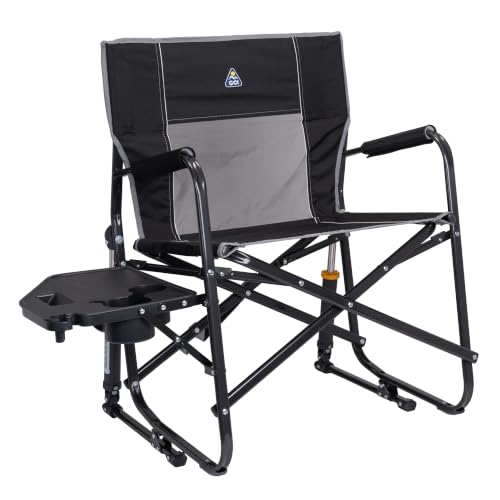
GCI Outdoor Freestyle Rocker XL with Side Table Camping Chair | Portable Folding Rocking Chair with Solid, Durable Armrests, Drink Holder & Comfortable Backrest — Black
Included for 'GCI Outdoor Freestyle Rocker Chair Review: Comfort, Weight Capacity, and Portability' because the listing specifies Portable Folding Rocking Chair with Solid and Durable Armrests, details this guide uses to compare options.
View on Amazon
GCI Outdoor Freestyle Rocker XL Camping Chair - Indigo Blue
Included for 'GCI Outdoor Freestyle Rocker Chair Review: Comfort, Weight Capacity, and Portability' because the listing specifies Indigo Blue, details this guide uses to compare options.
View on Amazon
GCI Outdoor Freestyle Rocker XL Camping Chair with Side Table - Red
Included for 'GCI Outdoor Freestyle Rocker Chair Review: Comfort, Weight Capacity, and Portability' because the listing specifies Red, details this guide uses to compare options.
View on AmazonTwo realities to know about this design:
- The arc is modest. This is a gentle gliding rock, not the deep swoop of a wooden porch rocker. If you’re picturing a front-porch experience, recalibrate — it’s more “soothing bounce” than “rocking back to look at the stars.”
- Moving parts wear. The pistons are the first component to develop looseness or a squeak after seasons of use. A shot of silicone lubricant on the piston shafts each season keeps the action smooth. Bolts can also work loose with the constant rocking motion — check them once a year.
Fit and Comfort: Who This Seat Actually Suits
The 19.7-inch seat height is the spec most shoppers skip over and the one that matters most day to day. Most folding camp chairs sit at 14–16 inches — low enough that getting out of them is a workout for knees and hips. The Freestyle Rocker sits at dining-chair height, which makes it one of the better portable options for older campers, anyone with joint issues, or people who just hate hoisting themselves out of a sagging bucket chair.
Comfort trade-offs to weigh:
- Bare fabric armrests. There’s no padding on the arms. Fine for an hour by the fire; noticeable after a three-hour tailgate.
- Mesh back panel. Great in July, slightly less supportive than a fully upholstered back. No lumbar pillow is built in.
- Upright posture. The seat geometry is fairly upright. Good for eating and conversation; less good if you want to slouch.
The 250 lb Capacity, Realistically
A 250 lb rating is a laboratory maximum under ideal conditions, not a comfort guarantee. Chairs rated at 250 lb tend to feel most solid for users under roughly 210–220 lb, especially during dynamic loads — plopping down, rocking hard, shifting to reach a cooler. If you’re at or above the rated limit, the seat fabric will tension noticeably and the frame may flex during rocking. Heavier users should look at camp chairs specifically rated 300 lb and up, which exist in the same price bracket from several camping brands.
Camping Chair or Patio Chair? A Decision Matrix
| Your situation | Freestyle Rocker verdict | Better alternative |
|---|---|---|
| Car camping, dispersed camping | Excellent — rocks on dirt, packs flat | — |
| Backpacking / hike-in sites | No — 12 lb is far too heavy | 2–3 lb ultralight camp chair |
| Tailgates, kids’ sports sidelines | Very good — flat fold, quick setup | — |
| Apartment balcony (small space) | Good — store folded against a wall, ~5″ deep | — |
| Permanent covered porch | Weak choice — steel/fabric wears outdoors | Wood or HDPE poly lumber rocker |
| User over ~230 lb | Marginal — near the 250 lb limit | 300+ lb rated big-and-tall camp chair |
| Kids and pets | Good with supervision — pinch points at fold joints | — |
| Bad back, gentle motion helps | Good — upright seat plus smooth rock | — |
The honest dividing line: treat the Freestyle Rocker as a portable chair that sometimes lives on the patio, not a patio chair. Left outside through sun and rain year-round, the polyester fades, the powder coat eventually chips at the fold joints, and rust follows. Used as intended — deployed when needed, stored dry — it holds up for many seasons.
Portability: Where the Folded Shape Matters
At roughly 25 × 5 × 35 inches folded, the Freestyle Rocker doesn’t shrink into a carry bag like smaller camp chairs — it stays nearly its full height and just gets thin. That’s a trade-off with clear winners and losers:
- Winner — car trunks and RV storage: It slides flat against a trunk wall, behind an SUV seat, or into an RV pass-through bay alongside a folding table.
- Winner — closet and garage storage: A row of four folded chairs occupies only about 20 inches of wall depth.
- Loser — long carries: The handle is a grab handle, not a shoulder strap, and there’s no carry bag. Twelve pounds gets heavy past a quarter-mile. If your campsite or sideline spot is far from parking, plan accordingly.
Freestyle Rocker vs. the RoadTrip Rocker
GCI Outdoor’s RoadTrip Rocker solves the Freestyle’s two most common complaints. It adds padded armrests and a wider, deeper seat, sits a touch higher (around 20 inches), and uses the same piston-rocking system and 250 lb rating. The cost is roughly 2 extra pounds of chair weight and a slightly higher price — RoadTrip models typically run $10–$20 more, with the Freestyle usually found in the $60–$80 market range and the RoadTrip in the $80–$100 range.
Buy the Freestyle if weight and packed size are your priority, or if it’ll be carried by someone who struggles with heavy gear. Buy the RoadTrip if the chair will live at the tailgate or firepit for hours at a time and arm padding matters to you — the extra two pounds won’t be noticed in a parking-lot context.
What Wears First (and How to Slow It Down)
- Piston hardware: squeaks and looseness — annual lubrication and bolt check.
- Powder coat at fold joints: chips from metal-on-metal folding — fold carefully, don’t slam it shut.
- Seat fabric corners: UV fading and seam strain — store out of sun; avoid sitting on the front edge edge-on.
- Mud in the foot caps: packs in during soft-ground use — knock them clean before folding to protect your trunk.
Frequently Asked Questions
Does the Freestyle Rocker actually rock on grass?
Yes — that’s the whole point of the piston design. Because the legs don’t move, the rocking works on grass, gravel, sand (with some sinking of the feet), and hard decking without scratching the surface.
Is it hard to fold?
No — it uses a pull-up fold action that collapses the chair flat in seconds. There are pinch points where the frame pivots, so keep fingers (and kids’ fingers) clear during setup and takedown.
Can it stay on the patio all summer?
It can, but expect faster fabric fading and eventual rust at the joints. For a dedicated outdoor rocker that lives outside permanently, a wood or recycled-plastic lumber rocker is the more durable buy — the Freestyle earns its keep through portability.