Key takeaways
- Marketing photos of the pit sitting directly on wood or composite boards with no stand or mat.
- No stated wall thickness or steel grade; “stainless steel” alone can mean a 0.8 mm 201-grade shell.
- Single wall with decorative cutouts sold as smokeless.
- No way to remove ash without tipping a 40-pound pit.
- No spark screen available for the model.
- “Deck safe” claims with no lift height or mat recommendation.
- Diameter over 30 inches marketed for deck use.
The word “smokeless” sells fire pits, but it is not the spec that keeps a wood deck from scorching. Buyers pick a pit for its flame photos, set it directly on composite boards, and find a gray heat ring under it after two evenings. Others buy a 30-inch pit for a 10 x 10 foot deck and discover the 36-inch clearance to the railing does not exist. The third common miss is weight and portability: a 60-pound steel pit that never gets moved is fine on a patio, but on a deck it blocks a door or a stair every time. A fire pit on a wood deck is a heat management problem first and a mood-lighting purchase second.
Decide These 3 Things First
1. Is a wood fire allowed on your deck at all? Many municipalities and most HOAs prohibit open wood burning within 10 to 25 feet of a structure, and a deck attached to the house is part of the structure. Check before buying. If wood is banned, a propane fire table is the only legal path.
Our top picks



As an Amazon Associate we earn from qualifying purchases at no extra cost to you.
2. How much deck is available? Measure the clear area. You need the pit’s diameter plus 36 inches on every side to railings, siding, furniture, and the grill, and at least 10 feet overhead to any roof, pergola, or branch. A 24-inch pit needs an 8 x 8 foot clear circle; a 30-inch pit needs 8.5 x 8.5 feet.
3. How many people and how often? A 19- to 22-inch pit warms 3 to 4 people and burns 12-inch splits. A 24- to 27-inch pit handles 5 to 7 people and 16-inch splits, the standard firewood length. A 30- to 42-inch pit is for 8-plus and burns a lot of wood; the OutVue 42 Inch Smokeless Fire Pit with 2 Grills at $189.99 is a backyard piece, not a deck piece, unless the deck is 16 feet wide or more.
Deck Protection: Stand, Base, and Heat Shield
This is the factor that matters most on wood or composite. Smokeless pits run hotter than a conventional ring because the double-wall design pulls air through the fire; the outer wall reaches temperatures that will discolor and eventually char boards within 4 to 8 inches below. You need two things: a stand that lifts the pit 4 to 8 inches off the deck, and a heat shield or fire-resistant mat with a footprint at least 12 inches larger than the pit in every direction. Some pits include a deck-rated stand, such as the OuterMust 24 Inch Smokeless Fire Pit with deck safe stand and ash pan at $139.99; others sell the stand separately for $40 to $90. A 36 x 36 inch or 40 x 40 inch fire pit mat rated for wood-burning use runs $30 to $70. Composite decking is more heat-sensitive than wood; boards can soften and warp at temperatures that only discolor pine, so treat the mat as mandatory on composite.
Size and Weight
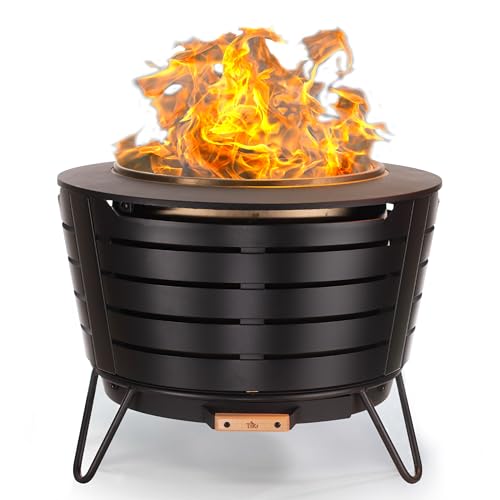
Nominal size is the outer diameter at the rim. Common deck-friendly sizes are 19 to 20 inches (12 to 18 pounds), 24 to 25 inches (20 to 35 pounds), and 27 to 30 inches (35 to 60 pounds). The TIKI Patio Smokeless Fire Pit, a 25-inch wood burning pit with cover at $295, sits in the middle band. Height matters for deck use too: a rim 15 to 18 inches high without a stand, or 20 to 24 inches with one, keeps flames visible from a seated position without putting the fire above chair-arm level. Weight decides whether the pit gets stored under cover after each use, which is the single best way to make stainless or carbon steel last.
Material and Wall Construction
Stainless steel (304 grade) is the premium choice: it resists rust, tolerates the 800-plus-degree outer wall temperatures, and weighs about 15 percent less than carbon steel of the same gauge. Carbon steel with a high-temperature powder coat costs 30 to 50 percent less and works, but chips in the coating rust within a season on a damp deck. Wall thickness runs 1.2 to 2 mm on budget pits and 2 to 3 mm on premium; thin walls warp with repeated heat cycles. Look for a true double wall with a bottom air intake ring and secondary combustion holes 1 to 2 inches below the rim; single-wall pits with a few holes are not smokeless in any meaningful sense.
Smokeless Performance and Ash Management
Secondary combustion works when the fire is hot and the wood is dry (under 20 percent moisture). Expect visible smoke for the first 10 to 15 minutes of every burn and any time you add a log; the marketing videos skip that part. Features that help: a removable ash pan or a lift-out base so you can empty it without flipping the whole pit, a spark screen (essential on a deck, $25 to $60 if not included), and a snuffing lid to kill the fire quickly. Grill grates, as on the Outdoor Fire Pit for Smokeless Firepit Wood Burning with Grill at $149.99, are a bonus for cooking but add grease drips to the deck; use the mat.
Price Tiers
In 2026, the smokeless market divides cleanly. From $100 to $170, you get a 19- to 24-inch carbon steel or thin stainless pit, often with a stand, screen, or grate bundled. From $180 to $350, expect 304 stainless, 2 mm or thicker walls, a proper ash pan, and a cover. Above $350, you are into 27- to 30-inch heavy stainless with lift-out fireboxes, integrated stands, and 5- to lifetime warranties. Spending more buys durability and easier cleanup; the flame looks about the same at every tier.
Warranty and Delivery
Budget pits carry 90 days to 1 year. Mid-tier stainless usually 1 to 2 years. Premium brands offer 5 years to lifetime against rust-through. Boxes weigh 20 to 70 pounds; most pits arrive assembled or need 10 minutes to attach a stand. Check whether the cover, screen, and stand are in the box or are separate purchases; the accessory total can add $80 to $150.
Spec Checklist
| Spec | Budget | Mid | Premium |
|---|---|---|---|
| Diameter | 19 to 22 in | 24 to 27 in | 27 to 30 in |
| Material | Powder-coated carbon steel or 1.2 mm stainless | 304 stainless, 1.5 to 2 mm | 304 stainless, 2 to 3 mm |
| Weight | 12 to 22 lb | 22 to 40 lb | 40 to 65 lb |
| Deck stand | Sold separately, $40 to $60 | Often included, 4 to 6 in lift | Integrated, 6 to 8 in lift |
| Ash removal | Tip and dump | Removable ash pan | Lift-out firebox or pan |
| Spark screen | Not included | Included or $25 to $40 | Included |
| Firewood length | 12 in splits | 16 in splits | 16 to 20 in splits |
| Price | $100 to $170 | $180 to $350 | $350 to $800 |
| Warranty | 90 days to 1 year | 1 to 2 years | 5 years to lifetime |
Red Flags
- Marketing photos of the pit sitting directly on wood or composite boards with no stand or mat.
- No stated wall thickness or steel grade; “stainless steel” alone can mean a 0.8 mm 201-grade shell.
- Single wall with decorative cutouts sold as smokeless.
- No way to remove ash without tipping a 40-pound pit.
- No spark screen available for the model.
- “Deck safe” claims with no lift height or mat recommendation.
- Diameter over 30 inches marketed for deck use.
FAQ
Can you put a smokeless fire pit on a wood deck?
Yes, with a stand that lifts it 4 to 8 inches and a fire-resistant mat at least 12 inches larger than the pit on every side, plus 36 inches of clearance to railings and siding and 10 feet overhead. Confirm local rules first, since many jurisdictions restrict wood fires near structures.
Do smokeless fire pits get hot underneath?
Very. The bottom air intake pulls heat down and the outer wall can exceed several hundred degrees. Without a stand, the deck surface directly below can discolor in a single evening and char over repeated use.
What size smokeless fire pit is best for a deck?
24 to 25 inches for most decks. It burns standard 16-inch firewood, warms 5 to 7 people, weighs 20 to 35 pounds so it can be moved, and needs an 8 x 8 foot clear area with 36-inch clearances.
Is stainless steel worth the extra cost for a deck fire pit?
On a deck, yes. Decks stay damp longer than patios, and carbon steel rusts wherever the coating chips. Rust streaks stain wood and composite, and they are hard to remove.