Key takeaways
- Buying by pack count instead of rail length. A 20-pack sounds like plenty until the deck has 60 feet of rail and stairs; measure first.
- Overhanging the cap. A 4-inch light on a 3.5-inch 2 by 4 cap sticks out on both sides, collects water underneath, and pops off when someone leans on it.
- Too bright at eye level. Lights over 50 lumens facing up or out on a top rail glare at anyone seated. Rail lights are for marking edges, not for reading.
- Ignoring shade. Panels under a roof edge or tree deliver half the runtime and die by 10 p.m. Put lights where the panel sees open sky at midday.
- Mixing color temperatures. Warm white at 2700 to 3000K matches most decks; mixing in cool white 6000K units from a different pack looks patchy.
- Mounting with adhesive only. Included foam tape fails in freeze-thaw. Use the screws, even on composite, with a dab of exterior sealant in the hole.
The Short Answer
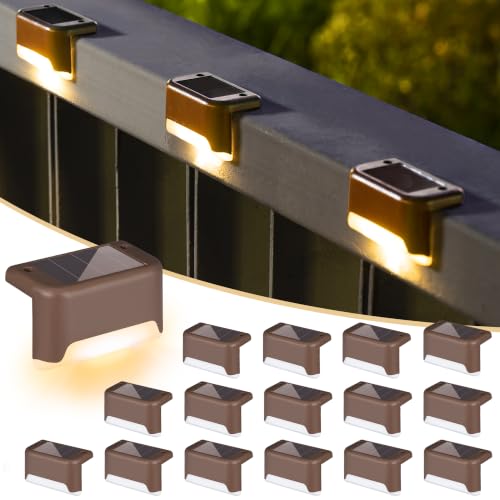
For the top rail of a deck, choose surface-mount solar lights that are 3 to 4 inches wide, 1 to 1.5 inches tall, and roughly 2 to 3 inches deep, so they sit fully on a standard 2 by 4 or 2 by 6 cap rail without overhanging the edge. Space them 6 to 8 feet apart for ambient glow, or 4 to 5 feet apart if you want the whole rail line to read as continuous light. For a typical 12 by 16 foot deck with about 40 feet of railing, that means 6 to 8 lights at wide spacing or 8 to 10 at close spacing. Post-cap lights are a different category; they fit 4 by 4 or 6 by 6 posts and light the corners, not the run. Brightness of 10 to 30 lumens per light is plenty for a rail; anything above 50 lumens on a top rail glares at seated eye level.
Standard Sizes
| Light type | Typical size (inches) | Typical size (cm) | Mounts on | Brightness | Spacing | Price per light |
|---|---|---|---|---|---|---|
| Compact surface-mount puck | 3 x 2 x 1.2 | 7.6 x 5 x 3 | Top of 2 x 4 cap rail (3.5 in wide), stair risers, fence tops | 6 to 15 lumens | 4 to 6 ft | $1.00 to $2.50 in 16 to 20 packs |
| Standard surface-mount | 4 x 3 x 1.5 | 10 x 7.6 x 3.8 | Top of 2 x 6 cap rail (5.5 in wide), wide composite rails | 10 to 30 lumens | 6 to 8 ft | $2.50 to $5.00 |
| Stainless housing surface-mount | 4.3 x 3 x 1.7 | 11 x 7.6 x 4.3 | Cap rails, step edges, wall faces | 15 to 40 lumens | 6 to 8 ft | $4.00 to $8.00 |
| Side-mount rail light | 4 to 6 x 2 to 3 x 1 to 1.5 | 10 to 15 x 5 to 7.6 x 2.5 to 3.8 | Outer face of rail or fascia board | 10 to 30 lumens | 5 to 8 ft | $2.00 to $6.00 |
| Post-cap light, 4 x 4 | 5 x 5 x 3 to 4 (fits 3.5 to 4 in post) | 12.7 x 12.7 x 7.6 to 10 | 4 x 4 nominal post tops | 15 to 50 lumens | Every post, 6 to 8 ft | $8.00 to $25.00 |
| Post-cap light, 6 x 6 | 7 x 7 x 3.5 to 4.5 (fits 5.5 to 6 in post) | 17.8 x 17.8 x 9 to 11.4 | 6 x 6 nominal post tops | 20 to 60 lumens | Every post, 6 to 8 ft | $12.00 to $40.00 |
Most rail lights use a 0.1 to 0.3 watt LED, a 1.2 volt nickel-metal hydride or 3.2 volt lithium cell of 300 to 800 mAh, and a 2 by 2 inch to 3 by 3 inch solar panel. Expect 6 to 10 hours of light after a full sunny day and 3 to 5 hours after an overcast one. IP65 is the minimum weather rating worth buying for a rail exposed to rain.
Our top picks



As an Amazon Associate we earn from qualifying purchases at no extra cost to you.
How to Measure Your Space
- Measure the cap rail width. A 2 by 4 cap is 3.5 inches (8.9 cm) wide; a 2 by 6 is 5.5 inches (14 cm); composite caps run 3.5 to 6 inches. Your light must be narrower than the rail by at least 0.25 inch on each side or it will overhang and catch sleeves.
- Measure total rail length. Add up every run of railing that will get lights. Do not include the house side or gaps for stairs and gates. A 12 by 16 foot deck attached to the house usually has 36 to 44 feet of rail.
- Locate the posts. Mark post positions, typically every 6 to 8 feet. Surface-mount lights should sit midway between posts or evenly divided in each bay; post-cap lights replace the caps entirely and light corners and rail ends.
- Divide by spacing. Rail length divided by 6 to 8 gives the count for ambient lighting; divided by 4 to 5 for a continuous line. Round up and add 2 spares, because one or two units in any pack of 16 to 20 tend to fail in the first year.
- Check the sun. Solar panels on the rail need 5 to 6 hours of direct sun. A rail under a roof overhang, a shade tree, or on the north side of the house will get half the runtime. If the top rail is shaded, consider side-mount lights on a sunnier fascia or post caps that sit higher.
- Test seated glare. Sit in a deck chair and hold a phone flashlight at rail height. If it is in your eyes, choose a downward-facing lens or side-mount lights on the outer face of the rail instead of top-mounted ones.
By Room or Use Case
Small deck or balcony, under 30 feet of rail
Six to eight compact 3-inch pucks at 4 to 5 foot spacing give a continuous soft glow without a lot of hardware. A 16-pack at $20 to $40 covers it with spares. On a 3.5 inch cap rail, the 3-inch width is the largest that sits cleanly.
Standard attached deck, 12 by 16 feet
Roughly 40 feet of rail on three sides. Eight standard 4-inch lights at 6 to 8 foot spacing, plus post-cap lights on the 4 to 6 corner and stair posts if you want the outline defined, is the common layout. Total cost lands at $40 to $120 depending on whether you add post caps.
Deck with stairs
Stairs need their own lights at every other riser or on the stringer face at 2 to 3 foot spacing, plus one at the top and bottom step. A 2 by 4 handrail on stairs takes the same 3-inch pucks as the deck rail. Plan on 4 to 8 additional lights for a typical 5 to 8 step run.
Long fence line or pool fence
For 60 to 100 feet of rail, spacing out to 8 to 10 feet keeps the cost sensible at 8 to 12 lights and still marks the boundary. Choose stainless or black steel housings here; the cheapest ABS plastic housings chalk and yellow within two summers in full sun.
Composite railing systems with wide caps
Composite caps of 5 to 6 inches take the larger 4 to 4.5 inch stainless housings. Because composite rails often hide the post inside a sleeve, post-cap lights must match the sleeve size, usually 4 by 4 or 5 by 5 inches actual, and many composite makers sell matching low-voltage caps that cost $30 to $60 each but never need sun.
Common Sizing Mistakes
- Buying by pack count instead of rail length. A 20-pack sounds like plenty until the deck has 60 feet of rail and stairs; measure first.
- Overhanging the cap. A 4-inch light on a 3.5-inch 2 by 4 cap sticks out on both sides, collects water underneath, and pops off when someone leans on it.
- Too bright at eye level. Lights over 50 lumens facing up or out on a top rail glare at anyone seated. Rail lights are for marking edges, not for reading.
- Ignoring shade. Panels under a roof edge or tree deliver half the runtime and die by 10 p.m. Put lights where the panel sees open sky at midday.
- Mixing color temperatures. Warm white at 2700 to 3000K matches most decks; mixing in cool white 6000K units from a different pack looks patchy.
- Mounting with adhesive only. Included foam tape fails in freeze-thaw. Use the screws, even on composite, with a dab of exterior sealant in the hole.
FAQ
How far apart should solar lights be on a deck railing?
Six to 8 feet (1.8 to 2.4 m) apart for soft ambient marking, which usually means one light per bay between posts. Four to 5 feet (1.2 to 1.5 m) apart if you want an unbroken line of light. Stairs need closer spacing at 2 to 3 feet.
Will a 4-inch solar light fit on a 2 by 4 top rail?
Not cleanly. A 2 by 4 is 3.5 inches wide, so a 4-inch light overhangs a quarter inch on each side. Choose 3-inch pucks for 2 by 4 caps and save the 4-inch housings for 2 by 6 or composite caps of 5.5 inches or more.
How many lumens do I need for a deck rail?
Ten to 30 lumens per light is the comfortable range for a top rail; it marks the edge and lights the deck surface faintly without glare at seated height. Post-cap lights on corners can go to 40 to 60 lumens because they sit higher and face down.
Are solar rail lights bright enough for a deck in 2026, or should I hardwire?
For marking edges and ambiance, quality solar lights at 10 to 30 lumens with IP65 housings do the job for $1 to $8 per unit and no wiring. If you want to see a plate of food or read at night, add a low-voltage string or a wall-mounted fixture; no rail light, solar or wired, is designed for task lighting.