
Key takeaways
- Match the ceiling to your row, not your curl. Back muscles are large and tolerate load well. If your heaviest single-arm row set of 12 already feels easy at the top of your range, buy the next increment up before you buy anything else. Under-loading is the single most common reason home back training stalls.
- Judge coating by sweat, not by looks. Neoprene grips beautifully dry and gets slick when soaked. If you train hot or in a garage, plan on a towel within reach, and consider whether a knurled metal handle suits you better for anything above the mid-teens.
- Check what you’ll brace against.
- Prefer flat-ended shapes for floor work. Renegade rows, deadstop rows, and any set where you park the weight mid-series all go smoother when the dumbbell stays put. Round ends roll toward your toes at the worst moment.
- Buy structure, not inspiration. A card deck earns its keep by removing decisions. Look for clear illustrations, named muscle groups, and enough exercise volume — a hundred-plus movements — that you can rotate for months without repeating a session verbatim.
What's inside
Back day with dumbbells fails for reasons that have nothing to do with your lats. It fails because your fingers give out on the eighth rep of a row, or because you cannot find a stable place to brace your off-hand, or because the heaviest thing in the house is a 15-pounder and your back stopped caring about 15 pounds two months ago. Grip, support, ceiling. Those three constraints decide whether a home back workout builds thickness or just burns twenty minutes. A rack of adjustable plates fixes the ceiling and ignores the other two. A pile of printouts fixes nothing.
The kit below is deliberately unglamorous: a set of neoprene-coated hand weights and a pack of laminated exercise cards. Together they cover the beginner-to-intermediate window where most people actually live — the phase where you need light-to-moderate loads that don’t shred your palms, plus a system that tells you what a single-arm row, a reverse fly, and a pullover have to do with each other. Below you’ll find how the two pieces fit, where each one runs out of runway, and how to sequence them so the neoprene doesn’t become a drawer full of colored bricks.
As an Amazon Associate we earn from qualifying purchases at no extra cost to you. Product prices and availability are accurate as of the date shown and are subject to change.

#1 Pick

#2 Pick


#4 Pick


#6 Pick

#7 Pick

Quick Comparison
| Feature | Bodyweight & Dumbbell Workout Cards (2 Pack) | Amazon Basics Neoprene Dumbbell Hand Weights |
|---|---|---|
| Primary role in the kit | Programming and exercise selection | Load and grip surface |
| Solves | “I don’t know what to do next” | “The bar slips and my forearms quit first” |
| Back-specific content | Rows, flies, pullovers, hinges, plus bodyweight pulls | Any unilateral or bilateral pulling pattern |
| Weight range | Not applicable | Typically 1–20 lb per hand, sold singly or in sets |
| Grip character | — | Soft neoprene shell, slightly tacky when dry |
| Floor behavior | — | Flat-sided ends resist rolling |
| Storage footprint | Deck-sized; fits a gym bag pocket | Stacks in a cube or under a couch |
| Best for | Novices, travelers, anyone rebuilding a routine | Higher-rep back work, warm-ups, rehab-adjacent volume |
| Main limitation | Illustrations only go so far on form nuance | Hard ceiling — heavy rows outgrow it |
How to Choose
- Match the ceiling to your row, not your curl. Back muscles are large and tolerate load well. If your heaviest single-arm row set of 12 already feels easy at the top of your range, buy the next increment up before you buy anything else. Under-loading is the single most common reason home back training stalls.
- Judge coating by sweat, not by looks. Neoprene grips beautifully dry and gets slick when soaked. If you train hot or in a garage, plan on a towel within reach, and consider whether a knurled metal handle suits you better for anything above the mid-teens.
- Check what you’ll brace against.
- Prefer flat-ended shapes for floor work. Renegade rows, deadstop rows, and any set where you park the weight mid-series all go smoother when the dumbbell stays put. Round ends roll toward your toes at the worst moment.
- Buy structure, not inspiration. A card deck earns its keep by removing decisions. Look for clear illustrations, named muscle groups, and enough exercise volume — a hundred-plus movements — that you can rotate for months without repeating a session verbatim.
Top Picks Reviewed
2 Pack – Bodyweight & Dumbbell Fitness Workout Cards – Over 100 Exercises
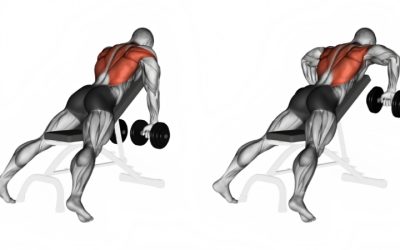
This is the piece people skip and then regret. Two decks, one bodyweight and one dumbbell, each card carrying an illustrated movement with the target musculature spelled out. For back training that pairing matters more than it sounds: the dumbbell deck gives you the loaded pulls — bent rows, single-arm rows, reverse flies, pullovers, hinge variations — while the bodyweight deck supplies the supporting cast of scapular work, bridges, and prone raises that keep your rear delts and mid-back from lagging behind your lats. The physical cards are the point. Laminated stock survives a chalky hand and a puddle on the garage floor, and shuffling three cards into a sequence takes less time than unlocking a phone. The honest limitation: illustrations show positions, not mistakes. A card can tell you to row; it cannot tell you your elbow is flaring or your torso is rising with each rep. Film one set from the side during your first week and the deck becomes twice as useful.
Amazon Basics Neoprene Dumbbell Hand Weights for Exercise and Muscle Toning
These are the quiet workhorses of a home back routine. The neoprene shell gives a soft, slightly grippy surface that lets you hold a moderate weight through long sets without your fingers becoming the limiting factor — which is exactly the failure mode that ruins high-rep row work. Color coding and molded weight markings mean you grab the right one without squinting, and the flat-sided ends keep them from rolling across the floor between sets. The practical sweet spot for back training is a pair in the 8-to-20 pound band, plus a lighter pair for reverse flies and prone raises, where anything heavy turns the movement into a shrug. Be clear-eyed about the ceiling: neoprene sets top out around 20 pounds per hand, and a trained back will eventually laugh at that on a supported row. Until then, you can extract enormous mileage by slowing the eccentric to three or four seconds, pausing at the top, and pushing sets into the 15-to-20 rep range where mechanical tension and fatigue overlap.
Frequently Asked Questions
Can I actually build a back with 20-pound dumbbells?
Yes, up to a point. Tempo control, pauses, single-arm work, and higher rep targets all raise the effective difficulty of a fixed load. Where light weights genuinely fall short is heavy hinging and loaded carries. Once a 20-pound single-arm row for 20 slow reps stops being hard, you need heavier iron or a resistance band to keep progressing.
Does neoprene wear out?
The coating can nick or compress if you repeatedly clang the weights together or drop them on concrete. Set them down rather than releasing them, wipe sweat off after training, and store them out of direct sun. Treated reasonably, the shell outlasts the point at which you outgrow the weight.
What’s the minimum useful setup for back day?
One pair of moderate weights, one pair of light weights, a bench-height surface to brace against, and something that dictates your exercise order. That is the whole list. Add a doorway pull-up bar later if you want a vertical pulling pattern the dumbbells can’t replicate.
Are the cards worth it if I already follow a program?
If your program is written and you’re following it, the decks become a substitution library — useful when a movement aggravates something or when travel strips you down to bodyweight. If you don’t have a program, they’re the more valuable of the two purchases.
Final Thoughts
Treat this pair as a starter chassis rather than a finished vehicle. The neoprene handles grip and gives you a clean, non-rolling load for the rep ranges where back training is most forgiving; the cards handle structure and keep you from doing the same three rows until you’re bored of them. Your first upgrade should come from whichever constraint bites first — most people find it’s the ceiling, and the fix is one heavier pair, not a whole new system. Get a bracing surface sorted, film a set now and then, and let the weights be the thing you outgrow rather than the thing you never fully used.



Write Your Review
No reviews yet. Be the first to share your experience!