
Key takeaways
- Prioritise a low starting weight: Tricep isolation works best light. Equipment that starts at 20 lb per hand is more useful than something that starts at 40, regardless of the maximum.
- Rotatable handles spare the wrist: Being able to angle the forearm slightly during extensions removes a common source of elbow and wrist irritation. Dumbbells allow it; a fixed straight bar does not.
- Cables change the resistance profile: A pushdown is hardest at lockout and easiest at the stretch, which is gentler on the tendon than a lying extension that peaks with the elbow bent under load.
- Small increments prevent overreaching: Jumping from 25 to 40 lb on an extension is how people get hurt. Look for 5 lb steps in the working range or use fixed dumbbells for isolation work.
- Control the range, not just the load: Stopping slightly short of full lockout and avoiding an extreme stretch at the bottom protects the elbow far more than any piece of equipment.
What's inside
Triceps are where home lifters most often develop elbow pain, and the cause is usually mechanical rather than excessive. Lying extensions with a straight bar force the forearm into a fixed rotation while the elbow travels under load. Add a weight that is slightly too heavy and a range that goes slightly too deep, and the tendon at the back of the elbow takes the difference. Six weeks later, curling hurts too.
Choosing equipment with that in mind changes the shortlist. Rotatable dumbbell handles let the forearm find a comfortable path. Cable attachments provide resistance that drops off at the bottom of a pushdown rather than peaking there. An arm blaster removes the elbow drift that makes people compensate with load. Below, six pieces of tricep equipment assessed for joint friendliness as much as for training effect, spanning adjustable dumbbells from 20 to 90 pounds, a pulley system, and a hex dumbbell rack.
As an Amazon Associate we earn from qualifying purchases at no extra cost to you. Product prices and availability are accurate as of the date shown and are subject to change.

#1 Pick

#2 Pick
#3 Pick

#4 Pick

#5 Pick

#6 Pick

#7 Pick

Quick Comparison
| Product | Best For | Standout Feature | Watch Out For |
|---|---|---|---|
| FITPLAM Adjustable Dumbbells | Neutral-grip extensions | Six settings from 20 lb | Long bar at heavy settings |
| Arm Blaster Isolator | Preventing elbow drift | Fixes upper arm position | Narrow exercise range |
| 5-in-1 Connector Dumbbells | Varied grip widths | Bar conversion included | Straight bar irritates some wrists |
| 4-in-1 Adjustable Dumbbells | Light isolation work | 20 lb starting load | Coarse jumps between settings |
| SERTT Cable Pulley System | Joint-friendly loading | Tension eases at the stretch | Anchor point required |
| CAP Hex Dumbbell Set | Precise light increments | Fixed weights, rubber coated | Costly to cover a full range |
How to Choose
- Prioritise a low starting weight: Tricep isolation works best light. Equipment that starts at 20 lb per hand is more useful than something that starts at 40, regardless of the maximum.
- Rotatable handles spare the wrist: Being able to angle the forearm slightly during extensions removes a common source of elbow and wrist irritation. Dumbbells allow it; a fixed straight bar does not.
- Cables change the resistance profile: A pushdown is hardest at lockout and easiest at the stretch, which is gentler on the tendon than a lying extension that peaks with the elbow bent under load.
- Small increments prevent overreaching: Jumping from 25 to 40 lb on an extension is how people get hurt. Look for 5 lb steps in the working range or use fixed dumbbells for isolation work.
- Control the range, not just the load: Stopping slightly short of full lockout and avoiding an extreme stretch at the bottom protects the elbow far more than any piece of equipment.
Top Picks Reviewed
Gentlest on the Joints: SERTT Cable Pulley System
Pushdowns and rope overhead extensions load the triceps hard while the resistance curve eases exactly where the elbow is most vulnerable. The rope attachment also lets the hands separate at lockout, allowing a natural forearm rotation that a bar prevents.
It requires a solid anchor point, which not every room offers. Door-mounted anchors work but must be rated properly and positioned carefully.
Best for Precise Loading: CAP Hex Dumbbell Set
Fixed rubber-coated dumbbells in a rack give exact, repeatable increments — the 5 lb steps that isolation work needs and that adjustable systems rarely provide in the light range. Picking the next weight takes seconds.
Covering a useful range with fixed weights costs considerably more than an adjustable set, and the rack claims real floor space.
Best Form Corrector: Arm Blaster Isolator
Elbow drift is the mechanism by which a tricep extension becomes a shoulder movement and the joint takes the load. Fixing the upper arm eliminates it immediately, which usually means dropping the weight and feeling the muscle properly.
It only helps a narrow band of exercises and does nothing for overhead or lying variations. Consider it an adjunct, not a foundation.
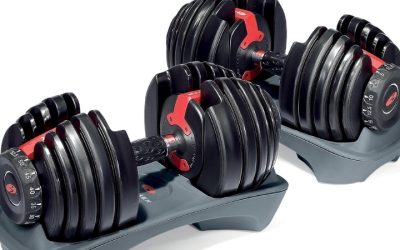
Best Adjustable Option: FITPLAM Adjustable Dumbbells
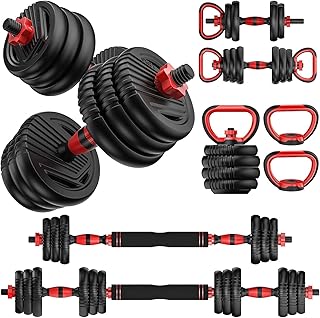
Starting at 20 lb with six settings to 90, this covers light kickbacks and heavier close-grip work from one purchase, and the dumbbell format allows the forearm rotation that spares the wrist during extensions.
At the higher settings the bars get long, which makes overhead extensions awkward and increases the chance of clipping your head on the way down.
Most Grip Options: 5-in-1 Connector Dumbbells
Being able to switch between two dumbbells and a connected bar lets you vary grip width and hand position across a session, which distributes stress rather than repeating the same joint angle every set.
The straight bar itself can aggravate wrists in people who find pronated positions uncomfortable. If that is you, stay with the dumbbell configuration.
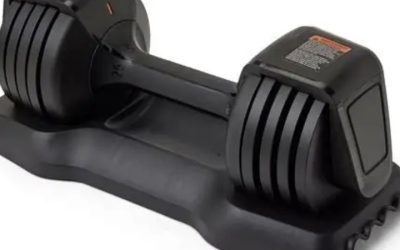
Best Entry Set: 4-in-1 Adjustable Dumbbells
A 20 lb starting load and steps to 80 lb make this a sensible first purchase for someone building tricep strength cautiously, with barbell and kettlebell conversions adding value elsewhere in the programme.
The gaps between settings are wide. For isolation work that ideally progresses in 5 lb steps, you may find yourself repeating a weight for longer than necessary.
Frequently Asked Questions
Why do skull crushers hurt my elbows?
Typically too much load combined with too deep a range and a fixed forearm position. Reduce the weight, stop short of a full stretch, and try dumbbells instead of a bar so the wrists can rotate.
Are cable pushdowns better than dumbbell extensions?
Not better, but complementary. Pushdowns load the contracted position with a gentler curve on the elbow, while overhead extensions load the stretched position where most growth occurs. Doing both is ideal.
How much weight should I use for triceps?
Enough for eight to fifteen controlled reps with the upper arms staying still. If the elbows drift forward or the shoulders join in, the load is too heavy for the exercise.
Can I train triceps if my elbows already hurt?
Often yes, with reduced range and lighter loads — pushdowns are usually tolerated when extensions are not. Persistent pain lasting more than a couple of weeks warrants proper assessment rather than a change of equipment.
Final Thoughts
For triceps that already complain, the SERTT Cable Pulley System offers the most forgiving resistance profile and the widest range of comfortable grips. Anyone building a home setup from scratch will get the most controllable progression from the FITPLAM Adjustable Dumbbells, with the Arm Blaster Isolator as a cheap fix if your elbows drift during extensions.

Write Your Review
No reviews yet. Be the first to share your experience!