The Short Answer
A cantilever umbrella needs far more base weight than a center-pole umbrella of the same canopy size, because the canopy hangs several feet off to one side and acts like a lever. The working rule: 10-foot round or 9-foot square cantilever canopies need 150 to 200 pounds of ballast; 11-foot round or 10-foot square canopies need 200 to 300 pounds; 13-foot round or 11- to 12-foot square canopies need 300 to 400 pounds. In consistently windy locations, add 25 to 50 percent to those figures or bolt the cross base to concrete instead.
The umbrella manufacturer’s minimum is a floor, not a target. Most list a figure that keeps the umbrella upright in calm conditions; real patios have gusts.
Our top picks
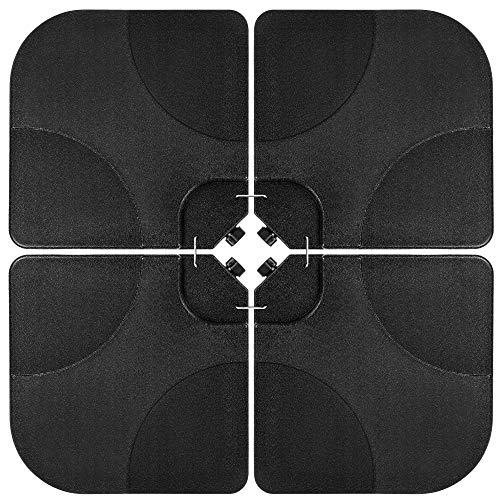
 Simple Deluxe 4pcs Cantilever Offset Patio Market
- Heavy-duty & weather-resistant: Made of HDPE plastic to…
- Sturdy 4-plate design: The 4 square shaped weight…
- Easy-to-fill spouts: Each plate is built with a…


As an Amazon Associate we earn from qualifying purchases at no extra cost to you.
Standard Sizes
Cantilever bases come in two formats. Fillable plate sets are four (sometimes two) hollow plastic slabs that sit on the arms of the umbrella’s steel cross base and fill with sand or water. Cast or concrete bases are one-piece units for umbrellas that bolt to a central plate. The table below gives the typical footprint and weight of the common plate sets, with two listed examples for reference: the Outsunny 2-PCs 231lb Cantilever Offset Patio Umbrella Base Weight Set at $66.49 and the Yaheetech 200lbs 4-Piece Offset Cantilever Patio Umbrella Base at $56.99.
| Base type | Plate footprint (each) | Total footprint (assembled) | Weight filled (sand / water) | Canopy it suits |
|---|---|---|---|---|
| 4-piece plate set, light | 19.5 x 19.5 x 5.5 in (50 x 50 x 14 cm) | 39 x 39 in (99 x 99 cm) | 155 lb sand / 100 lb water | Up to 9 ft square or 10 ft round, sheltered patio |
| 4-piece plate set, standard | 20 x 20 x 6 in (51 x 51 x 15 cm) | 40 x 40 in (102 x 102 cm) | 200 lb sand / 130 lb water | 10 ft square or 11 ft round, average exposure |
| 2-piece plate set, heavy | 20 x 40 x 6.5 in (51 x 102 x 17 cm) | 40 x 40 in (102 x 102 cm) | 231 lb sand / 150 lb water | 10 ft square or 11 ft round, windier sites |
| 4-piece plate set, extra heavy | 22 x 22 x 7 in (56 x 56 x 18 cm) | 44 x 44 in (112 x 112 cm) | 250 to 300 lb sand | 11 to 12 ft square or 13 ft round |
| Cast concrete or steel one-piece | 26 to 32 in diameter, 4 to 6 in tall (66 to 81 cm, 10 to 15 cm) | Same | 200 to 400 lb | Bolt-mount cantilevers, all sizes |
| Ground anchor / concrete bolt-down | 18 x 18 in plate (46 x 46 cm) | Same | Not applicable | Any size, permanent placement |
Pricing for fillable sets runs $45 to $90 in 2026. The Simple Deluxe 4pcs Cantilever Offset Patio Market Stand with U Locking Shape Weights lists at $52.21, and the Best Choice Products 4-Piece 155lb Capacity Heavy-Duty Cantilever Offset Patio Umbrella Stand Square Base Plate Set at $69.99. Cast one-piece bases run $150 to $500.
How to Measure Your Space
- Measure the umbrella’s cross base. Most cantilever cross bases span 36 to 40 inches (91 to 102 cm) tip to tip and have arms 3.5 to 4 inches (9 to 10 cm) wide. Plate sets are made to slot over arms in this range; write down the arm width and the distance from the center post to the arm tip.
- Measure the canopy. Round canopies are measured across the diameter; square and rectangular canopies by side length. A 10-foot square canopy has about 100 square feet of sail area; a 10-foot round has about 79 square feet, which is why square umbrellas need more weight.
- Measure the offset. Stand the umbrella up and measure horizontally from the pole to the center of the canopy. Typical offsets run 5 to 7 feet (150 to 215 cm). Longer offset means more leverage and more weight required.
- Check the floor. A filled base needs a flat, level surface. Pavers with a 1/4-inch height difference under one plate will rock the whole assembly.
- Note the exposure. Count how many sides of the patio are open to wind. Zero or one side: manufacturer minimum is adequate. Two sides: add 25 percent. Three or more, or any rooftop or waterfront: add 50 percent or bolt down.
- Plan the fill. Dry sand weighs roughly 100 pounds per cubic foot; water weighs about 62. A plate rated 50 pounds with sand holds only about 31 pounds of water. Play sand comes in 50-pound bags, so a 200-pound set needs four bags.
By Room or Use Case
Dining patio, 6-seat table, 10-foot square cantilever
Use a 200-pound sand-filled set at minimum. The canopy will be parked over the table most of the time and rotated as the sun moves, and rotation is when a light base tips.
Pool deck, 11-foot round cantilever
Pool decks are open on at least two sides and often catch afternoon wind. Plan 250 to 300 pounds, use sand rather than water, and close the canopy whenever the pool is not in use.
Small balcony or condo terrace, 8- to 9-foot cantilever
A 155-pound set is usually sufficient, but confirm the balcony’s live-load rating; 155 pounds of base plus a 60-pound umbrella on a 40 x 40 inch footprint is a manageable 20 pounds per square foot.
Rooftop deck or lakefront
No fillable set is reliably adequate. Bolt the cross base to a concrete pad or use a 300-pound-plus cast base, and take the canopy down in any forecast above 20 mph.
Lounge area with a 13-foot round or 12-foot square canopy
These oversized canopies need 300 to 400 pounds. Two stacked plate sets or a heavy cast base are the realistic options; a single 200-pound set will fail in the first storm.
Common Sizing Mistakes
- Filling with water and expecting the sand rating. Water gives roughly 60 to 65 percent of the sand weight. A “200 lb” set filled with water is a 130-pound set.
- Buying plates before checking arm width. Plates with a 3.5-inch slot do not fit a 4-inch arm, and vice versa.
- Trusting the umbrella’s minimum. That number assumes still air. Treat it as the lightest acceptable option for a sheltered courtyard only.
- Using a center-pole base. A 50-pound round base is fine for a 9-foot market umbrella and useless for a cantilever, which needs three to five times the mass and a wide footprint.
- Leaving the canopy open in wind. No base survives a fully open 11-foot canopy in a 40 mph gust. Weight buys time, not immunity.
- Ignoring freeze damage. Water-filled plates crack in winter. Drain them or use sand.
FAQ
How much weight does a 10-foot cantilever umbrella need?
For a 10-foot square canopy, 200 to 250 pounds of sand ballast. For a 10-foot round, 150 to 200 pounds. Increase by 25 to 50 percent for exposed sites.
Is sand or water better for cantilever umbrella base weights?
Sand, in almost every case. It is about 60 percent heavier for the same volume, does not freeze and split the plates, and does not slosh when the umbrella rotates. Water is only worth it when you need to empty and move the base often.
Can I use pavers or bricks instead of a base weight set?
Yes, if they sit securely on the cross base arms. Standard 12 x 12 x 2 inch concrete pavers weigh 15 to 18 pounds each, so 12 to 14 pavers approximate a 200-pound set. They shift more easily than interlocking plates and look less tidy.
Do I still need weights if I bolt the umbrella to concrete?
No. Four 3/8-inch concrete anchors into a 4-inch slab hold a cantilever more securely than any weight set. Bolting is the best solution for permanent placement; weights are for umbrellas that need to move.