Key takeaways
- Dramatically less smoke. With dry hardwood and a full fire, neighbors and anyone downwind stop complaining. Clothing and hair no longer smell like a campfire the next morning.
- Fewer sparks and embers. The secondary burn consumes most flying embers, which is the main fire risk on a wood or composite deck.
- Efficient burn. Wood turns to fine ash rather than half-burned chunks, so cleanup is a quick dump of the ash pan every three or four fires.
- Real heat output. A 25-inch pit throws enough warmth for four to six people seated 3 to 4 feet away; a 40-inch pit handles eight to twelve.
- Portable. At 30 to 70 pounds, most can be carried to the yard, the driveway, or a campsite.
- Cooking option. Many larger pits ship with or accept grill grates, turning the fire into a wood-fired grill.
The Short Answer
Yes, for most deck owners a smokeless fire pit is worth it, on one condition: you pair it with a heat shield or a raised stand so the bottom of the pit sits well above the decking. Smokeless pits solve the two problems that make traditional wood fires miserable on a deck, which are smoke drifting into the house and sparks landing on composite or wood boards. They do not solve the third problem, which is radiant heat cooking the deck beneath the pit. If you are not willing to add a $50 to $150 heat deflector or stand, or your HOA or lease forbids open wood fires entirely, a propane fire table is the safer buy.
What You Actually Get
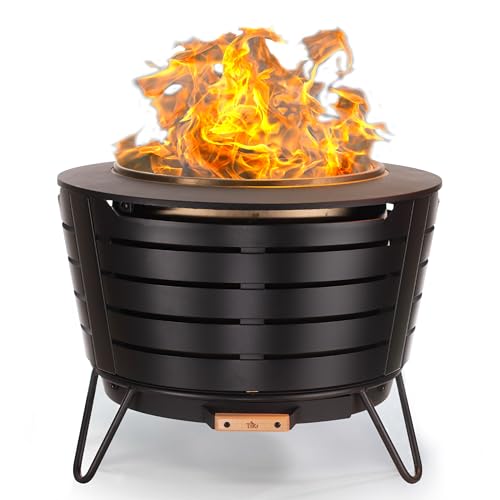
A smokeless fire pit is a double-walled stainless or carbon steel cylinder. Cold air enters holes around the base, rises inside the hollow wall, heats up, and exits through a ring of holes just below the rim. That preheated air feeds a secondary burn that consumes most of the smoke and sparks before they leave the pit. The effect is real: once the fire is hot, typically 10 to 15 minutes after lighting, you get a tall clean flame with a fraction of the smoke of an open ring. It is not literally zero smoke; damp wood, a fire that is too small, or smothering the flame with too many logs will still produce some.
Our top picks

As an Amazon Associate we earn from qualifying purchases at no extra cost to you.
Sizes run from tabletop models around 15 inches up to 40-plus-inch party pits. A 25-inch stainless pit with a lid weighs about 30 to 40 pounds, holds three or four 16-inch splits, and sells for roughly $250 to $350. A 40-plus-inch carbon steel model with grill grates and a stand can run $180 to $400 and weigh 50 to 70 pounds, giving you room for five or six full logs and a cooking surface for a crowd. Most include a removable ash pan and a lid or cover; stands, heat shields, spark screens, and grill accessories are usually sold separately, so budget another $60 to $200 to fully outfit one for deck use.
Pros
- Dramatically less smoke. With dry hardwood and a full fire, neighbors and anyone downwind stop complaining. Clothing and hair no longer smell like a campfire the next morning.
- Fewer sparks and embers. The secondary burn consumes most flying embers, which is the main fire risk on a wood or composite deck.
- Efficient burn. Wood turns to fine ash rather than half-burned chunks, so cleanup is a quick dump of the ash pan every three or four fires.
- Real heat output. A 25-inch pit throws enough warmth for four to six people seated 3 to 4 feet away; a 40-inch pit handles eight to twelve.
- Portable. At 30 to 70 pounds, most can be carried to the yard, the driveway, or a campsite.
- Cooking option. Many larger pits ship with or accept grill grates, turning the fire into a wood-fired grill.
Cons
- Radiant heat underneath. The base of a smokeless pit can reach 400°F to 600°F. Composite decking softens around 170°F to 200°F and wood can scorch under sustained heat. A stand or heat shield is mandatory, not optional.
- It still needs dry wood. Kiln-dried or well-seasoned hardwood under 20 percent moisture is required for the smokeless effect. Green or wet wood smokes like any other fire.
- Smoky start and finish. The first 10 minutes and the last 20 minutes of a burn, when the pit is not fully hot, produce noticeable smoke.
- Uses more wood. The hot, oxygen-rich burn goes through logs 25 to 50 percent faster than a smoldering open pit.
- Stainless discolors, steel rusts. Stainless turns bronze or blue after a few fires; carbon steel models need to stay dry or they rust. Neither affects performance, but both bother some buyers.
- Code and insurance limits. Many municipalities require 10 to 25 feet of clearance from structures for open wood fires, and some deck warranties exclude fire pit damage entirely.
Who Should Buy It
Buy a smokeless pit if you have a deck that opens onto a yard, use it regularly in spring and fall, and have been put off wood fires by smoke drifting through open windows. It is the right choice if you enjoy the ritual of a real wood fire, want the option to cook over it, and have a dry place to store split hardwood. A household that will use it 15 or more evenings a year gets clear value at the $200 to $350 price. It also suits anyone who wants one pit for the deck, the beach, and the campsite rather than a stationary propane table.
Who Should Skip It
Skip it if your deck is small (under about 10 by 12 feet) and cannot provide 5 to 6 feet of clearance from railings, siding, and overhangs; the tall flame of a smokeless pit needs vertical clearance of 10 feet or more as well. Skip it if your HOA, lease, or local fire code bans wood-burning devices on decks, which is common in townhome communities and dry western states. Skip it if you want instant on-and-off convenience without hauling wood or dumping ash; a propane fire table does that better. And skip the cheapest carbon steel models if your deck is exposed to rain and you will not store the pit under cover.
Cheaper Alternatives
| Option | Cost | Trade-off |
|---|---|---|
| Basic steel fire bowl with spark screen | $50 to $120 | Full smoke and sparks; screen blocks the view; highest risk on a deck |
| Tabletop smokeless pit (12 to 16 inch) | $80 to $180 | Ambiance only; little heat; burns small kindling or pellets for 30 to 45 minutes |
| Propane fire table, 30,000 to 50,000 BTU | $200 to $600 | No smoke, instant control, deck-safe on most surfaces; less heat than wood and no crackle |
| Chiminea (clay or cast iron) | $100 to $300 | Directs smoke upward but does not eliminate it; heavy; clay cracks in freeze-thaw |
| DIY smokeless pit from a stainless drum and inner liner | $60 to $120 in materials | Works if you can weld or drill accurately; no warranty; rough finish |
| Bioethanol tabletop burner | $60 to $200 | Clean and deck-safe; small flame; fuel runs $3 to $5 per hour |
FAQ
Can a smokeless fire pit sit directly on a composite deck?
No. Even with a base temperature lower than an open pit, sustained heat above 200°F can warp, discolor, or delaminate composite boards. Use a stand that lifts the pit 6 to 12 inches and a heat shield or fire pit mat rated for at least 1,000°F beneath it. Check your decking manufacturer’s warranty; several void coverage for any fire pit damage regardless of shielding.
How much clearance does a smokeless fire pit need on a deck?
Most manufacturers recommend at least 5 to 6 feet horizontally from railings, siding, furniture, and cushions, and at least 10 feet vertically to any roof, pergola, or overhang. Local codes may require more, commonly 10 to 25 feet from the house for any open flame, so check before you buy.
Is stainless steel worth the extra cost over carbon steel?
For deck use, usually yes. Stainless (304 grade) will not rust through even if it sits in rain, and it weighs less for the same size. Carbon steel is cheaper and often thicker, but it needs a cover and dry storage or it will rust within a season. If you will always store the pit under a lid or indoors, carbon steel saves $50 to $150.
What size smokeless fire pit is right for a typical deck in 2026?
A 19 to 25 inch pit suits decks of 12 by 16 feet or smaller and groups of four to six people. Go to 30 inches or more only if your deck is at least 16 by 20 feet, because the larger flame needs more clearance and throws enough heat to be uncomfortable within 3 feet. For very small decks, a 12 to 16 inch tabletop model gives the look without the clearance problem.