Key takeaways
- Counting total cooking area. Manufacturers add the warming rack. A “650 square inch” grill may have only 450 on the main grate. Compare primary grate numbers only.
- Buying by burner count. Four narrow burners on a 400-square-inch grate is not the same as four on a 550-square-inch grate. Square inches decide capacity; burners decide zone control.
- Ignoring clearance. A 60-inch grill on a 7-foot-wide deck section leaves 12 inches to the railing, half the minimum, and will discolor vinyl or scorch wood within a season.
- Chasing BTUs. High BTU per square inch with a thin lid and light grates means hot spots and heat loss. Look for 80 to 100 BTU per square inch and heavy grates instead.
- Forgetting lid height. A grill under a low eave or awning may fit closed but hit the structure when the lid opens to 60 to 66 inches.
- Oversizing for holidays. Twice-a-year crowds do not justify an 800-square-inch grill that takes 15 minutes to preheat and doubles fuel use every other night.
The Short Answer
A family of four needs a gas grill with 400 to 500 square inches of primary cooking area, which in practice means a 3- or 4-burner grill about 48 to 55 inches wide with the side shelves up. That handles 16 to 20 burgers or a whole spatchcocked chicken plus vegetables in one round. A family of five or six that hosts on weekends should step up to 500 to 650 square inches and 4 to 6 burners, roughly 55 to 65 inches wide. Anything larger than about 700 square inches is for regular crowds of 10 or more and costs more in propane every time you light it. The number that matters more than burner count is square inches of primary grate per person: plan on 70 to 100 square inches for each person you cook for on a normal night, then add 25 percent for the meals when you want everything on the grill at once.
Standard Sizes
| Grill class | Burners | Primary cooking area | Typical width with shelves | Typical width (cm) | Feeds | Price range |
|---|---|---|---|---|---|---|
| Compact / portable | 2 | 250 to 350 sq in (1,600 to 2,250 sq cm) | 40 to 48 in | 102 to 122 | 2 to 3 | $150 to $400 |
| Small family | 3 | 400 to 480 sq in (2,600 to 3,100 sq cm) | 48 to 54 in | 122 to 137 | 3 to 4 | $200 to $600 |
| Standard family | 4 | 450 to 550 sq in (2,900 to 3,550 sq cm) | 52 to 58 in | 132 to 147 | 4 to 6 | $220 to $900 |
| Large family / entertaining | 5 to 6 | 550 to 700 sq in (3,550 to 4,500 sq cm) | 58 to 68 in | 147 to 173 | 6 to 10 | $400 to $1,500 |
| Built-in, 32 to 36 in | 4 to 5 | 600 to 800 sq in (3,900 to 5,200 sq cm) | 32 to 36 in grill head; island adds 24 in or more | 81 to 91 head | 8 to 12 | $1,300 to $5,000 |
| Extra large freestanding | 6 to 8 | 700 to 1,000 sq in (4,500 to 6,450 sq cm) | 66 to 80 in | 168 to 203 | 10 or more | $700 to $3,000 |
Depth is fairly constant at 22 to 27 inches (56 to 69 cm) for cart grills and height is 44 to 50 inches (112 to 127 cm) with the lid closed and 60 to 66 inches with it open. Weights run from 60 pounds for a 2-burner to 150 to 200 pounds for a 6-burner with a cabinet. Total BTU output of 36,000 to 50,000 is typical for 4 burners; more BTUs do not mean a better grill, and 80 to 100 BTU per square inch is a reasonable ratio.
Our top picks


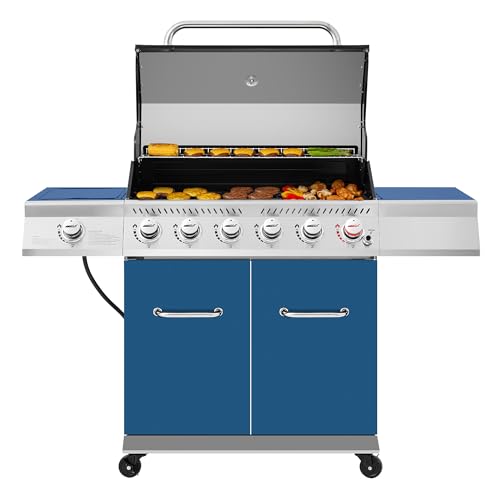

As an Amazon Associate we earn from qualifying purchases at no extra cost to you.
How to Measure Your Space
- Measure the grilling spot. Record the width and depth of the patio or deck area where the grill will stand, and note the surface: concrete, pavers, composite, or wood.
- Subtract safety clearance. Keep 24 inches (61 cm) between the back and sides of the grill and any siding, railing, or fence, and 36 inches (91 cm) if the wall is vinyl or the railing is wood. Allow 36 inches of open space in front to stand and open the lid. Never place a grill under an eave, soffit, or pergola with less than 8 feet of clearance.
- Determine maximum grill width. Available width minus 48 inches of side clearance (24 each side) is your maximum width with shelves up. A 10-foot-wide deck section therefore accommodates a grill up to 72 inches wide; a 7-foot section limits you to about 36 inches, which is a 2-burner or a 3-burner with folding shelves.
- Count people, then add. Multiply household members by 70 to 100 square inches. A family of four lands at 280 to 400; add 25 percent for full-grill meals to reach 350 to 500 square inches of primary grate.
- Check the propane and storage plan. A 20-pound tank is 12 by 18 inches. Confirm the cart cabinet or tank hook fits it, and that the grill under its cover will not block a door or the path to the yard.
- Measure the delivery path. Boxed grills are 50 to 70 inches long and weigh 90 to 200 pounds. Gates, stairways, and tight corners between the driveway and the patio decide whether you assemble on site or carry it assembled.
By Room or Use Case
Apartment balcony or townhouse deck
Space is usually 6 to 8 feet wide and codes often prohibit propane above a certain floor. A 2-burner at 40 to 48 inches wide or a 3-burner with fold-down shelves that shrinks to 30 to 36 inches parked is the practical ceiling. Even a 2-burner at 300 square inches cooks 10 to 12 burgers, enough for a family of three or four in two quick rounds.
Small suburban patio with a family of four
A 4-burner grill of 450 to 550 square inches at 52 to 58 inches wide is the default for good reason. At $220 to $500 you get a side burner for sauces, enough grate for 16 to 20 burgers or 4 racks of ribs, and cart storage for the tank. Griddle-combo 4-burners in the same price range swap half the grate for a flat top, which suits families that cook breakfast, smash burgers, and stir-fry outdoors.
Family of five or six that hosts weekends
Step to 5 or 6 burners and 550 to 700 square inches, 58 to 68 inches wide. The benefit is not only space but zones: two burners high for searing, two low for holding, and a cool zone for buns. Six-burner grills at $400 to $700 typically include a side burner and 60,000 to 75,000 total BTU. Make sure the patio offers at least 9 feet of width for the grill plus clearance.
Outdoor kitchen or permanent grill station
Built-in grill heads of 32 to 36 inches with 600 to 800 square inches are the standard for masonry or modular islands. Budget $1,300 to $3,000 for a combo head that runs propane or natural gas and often adds a charcoal tray, plus the island itself. Plan an island length of at least 60 inches to leave 12 inches of counter on each side of the head.
Feeding a crowd regularly
If 10 or more people is a monthly event, 700 to 1,000 square inches on a 6- to 8-burner grill saves batch cooking, but it also burns 20 to 30 percent more propane for a Tuesday dinner for four. Many families do better with a 550-square-inch grill plus a second cooker such as a griddle or pellet smoker for parties.
Common Sizing Mistakes
- Counting total cooking area. Manufacturers add the warming rack. A “650 square inch” grill may have only 450 on the main grate. Compare primary grate numbers only.
- Buying by burner count. Four narrow burners on a 400-square-inch grate is not the same as four on a 550-square-inch grate. Square inches decide capacity; burners decide zone control.
- Ignoring clearance. A 60-inch grill on a 7-foot-wide deck section leaves 12 inches to the railing, half the minimum, and will discolor vinyl or scorch wood within a season.
- Chasing BTUs. High BTU per square inch with a thin lid and light grates means hot spots and heat loss. Look for 80 to 100 BTU per square inch and heavy grates instead.
- Forgetting lid height. A grill under a low eave or awning may fit closed but hit the structure when the lid opens to 60 to 66 inches.
- Oversizing for holidays. Twice-a-year crowds do not justify an 800-square-inch grill that takes 15 minutes to preheat and doubles fuel use every other night.
FAQ
How many square inches of grill do I need per person?
Plan on 70 to 100 square inches of primary cooking area per person for a normal meal, so a family of four is comfortable at 400 to 500 square inches. That leaves space to move food between hot and cool zones instead of packing the grate edge to edge.
Is a 3-burner grill big enough for a family of four?
Yes, if the primary grate is 400 square inches or more. Many 3-burners land at 420 to 480 square inches and cook 14 to 18 burgers at once. Where a 4-burner helps is zone control and the extra 60 to 100 square inches when grilling a full meal of protein and vegetables together.
How much clearance does a gas grill need from the house?
Most manufacturers specify 24 inches (61 cm) from the back and sides to any combustible surface, and many local codes and insurers ask for 36 inches (91 cm) from vinyl siding and 10 feet from any structure for grills on wood decks in some jurisdictions. Check your manual and local rules; the larger number always wins.
Should I buy a bigger grill than I need in 2026 to grow into?
Go one size up only if your household or hosting habits are clearly growing and the patio has the clearance. Otherwise, buy the 450 to 550 square inch grill that fits today; it preheats faster, uses less propane, and can be supplemented later with a griddle or smoker for the occasional crowd.