Key takeaways
- Center pole vents – a mesh or open gap where the two canopy halves meet at the pole, letting wind pass through the middle instead of pushing the whole umbrella sideways.
- Peripheral wind vents – small triangular mesh cutouts near the outer ribs on each canopy half, which release pressure before it reaches the rib tips.
What's inside
A PHI VILLA 15 ft patio umbrella needs a base weighing at least 80-100 lbs (or an in-ground/deck mount rated for that span), because the double-canopy design covers roughly 176-180 square feet and catches far more wind load than a standard 9-11 ft umbrella. Getting the base, vents, and rib construction right matters more than the canopy fabric on a piece this large.
What “15 ft” actually covers
The 15 ft measurement is the diagonal span of a double-sided (double-canopy) umbrella, typically built as two rectangular or square canopies of about 9 ft x 9.5 ft each, offset from a center or off-center pole. In practice this shades an area close to 15 ft long by 9 ft wide, which is enough to cover a 6-8 seat dining table plus some walking space around it, or two separate seating clusters on either side of the pole.
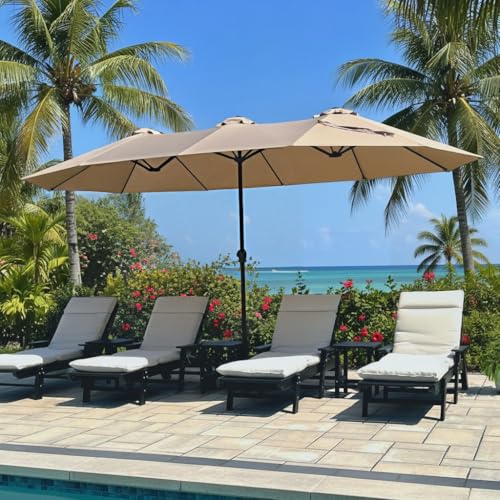
PHI VILLA 15ft Large Outdoor Patio Umbrella with Base Included, Beige
Included for 'PHI VILLA 15 Ft Patio Umbrella: Span, Wind Vents and Weight Needs' because the listing specifies Beige, details this guide uses to compare options.
View on Amazon
PHI VILLA 15ft Large Outdoor Patio Umbrella with Base Included, Navy Blue
Included for 'PHI VILLA 15 Ft Patio Umbrella: Span, Wind Vents and Weight Needs' because the listing specifies Navy Blue, details this guide uses to compare options.
View on Amazon
PHI VILLA 15ft Large Outdoor Patio Umbrella with Base Included, Light Grey
Included for 'PHI VILLA 15 Ft Patio Umbrella: Span, Wind Vents and Weight Needs' because the listing specifies Light Grey, details this guide uses to compare options.
View on Amazon
PHI VILLA 15ft Large Outdoor Patio Umbrella with Base Included,2-Tier,Beige
Included for 'PHI VILLA 15 Ft Patio Umbrella: Span, Wind Vents and Weight Needs' because the listing specifies 2-Tier and Beige, details this guide uses to compare options.
View on AmazonHeight clearance depends on the pole height and how far the umbrella is cranked open. Most 15 ft double models sit on poles around 8.5-9.5 ft tall, and once fully raised the canopy’s lowest edge (the rib tips) usually sits at 7-7.5 ft off the ground. That’s tall enough to walk under without ducking, but low enough that tall pergola attachments or overhead lighting can conflict with it. If you’re mounting near a deck rail, door header, or roofline, measure clearance from the actual mounting point, not just ground level, since a base-mounted pole starts a foot or so lower than one bolted to a raised deck.
Fit against common outdoor layouts
| Space | Approx. size | 15 ft double canopy fit |
|---|---|---|
| Small patio | 10 x 12 ft | Tight; canopy overhangs edges by 1-2 ft on each side, limited room for a second seating area |
| Standard patio | 14 x 16 ft | Comfortable; shades a dining set and leaves 3-4 ft of walking clearance |
| Pool deck | 16 x 20 ft | Good fit; can shade a lounge cluster and a dining set on opposite sides of the pole |
| Balcony | Under 8 ft depth | Not recommended; canopy width exceeds most balcony footprints and wind exposure is higher |
Vent design and rib construction
Because a double canopy this size acts like a sail, the vent system is what keeps it from flipping or tearing in gusty conditions rather than just adding style. PHI VILLA’s 15 ft models generally use one of two vent approaches:
- Center pole vents – a mesh or open gap where the two canopy halves meet at the pole, letting wind pass through the middle instead of pushing the whole umbrella sideways.
- Peripheral wind vents – small triangular mesh cutouts near the outer ribs on each canopy half, which release pressure before it reaches the rib tips.
The ribs themselves are the load-bearing skeleton, and on a 15 ft double-canopy unit you’re typically looking at 12-16 ribs total (6-8 per side), made from either powder-coated steel or aluminum. Steel ribs flex less under steady wind but are heavier and can develop rust at the joints over a few seasons if the coating chips. Aluminum ribs resist corrosion better and keep the whole assembly lighter, but they can bend permanently if the umbrella is left open in a sudden storm gust above 25-30 mph. Either way, manufacturers rate these umbrellas for light-to-moderate wind (generally up to 20-25 mph open); above that, the umbrella should be closed regardless of how good the vents are.
Fabric and frame trade-offs
| Component | Common option A | Common option B | Trade-off |
|---|---|---|---|
| Canopy fabric | Polyester (150-180 GSM) | Solution-dyed acrylic | Polyester is cheaper and lighter but fades faster in direct UV; acrylic resists fading longer and costs more |
| Pole/rib material | Steel | Aluminum | Steel is more rigid in steady wind but heavier and rust-prone; aluminum is lighter and corrosion-resistant but bends under sudden gusts |
| Crank mechanism | Single hand crank | Crank + tilt combo | Tilt adds shade flexibility but adds a failure point and usually isn’t rated for full double-canopy 15 ft spans |
Base weight and anchoring, by mounting type
This is the part most buyers underestimate. A 15 ft double canopy has roughly 2-3x the surface area of a standard 9 ft market umbrella, so the base needs to scale up accordingly, not just be “a bit heavier.”
- Freestanding base (patio/lawn use): plan for 80-100 lbs of filled weight, usually achieved with a base plate rated for 50-60 lbs and 4-6 fillable weight rings or sandbags stacked on top. Cross-style or plate-style bases work; a single small round base under 50 lbs will not hold this umbrella in anything more than a light breeze.
- Table-mounted (through a table’s center hole): the table itself must weigh at least 100 lbs or be secured to the ground, since the umbrella transfers wind load into the table legs. A lightweight resin table is not sufficient on its own.
- In-ground mount (sleeve set in concrete): the most stable option for a 15 ft double canopy; a sleeve set in a concrete footing at least 12 inches deep and 10-12 inches in diameter effectively removes the freestanding-base weight requirement.
- Deck mount (surface-bolted bracket): requires the bracket to be lag-bolted into joists, not just deck boards, and the umbrella should still be closed in sustained wind above the manufacturer’s rating since a deck mount has less give than a weighted base.
As a rule of thumb, double the base weight you’d use for a 9-11 ft single-canopy umbrella. If a supplier lists a 40-50 lb base as sufficient for a 15 ft double canopy, treat that as a minimum for calm, sheltered spots only, not a general recommendation.
Assembly and moving realities
Boxed weight for a 15 ft double-canopy umbrella (pole, ribs, and canopy, without base) typically runs 35-50 lbs, and the box is long enough (often 7-8 ft) that it won’t fit through a standard 32-36 inch interior doorway diagonally without tilting it through at an angle. Two people make assembly meaningfully easier, mainly for threading the canopy onto the ribs and lifting the pole into a filled base without tipping it.
On wear points: the crank mechanism and the fabric at the rib tips are what fail first, generally after 2-4 seasons of regular use. Cranks wear out faster with frequent open/close cycles in gritty or sandy environments (beach-adjacent patios), while fabric at the rib tips abrades from repeated flexing in wind even if it’s protected from direct sun. Closing the umbrella whenever it’s not actively providing shade, rather than leaving it open between uses, is the single biggest factor in extending both parts’ lifespan.
Which setup fits your situation
| Your situation | Recommended approach |
|---|---|
| Small 10×12 ft patio, want max shade | Skip the 15 ft double canopy; a single 9-10 ft umbrella fits better and needs a lighter base |
| Standard patio, windy coastal or plains location | In-ground sleeve mount with concrete footing, aluminum ribs for corrosion resistance |
| Renters, no permanent mounting allowed | Freestanding base at 90-100 lbs with weight rings; commit to closing it in wind above 20 mph |
| Pool deck with existing large dining table | Table-mounted, provided the table itself is 100+ lbs or anchored |
| Frequent open/close use, budget-conscious | Steel ribs, polyester canopy; accept faster fading but lower upfront cost |
Getting the span and clearance right solves comfort; getting the base weight and mount right solves whether the umbrella survives its first real windy afternoon. Size the base to the canopy, not to what looks proportional in a product photo.